
Battle of Eupatoria
Two officers were offered the command and both found excuses to refuse it. Neither believed the attack on Eupatoria could succeed, and neither wanted his name attached to the failure. So Prince Menshikov turned instead to Lieutenant General Stepan Khrulev, an artillery officer described as willing to do exactly what he was told. On 17 February 1855, Khrulev led nearly nineteen thousand men against the walls of a Black Sea port during the Crimean War, and the doubts of those first two officers proved entirely correct. What happened at Eupatoria would ripple all the way to the throne room in St. Petersburg.
A Tsar's Fear
By the winter of 1854, the Crimean War had settled into a grinding siege of Sevastopol, and both sides were pouring reinforcements onto the peninsula. Eupatoria mattered because it was one of two main points where the Allies landed their troops and supplies from across the Black Sea. Tsar Nicholas I saw the danger clearly. He feared that an Allied force built up at Eupatoria, seventy-five kilometers north of Sevastopol, could push inland and sever Crimea from Russia at the narrow Isthmus of Perekop, choking off the flow of men and materials to the front. The Tsar's instruction was blunt: take Eupatoria, and if it could not be held, destroy it. Menshikov set about finding someone to do it.
The Assault at Dawn
The city was no easy target. Some 33,000 defenders held it, mostly Turkish infantry under the experienced Omar Pasha, protected by an earthen wall, a water-filled ditch, thirty-four cannon, and the guns of Allied warships anchored offshore. Khrulev planned a three-column attack, feinting at the flanks to draw defenders away before punching through the center. Through the night of 16 February his men crept into position and silently built firing platforms in the dark. But watchful Tatars spotted the advance at dawn and raised the alarm; the Turks were already on the parapets when the first shots rang out around six in the morning. For an hour the artillery of both sides hammered away across the frozen ground.
Stopped at the Ditch
When the Russian guns gained the upper hand and the Turkish fire slackened, Khrulev sent his infantry forward on the left, among them a battalion of Greek volunteers who had joined the Russian side only weeks before. Sheltering in the ruins of a cemetery, the soldiers pressed toward the walls with scaling ladders and bundled brushwood, moving through a crossfire of canister shot, rifle fire, and naval bombardment. Then the attack simply stopped. The defensive ditch was flooded too deep to cross, and no amount of courage could get the ladders against the walls. After repeated failed attempts, the men fell back to the cemetery. Khrulev, seeing at once that the ditch could not be beaten, ordered a retreat around ten that morning.
The Weight of a Defeat
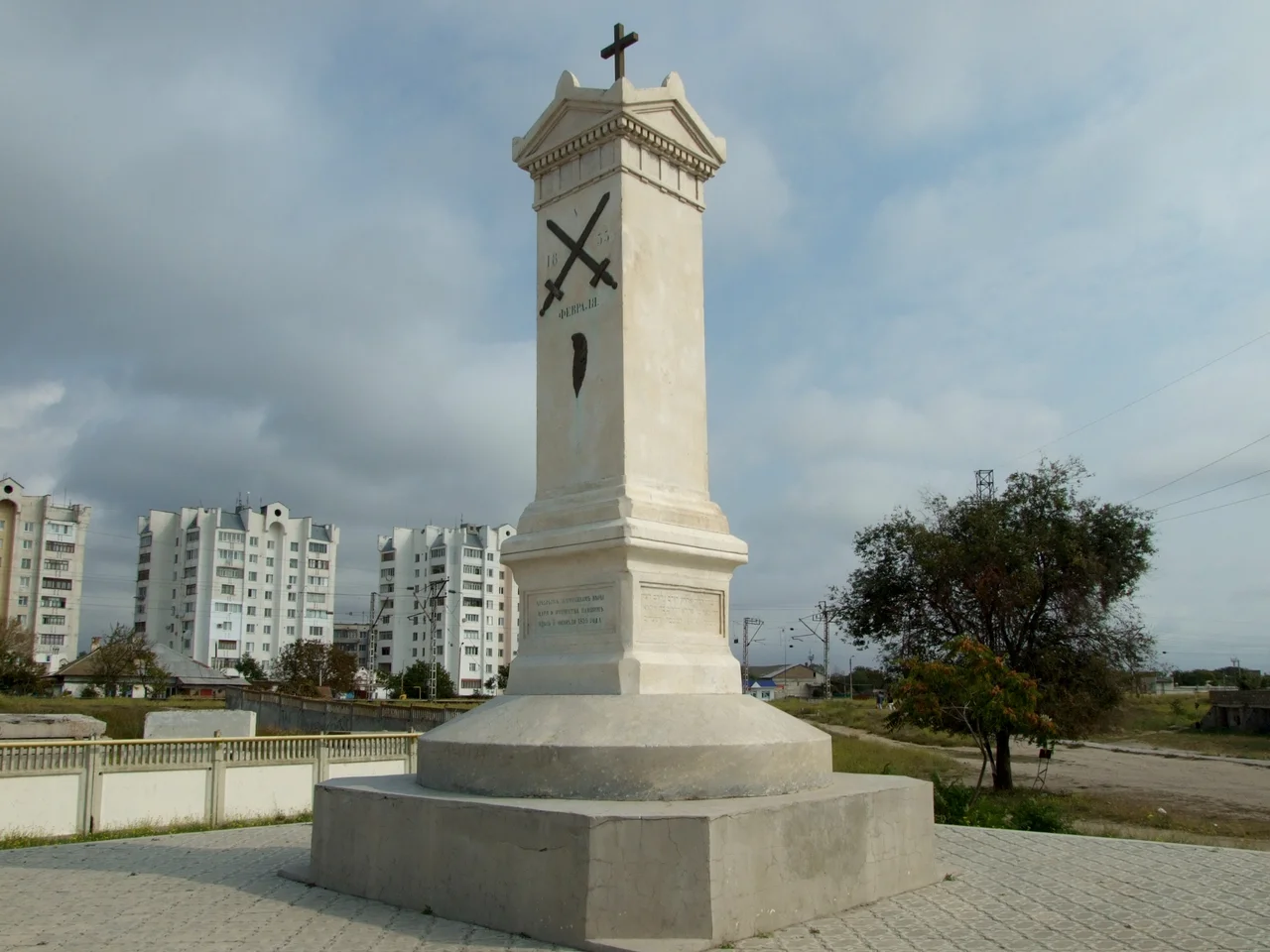
The cost fell hardest on the attackers. The Russians lost 168 killed, 583 wounded, and 18 missing, nearly twice the Turkish casualties of 91 killed and 286 wounded; among the Ottoman dead was General Selim-Pasha. These were thousands of individual men, freezing on a Crimean plain over a town that would not fall. The news struck the Tsar hard. Already ill, Nicholas I seemed broken by the defeat and died on 2 March 1855, only weeks later. His son, Alexander II, dismissed Khrulev and replaced Menshikov, yet did not rush to end the war. Strategically the battle changed little except to confirm what both sides already knew: as long as the Allies held the sea and Eupatoria, the threat to the Russian flank would remain, and the siege of Sevastopol would go on. A monument now stands on the battlefield, marking the place where a doomed assault ran up against a flooded ditch and stopped, and where the doubts of two officers who declined the command were answered in the plainest possible terms.
From the Air
The Battle of Eupatoria was fought at the edge of the modern city of Yevpatoria, near 45.19°N, 33.37°E on Crimea's western coast. From 3,000–5,000 feet the coastal city and the broad sweep of Kalamita Bay to the south are clearly visible; a Crimean War monument marks the battlefield. The nearest airport is Saky (UKFI) just to the southeast.
Nearby Stories
- Tarkhankut Peninsula 17 km away
- Simferopol 28 km away
- Karkinit Bay 31 km away
- Soviet Cruiser Chervona Ukraina 35 km away
- Soviet Destroyer Otvazhny 35 km away
- Crimea 35 km away
- Syvash 77 km away
- Januarius MacGahan 385 km away