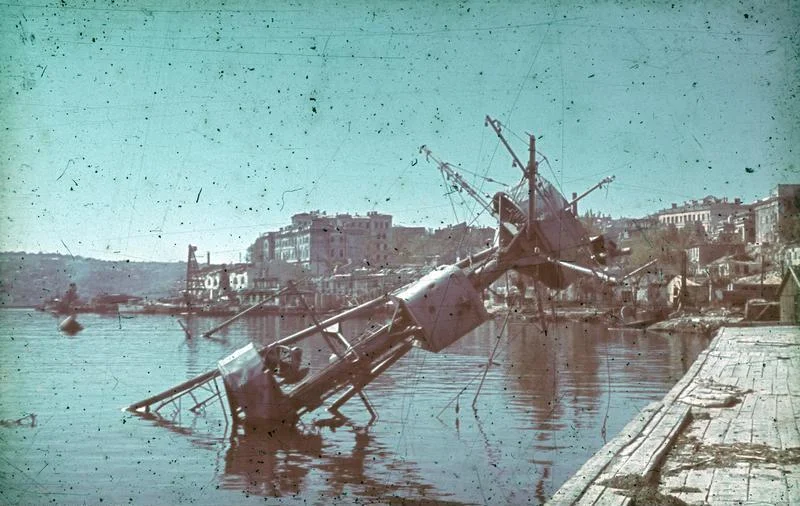

Soviet Cruiser Chervona Ukraina
The ship was launched into a country that no longer existed by the time she was finished. Begun under one empire, renamed for a Ukrainian statesman, run aground by her own builders, raised from the mud, and finally rechristened Chervona Ukraina, or Red Ukraine, this light cruiser carried the turbulence of her age in her very name. She spent the peaceful years showing the Soviet flag in the ports of the Mediterranean. She spent her war years under fire off the Crimean coast. And she met her end where so much Black Sea history has ended, in the harbor of Sevastopol.
A Hull With Three Names
Her story is a chronicle of Ukraine's chaotic early twentieth century, told through a single steel hull. Laid down before the First World War, she was still unfinished when revolution swept the Russian Empire away. In late 1918 the government of Hetman Pavlo Skoropadskyi, briefly ruling an independent Ukraine, restarted her construction, and in January 1919 she was formally named for the Cossack leader Bohdan Khmelnytsky. Within weeks the city of Nikolayev where she lay was captured by French-led Allied forces. As the Russian Civil War engulfed the region, shipyard workers deliberately ran the unfinished ship aground at her fitting dock to stop the retreating Whites from taking her. The Soviets raised her in 1920, renamed her Chervona Ukraina in 1922, and at last completed her in 1927, nearly two decades after the first plates were joined.
The Shape of a Warship
By the time she entered service she was a proper light cruiser, more than 160 meters long, driven by steam turbines to nearly thirty knots. She bristled with fifteen 130-millimeter guns and banks of torpedo tubes, and in an experiment that never quite worked, she was even fitted with cranes and a parking area to handle a floatplane, though no catapult was ever installed to launch one. In the tense years before the Second World War she sailed on goodwill visits to Turkey, Greece, and Italy, a graceful ambassador in peacetime gray. A final overhaul stripped away her aircraft gear and gave her modern Italian anti-aircraft mounts, weapons that would soon be tested against an enemy coming not from the sea but from the sky.
Three Bombs at Sevastopol
When war came to the Black Sea in 1941, Chervona Ukraina went straight into the fight. She helped lay a defensive minefield off Sevastopol, then poured gunfire onto the enemy during the siege of Odessa and escorted the convoys carrying reinforcements in and evacuees out. She ferried cut-off troops into besieged Sevastopol and brought fresh soldiers from the Caucasus. On the twelfth of November 1941, German Junkers Ju 87 Stuka dive-bombers caught her in the South Bay of Sevastopol and struck her three times. She held on through the day, and only after her crew was ordered off did she finally go down the next morning. Even in death she kept fighting: her guns were salvaged and folded into the fortress city's defenses, and two of her turrets went to arm another cruiser. Raised from the harbor floor years later, she served out her last days as a training hulk and then a target, a ship that had already died once and gave herself again to the sea.
From the Air
The waters associated with Chervona Ukraina lie around 45.83°N, 33.15°E off Crimea's western coast, though the cruiser was sunk in the South Bay of Sevastopol farther south. From cruising altitude this is open Black Sea water fringed by the low Crimean shoreline and its salt lakes. Saky air base (ICAO UKFI) lies to the east along the coast; Simferopol (UKFF) is inland to the southeast.
Nearby Stories
- Karkinit Bay 6.2 km away
- Tarkhankut Peninsula 13 km away
- Skadovsk 25 km away
- Donuzlav 27 km away
- Zaliznyi Port 32 km away
- Syvash 45 km away
- Azov-Syvash National Nature Park 60 km away
- Crimea 62 km away