
Azov-Syvash National Nature Park
Twice a year the sky over the northwestern Sea of Azov fills with wings. Ducks, herons, waders, and mute swans descend by the hundreds of thousands onto a low, dry sweep of steppe and shallow water in Kherson Oblast, resting and feeding before pressing on across continents. This is the reason the Azov-Syvash National Nature Park exists. Established on 25 February 1993 and covering more than 52,000 hectares, it protects a landscape that looks, at first, like almost nothing at all: flat grassland, salt-crusted shoreline, and lagoons so shallow you could wade for hours. Rain is scarce here, barely 260 millimeters a year, among the lowest in all of Ukraine, and the summers run hot and dry. Yet to the birds crossing the vast distances between Europe, Africa, and Asia, this austere shore is one of the most important stopovers on their entire flyway, a place to rest that has been reliable for far longer than any nation has claimed it.
Where a Million Wings Come to Rest
More than a million birds pass through this park in a single year, and the numbers hold specific weight. In some seasons the wetlands shelter more than one percent of the entire world population of red-breasted geese and greylag geese, a threshold that marks a site as globally significant under international conventions. The Red Book of Ukraine, the country's registry of species at risk, lists thirty kinds of birds recorded here, among them the white-tailed eagle and the little bustard, both also on the European Red List. The roll call of rarities is long: Kentish plovers and black-winged stilts, Eurasian oystercatchers, white-headed ducks, and Pallas's gull. Nearby, in the surrounding steppe, roam great and little bustards, demoiselle and common cranes, and a formidable roster of raptors, hen and pallid harriers, golden and greater spotted eagles, saker and peregrine falcons, and the lesser kestrel. In all, biologists have counted 197 bird species within the park's borders, drawn by the same reliable water and quiet that first made this a resting place millennia before anyone named it.
The Improbable Herds
The park's most surprising residents do not fly. Beginning in 1928, wildlife managers introduced grazing animals to the rich steppe grasses of Byriuchyi Island, and they thrived. By the early 1990s the herds had grown remarkable: red deer numbering in the hundreds, fallow deer well over a thousand, mouflon nearly a thousand strong, and even onagers, the wild asses of Asia, though only a few dozen of those. Pheasants were released for hunting and multiply still. Alongside these newcomers persist the island's native creatures, the grey hare and the fox, together with more than five thousand animal species in total across the reserve, 250 of them vertebrates. Beneath the surface, twenty-six kinds of commercially valuable fish move through the waters, from European flounder and the flatfish called kalkan to Russian and stellate sturgeon, a reminder that this thin, salty sea is far more alive than its bare shores suggest. The Red Book of Ukraine claims forty-eight of the park's vertebrates, from the great jerboa to the steppe polecat and the Azov dolphin.
The Pink Water
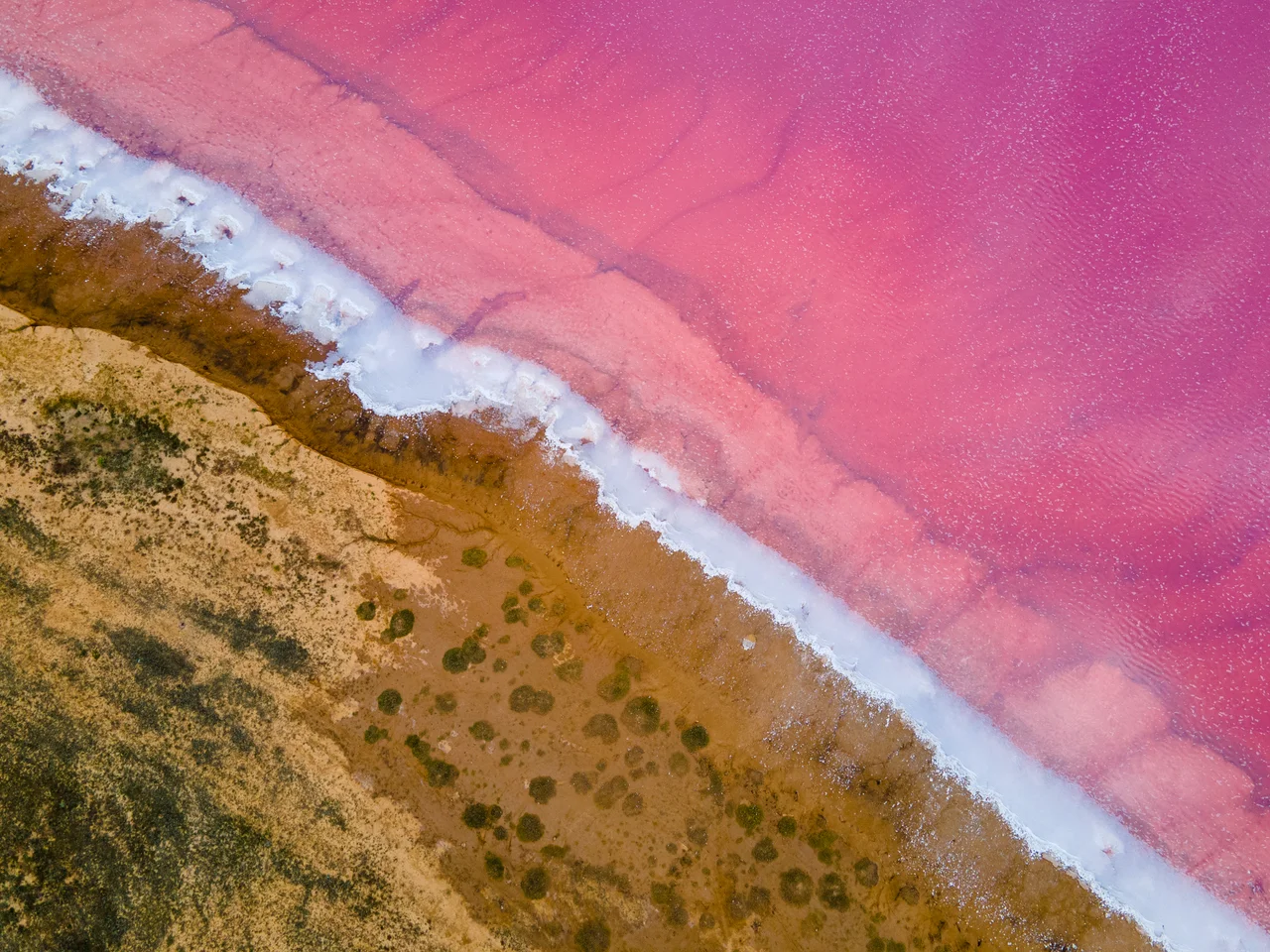
Come in high summer and the lagoons can turn a startling rose. The color is no trick of the light but a living thing: Dunaliella salina, a microscopic alga that tolerates water so salty almost nothing else survives, and blushes red under stress and sun. The Syvash sector where it flourishes is a hard place, dry-steppe soil, brackish vegetation, reed beds along the Utlyutsky estuary, and it is precisely that harshness that has kept it wild. On the more isolated islands of the Central Syvash, Churyuk and Kuyuk-Tuk among them, true southern steppe survives largely as it always was, spared the plow and the tread of livestock. To manage all this, the park is carved into zones: a strictly protected core of nearly 39,000 hectares in the Central Syvash, smaller areas set aside for recreation, and an economic zone besides. It is a working balance between people and wilderness, in a landscape whose very austerity is its greatest protection.
From the Air
The park centers near 46.10°N, 34.38°E, on and around Byriuchyi Island. A viewing altitude of 4,000 to 8,000 feet reveals the mosaic of steppe, sandy coquina beaches, and the mirror-flat Syvash lagoons, which may glow pink in summer. Look for the long low arc of the island against the open Azov. Nearest airport is Berdiansk (UKDB) to the northeast.
Nearby Stories
- Or Qapi Fortress 3.9 km away
- Swan Islands Nature Reserve 16 km away
- Byriuchyi Island 23 km away
- Arabat Spit 25 km away
- Aeroflot Flight 6515 85 km away
- Adziogol Lighthouse 117 km away
- Khortytsia 159 km away
- Chortitza Colony 171 km away