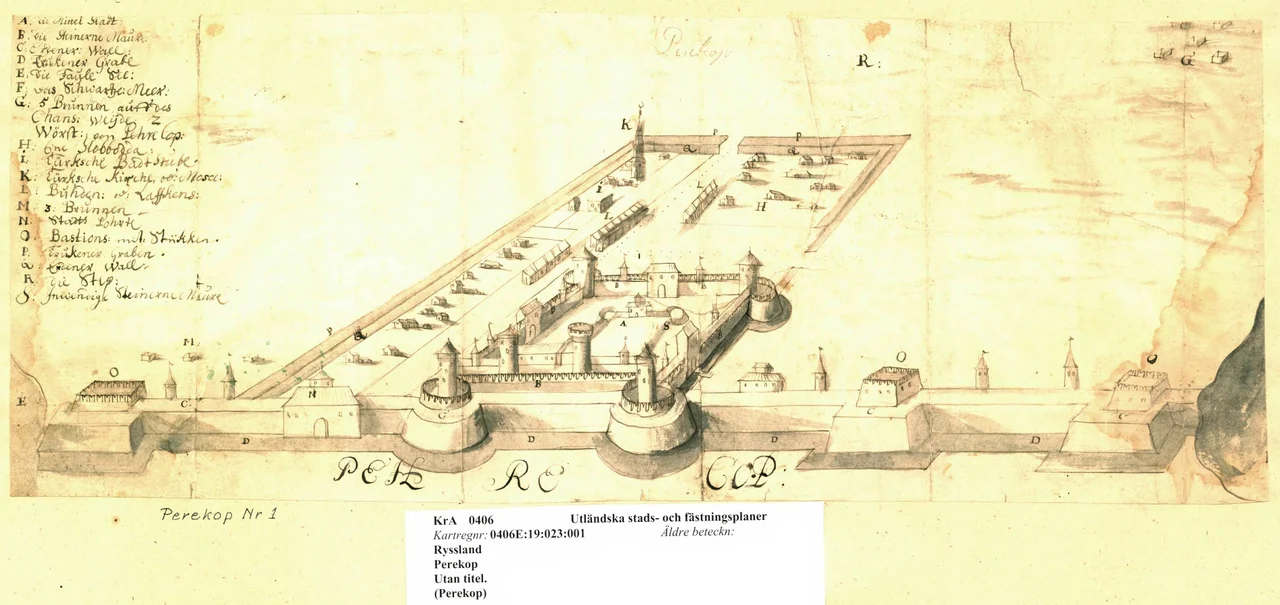

Or Qapi Fortress
The name says exactly what it was. Or Qapi means the Trench Gate in the Crimean Tatar language, and for centuries it was precisely that, the gate in the wall of earth that sealed off the Crimean Peninsula from the world beyond. Today only ruins remain, low ramparts and the scar of a ditch running across the narrowest neck of land connecting Crimea to the mainland. But when the Crimean Khanate ruled this peninsula, Or Qapi was called the key to the whole realm, the single fortified door through which any invader would have to pass.
The Khans Who Raised It
The fortress was the work of a dynasty. In the fifteenth century, Meñli Giray, khan of the newly powerful Crimean Khanate, began the fortifications at the Perekop isthmus, and his son Sahib I Giray carried the work forward. The Giray line would rule Crimea for centuries, and they understood their geography perfectly: their peninsula was almost an island, joined to the continent only by this slender bridge of land. Fortify the bridge, and you fortify everything. So they built at Or Qapi a stronghold of earthen ramparts faced with stone, positioning it astride the one road that led in and out. It was less a castle than a checkpoint on the grandest possible scale, controlling passage to an entire nation.
Broken by the Field Marshal
A gate, however strong, invites the battering ram. During the Russo-Turkish War of 1735 to 1739, the Russian field marshal Burkhard Christoph von Münnich brought the empire's armies against the fortifications. On the seventeenth of June 1736, his forces stormed the works and left the Tatar fortress in ruins. Two years later Russian troops under General Lacy took the position again. The Trench Gate had held back many, but it could not hold back the expanding Russian Empire, and the storming of Or Qapi marked a turning point in the long contest for control of Crimea, one that would end with the peninsula absorbed entirely.
What the Ruins Remember
The fortress never recovered its old power, and its last military life was brutal and brief. During the Second World War, the strategic ground it guarded changed hands repeatedly between Germany and the Soviet Union, the same narrow isthmus fought over yet again by armies who cared nothing for the khans who had first walled it. Now Or Qapi is a ruin among ruins, its ramparts weathered into the steppe. Yet the name endures, and it still means what it always meant. This was the gate, and beyond it lay a homeland worth the wall of earth built to defend it, a Crimean Tatar realm remembered in the very stones scattered across the ground.
From the Air
The ruins of Or Qapi lie at about 46.15°N, 33.70°E on the Isthmus of Perekop, near the settlement of Perekop at the northern approach to Crimea. From altitude, look for the narrow neck of land between the Black Sea and the pale Syvash lagoon, where the faint line of the old defensive trench and ramparts crosses the isthmus. Kherson (ICAO UKOH) lies to the north; Simferopol (UKFF) to the south.
Nearby Stories
- Swan Islands Nature Reserve 2.6 km away
- Skadovsk 10 km away
- Syvash 19 km away
- Karkinit Bay 35 km away
- Adziogol Lighthouse 63 km away
- Arabat Spit 72 km away
- Pontic Olbia 132 km away
- Khortytsia 174 km away