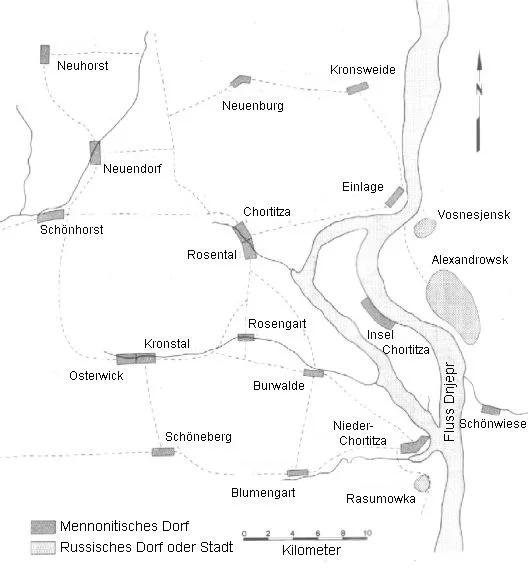

Chortitza Colony
In the winter of 1787, two hundred and twenty-eight families left the Vistula delta and set out across a continent for land they had never seen. They were Mennonites, Dutch in ancestry and Low German in speech, drawn east by a promise from Catherine the Great: free acres, religious freedom, exemption from military service, the right to their own schools and their own language. What they founded in 1789 on the banks of the Dnieper, near the island of Khortytsia, became Chortitza, the first Mennonite colony in the Russian Empire. It is remembered still as the Old Colony, the mother of them all. Its story runs from bare sod dugouts to prosperity, and then to one of the twentieth century's long tragedies.
The Bargain with an Empress
The Mennonites of the Vistula delta had a problem their faith could not solve: too many people, too little land. When Prussia absorbed the region in 1772, new laws made it nearly impossible for them to buy more. So when Catherine II's 1763 manifesto invited Europeans to farm Russia's empty steppes, the offer landed on receptive ears. Two delegates, Jakob Hoppner and Johann Bartsch, sailed to Riga in 1786, traveled overland to the Dnieper, and were presented to the empress herself as she inspected her southern conquests. The privileges they won were extraordinary for the age: seventy hectares per family, freedom of worship, no oaths, no conscription, self-governing villages. Prussia, unwilling to lose the community's wealth, granted passports only to its poorest members. That single restriction would shape everything: the settlers who left carried little money, and not one ordained minister among them.
Sod Houses on the Steppe
The pioneering years nearly broke them. Their intended site near Kherson had become a battlefield in a new Russo-Turkish war, so they were resettled near Alexandrovsk, present-day Zaporizhzhia. Barges carrying their possessions arrived ransacked; building timber was stolen before it reached them. Many were city tradesmen who had never farmed, and those who had found the dry steppe nothing like the delta they knew. Families dug into the earth, living in sod shelters and tents and wagons through the first hard seasons. Old divisions between the Frisian and Flemish branches of the church flared without pastors to steady them. In their distress the settlers turned on Hoppner and Bartsch, accusing them of misusing colony funds; both were excommunicated and Hoppner briefly jailed. Yet the community endured, and slowly, village by village, it took root.
A World of Their Own
Out of that hardship grew something remarkable. By the mid-nineteenth century Chortitza was prosperous, self-governing, and quietly modern. Every village ran its own elementary school at a time when compulsory education was unknown across most of Europe; the Central School, founded in 1842, eventually schooled thousands, and a girls' school followed in 1895. A public ferry, a merino flock, and communal enterprises funded new daughter colonies as the population swelled. Then came industry: factories at Chortitza and Rosental turned out mills, clocks, and agricultural machinery used across all of Russia. The three largest works would later merge and, after 1917, build tractors and cars under the Saporoschetz name, a lineage that survives in the automaking of the region today. Part of the community had already begun leaving for Canada in 1870, carrying the Old Colony's conservative ways to the Manitoba prairie.
The Long Unmaking
The First World War ended the calm, and the Russian Civil War brought terror to the villages. Late in 1919 the anarchist army of Nestor Makhno occupied the colony; its fighters murdered and raped, and the typhus they spread eventually reached nearly the whole population, killing more than one in ten. What followed was slower but no gentler. Communist grain seizures brought famine; in 1926 the village of Einlage was cleared and abandoned to make way for the rising waters of the new Dnieper dam, whose reservoir would drown the site once construction finished in 1932. Through the 1930s came dekulakization, collectivization, and exile: fifteen hundred men from a population of twelve thousand were sent to hard labor in the far north and Siberia. When the Second World War receded, most who remained were deported to Siberia and Kazakhstan and released onto the open steppe, where many did not survive. Today Ukrainians and Russians live in the old villages, while the descendants of Chortitza are scattered across Germany, Canada, and Central Asia, a people who built a home twice and lost it, carrying its memory wherever they went.
From the Air
Centered near 47.86 N, 35.009 W, on the west bank of the Dnieper just northwest of Khortytsia Island, now within and around the city of Zaporizhzhia. From the air the broad Dnieper, the long wooded island of Khortytsia, and the reservoir above the dam are the defining features. Best viewed at moderate altitude in clear weather. Nearest airport is Zaporizhzhia International (UKDE).
Nearby Stories
- Dnieper Rapids 16 km away
- Aeroflot Flight 3630 69 km away
- Battle of Dibrivka 72 km away
- Kryvbas 78 km away
- Azov Upland 87 km away
- Meotyda National Nature Park 157 km away
- Lake Lemuria 164 km away
- Second Battle of Kharkov 168 km away