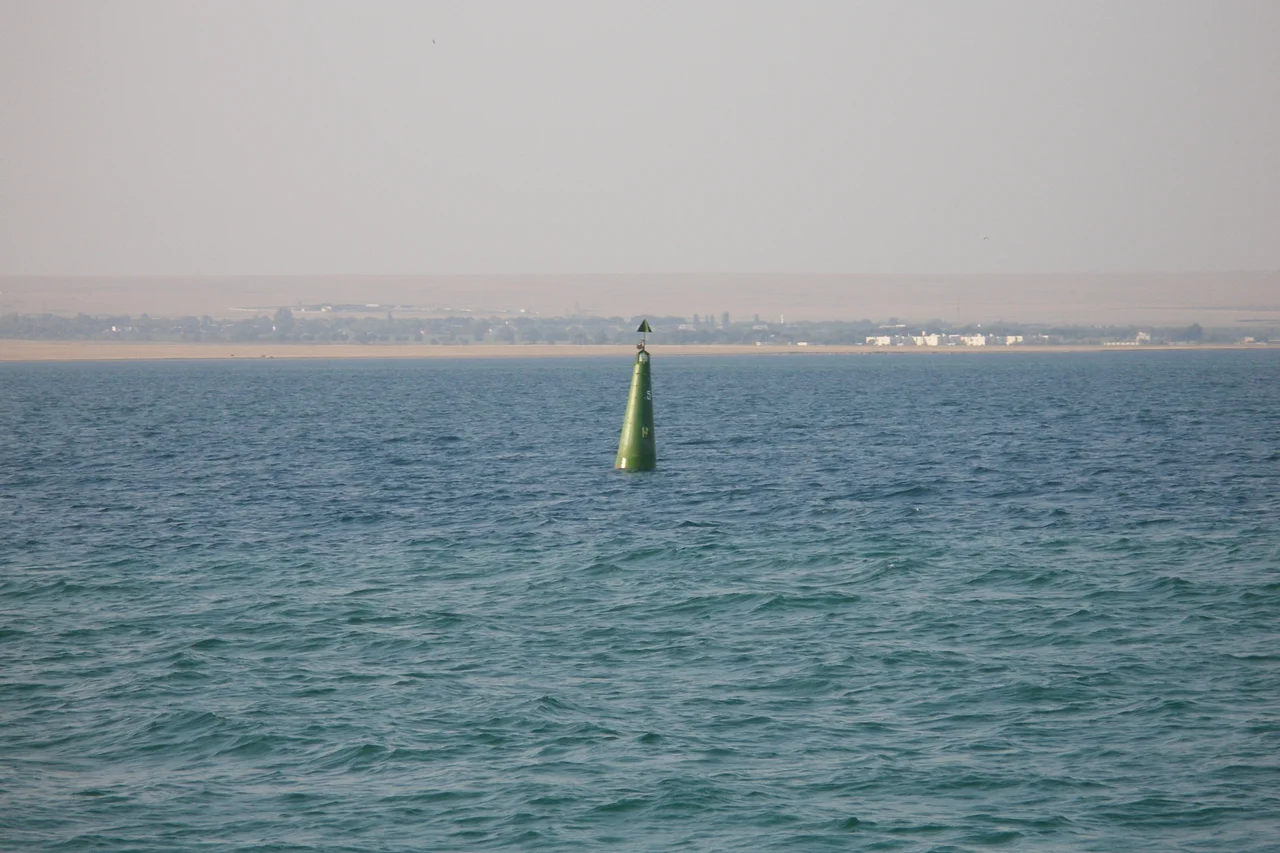

Donuzlav
There is a moment, near the head of Lake Donuzlav, where the water goes soft. Taste it near the mouth and it is as salty as the open sea; follow it inland and the salinity fades, freshened by springs bubbling up through the lakebed. This gradient, sea at one end and something gentler at the other, hints at Donuzlav's split personality. It is the deepest lake in Crimea and the largest in the Chornomorske Raion, a long finger of protected water reaching in from the coast, set aside as a landscape and recreational park. And yet, strictly speaking, it is no longer a lake at all. Somewhere in the twentieth century it quietly changed its own nature, and the story of how is one of the more curious tales this coast has to tell.
The Year a Lake Became a Bay
For most of its existence, Donuzlav was sealed off from the Black Sea by a peresyp, the local term for the long sandy bar that so often separates Crimea's coastal lakes from the open water. That barrier gave the lake its calm, its stillness, its identity. Then, in 1961, it was breached on purpose. Engineers washed a canal roughly 200 meters wide straight through the sandbar, opening the enclosed water directly to the sea. In that stroke, Donuzlav stopped being a true lake and technically became a bay, its once-private waters now joined to the great restless body beyond the shore. It is a rare thing, to be able to point to the exact year a lake changed what it fundamentally was.
Deep, Still, and Full of Life
Depth defines Donuzlav. As the deepest lake on the peninsula, it holds a volume of water that shallower Crimean lagoons cannot match, and that depth, combined with its mix of salt and spring-fed fresh water, makes it a distinctive underwater world. It has long drawn those who want to explore beneath the surface; a Russian-language book from 2001 gathered the notes of an underwater hunter who spent his time diving and fishing these waters, a small testament to the lake's pull on people who love what lies below. Stand on its banks and the water stretches away, calm and broad, a protected refuge where the line between lake and sea, fresh and salt, blurs into a single quiet expanse.
A Landscape Set Apart
Donuzlav is more than a stretch of water; it is a protected place. Both the lake and the land around it are held as a landscape and recreational park of Crimea, a designation that recognizes something worth preserving in this long, low inlet on the peninsula's western coast. It belongs to a distinctly Crimean kind of geography, the coastal lakes and lagoons that the Black Sea walls off behind bars of drifting sand, the peresyp of local speech. Most stay shallow and briny; Donuzlav, uniquely, runs deep. That combination of depth, shelter, and the freshening pull of its underwater springs makes its shoreline a quieter, gentler counterpoint to the open, exposed coast nearby, a broad refuge of calm water reaching back from the restless sea beyond the sandbar.
A Sheltered Water, Long Prized
A deep, sheltered inlet opening onto the Black Sea was always going to attract more than divers. Donuzlav's protected waters and the flat land around them have seen naval and military use for generations, from a Soviet-era air base established nearby, decommissioned in 1995, to later military activity along its shores. Even in recent years the bay has appeared in the news of the wider Russo-Ukrainian conflict. But strip away the strategic interest, and what remains is the water itself: the deepest lake in Crimea, transformed by a single canal, fed by hidden springs, its salinity shifting from sea to something softer as you move inland. Donuzlav is, at heart, a study in gradients, a place that refuses to be just one thing.
From the Air
Centered near 45.34 N, 33.01 E on Crimea's western coast in the Chornomorske Raion. From 3,000 to 5,000 feet the long, deep inlet of Donuzlav is unmistakable, a narrow arm of water reaching inland from the Black Sea through the gap cut in its sandbar. Saky (Saki) airfield lies to the east toward Yevpatoria.
Nearby Stories
- Saky 20 km away
- Battle of the Alma 28 km away
- Soviet Destroyer Otvazhny 31 km away
- Karkinit Bay 36 km away
- Swan Islands Nature Reserve 40 km away
- Zaliznyi Port 66 km away
- Racecourse of Achilles 104 km away
- Januarius MacGahan 372 km away