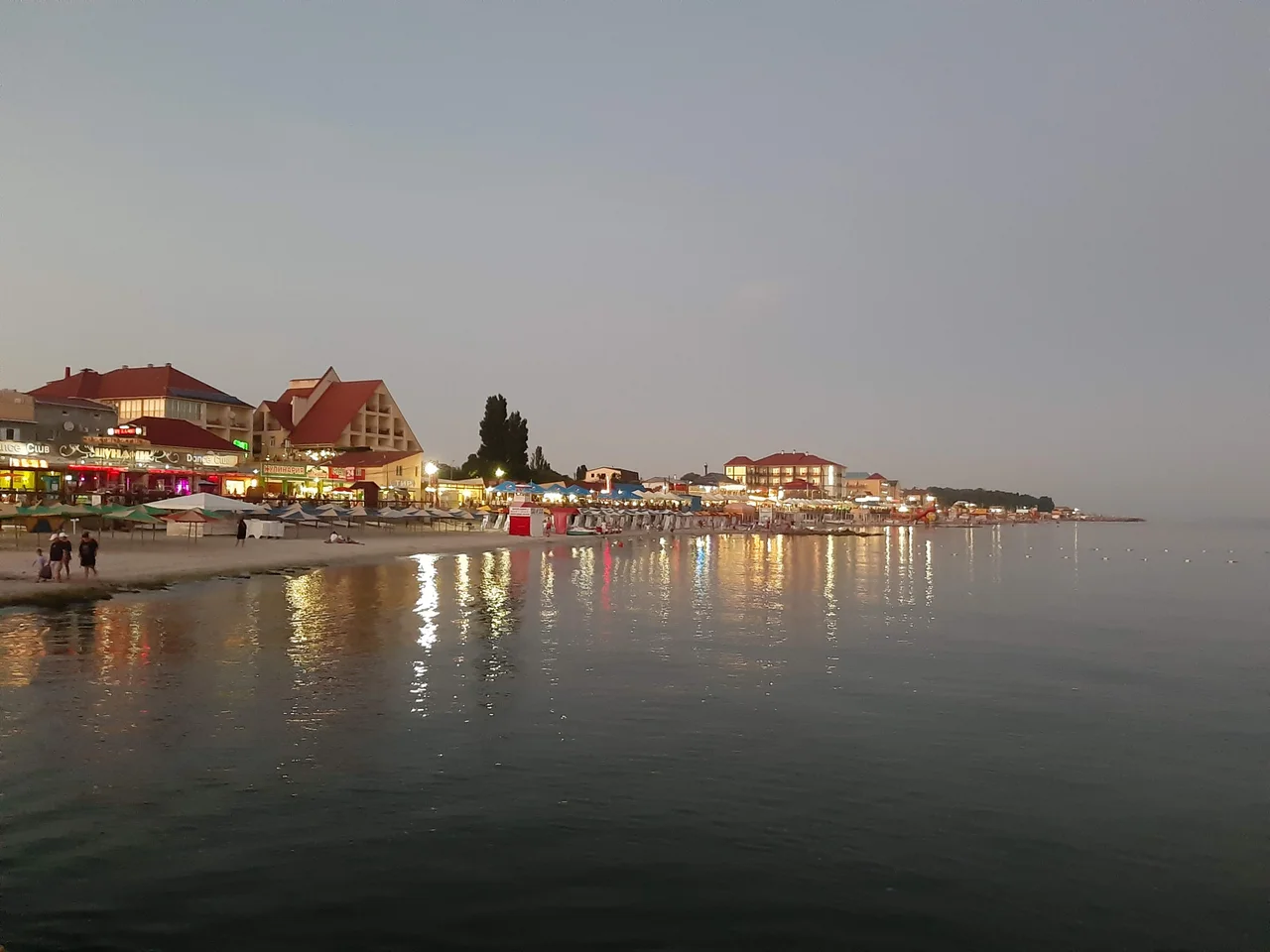

Zaliznyi Port
In summer, the whole point of Zaliznyi Port is the beach: a shallow, warm ribbon of Black Sea shore on the Kherson coast, backed by low dunes and the wide, flat light of southern Ukraine. Yet the village carries a name that has nothing to do with sunbathing and everything to do with mystery. Zaliznyi Port means Iron Port, and historians still disagree about where the name came from. There is no iron here, no great harbor of ships and cranes, just a resort town whose title hints at some forgotten origin story that the sand has long since covered over.
One Street Facing the Sea
The village is younger than it sounds. Though a small settlement took root here in the late nineteenth century under the Russian Empire, Zaliznyi Port was formally founded and named in 1922, in the early Soviet years. According to local accounts, peasants from the nearby town of Hladkivka, then called Kelehei, moved to the coast and worked the land, shipping their produce out from boats loaded along the shore. Growth came slowly. As late as the 1940s, the entire village amounted to a single street running parallel to the seashore, a modest line of houses between the fields and the water. For decades it remained exactly that: a quiet agricultural outpost that happened to sit on a very good stretch of beach.
A Resort Rediscovered
The village's fortunes turned when Ukrainians began looking for somewhere new to spend the summer. After 2014, with travel to the Crimean peninsula cut off, vacationers who had once headed south to Crimean resorts needed another shore, and Zaliznyi Port was ready to receive them. Its shallow, gently warming waters, its low prices, and its unpretentious, nostalgic atmosphere made it a favorite for family beach holidays. In December 1997 the Ukrainian parliament had already given it official standing as a resort village, and now that designation came to life. For a stretch of years, this once one-street settlement filled each summer with visitors chasing the simple pleasures of sand, sea, and a slow coastal afternoon.
The Riddle of the Iron Port
Then there is that name, which no one has quite explained. Historians offer two main theories for why a sleepy farming settlement on a sandy coast came to be called the Iron Port, but neither has settled the matter, and the puzzle lends the village a faint air of mystery it otherwise lacks. What is certain is how modest its beginnings were. In the early 1920s, peasants who moved here from nearby Kelehei worked the land and loaded their harvests onto boats along the shore, a small agricultural port in the plainest sense of the word. There was no iron, no industry, only fields, a beach, and the sea. The grand name and the humble reality have coexisted ever since, a mismatch that gives Zaliznyi Port its particular, understated charm.
Between the Reserve and the Water
Geography gives Zaliznyi Port a quiet distinction: it sits on the very doorstep of the Black Sea Biosphere Reserve, one of Ukraine's great sanctuaries for birds and coastal wildlife, roughly 45 kilometers from the town of Skadovsk and 60 from the city of Kherson. Step out of the village in one direction and you find the busy summer beach; step out the other way and you enter a protected wetland world of dunes, shallows, and migrating flocks. The village has always been small, its recorded population hovering near 1,500 in both the 1989 and 2001 censuses, a place where the human presence is a thin, warm-weather layer between two kinds of coast. Like so much of this shoreline, Zaliznyi Port has known hard recent years, its summer rhythms interrupted, yet it remains at heart what it has been for a century: a village that lives by the sea.
From the Air
Located at 46.1222 N, 32.2983 E on the Kherson coast, near the edge of the Black Sea Biosphere Reserve. From 2,000 to 3,500 feet the village reads as a small grid of streets pressed against a long, pale beach, with the reserve's dunes and lagoons stretching away to the sides. Kherson International Airport (UKOH) lies to the north.
Nearby Stories
- Adziogol Lighthouse 11 km away
- Tendra Spit 11 km away
- Dzharylhach 14 km away
- Kinburn Spit 19 km away
- Soviet Cruiser Chervona Ukraina 36 km away
- Karkinit Bay 36 km away
- ArcelorMittal Kryvyi Rih 173 km away
- Danube Delta 183 km away