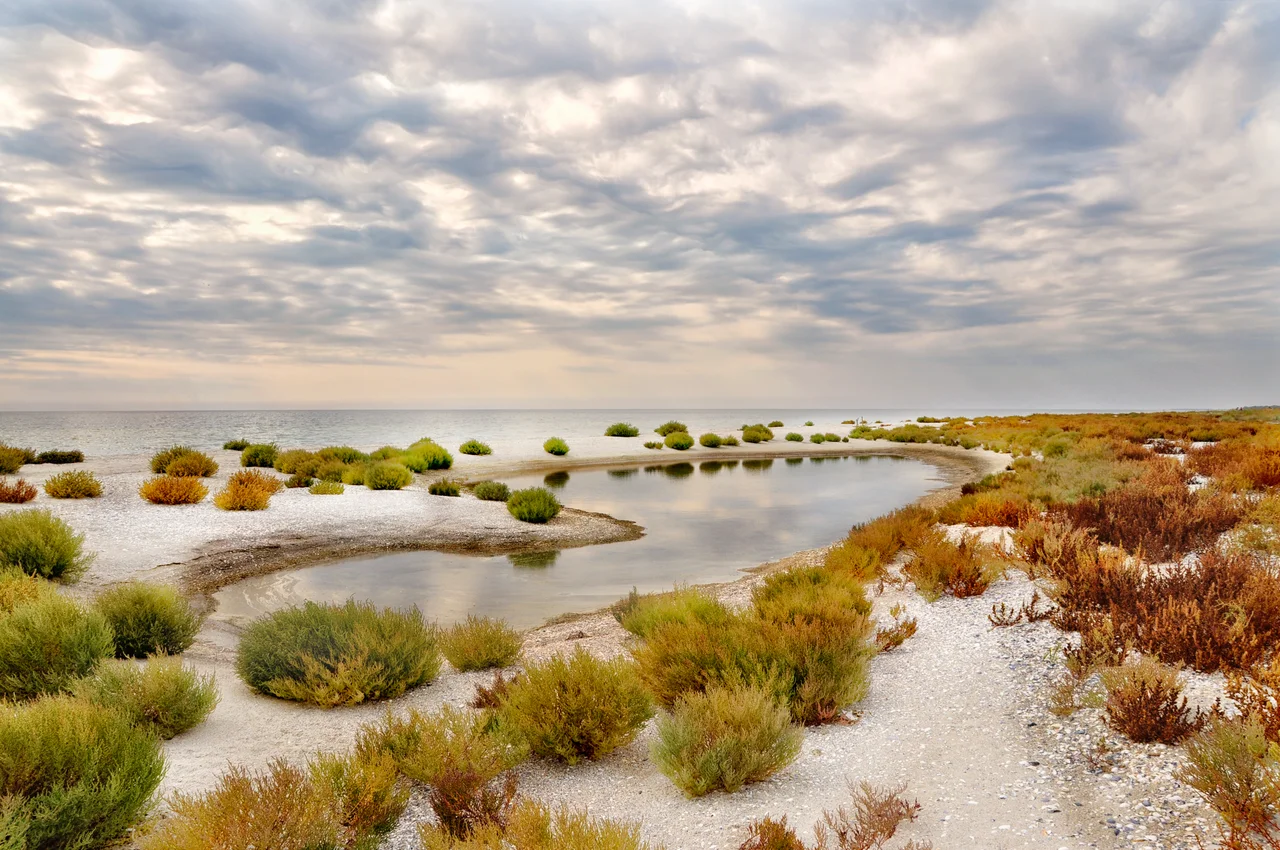

Kinburn Spit
In spring the ground here can carry up to a hundred wild orchids in a single square meter, and overhead the sky fills with the traffic of migration, some seven million birds funneling past on the great flyway between continents. The Kinburn Spit is a slender arm of sand, only about ten kilometers long and in places a hundred meters wide, reaching west into the Black Sea between the Dnieper-Bug estuary and Yahorlyk Bay. It is one of the richest small ecosystems in Ukraine, and one of the most quietly extraordinary strips of land on the whole northern coast.
A Ribbon Between Two Waters
Geography made the spit an oddity even before anyone drew a border across it. It occupies the westernmost tip of the Kinburn Peninsula, and though it belongs administratively to Mykolaiv Oblast, its only land access runs through neighboring Kherson Oblast. It is barely above the sea, wide at its base and tapering to a thread in its western half, with the open estuary to the north and the sheltered bay to the south. This is old ground, geologically speaking. During the second millennium BCE, rising seas drowned the plains of the lower Dnipro and left this estuary, Kinburn included, as wooded land. In the Late Bronze Age, itinerant metalworkers came here for its calcium and hematite sands, drawn even then to what the place had to offer.
Orchids, Vipers, and Seven Million Wings
The spit shelters a density of life out of all proportion to its size. Roughly six hundred species of higher vascular plants grow here, and its beaches and salt meadows nurse that astonishing orchid population, thirty to a hundred blooms per square meter in the richest patches. Among its endemic flora are cornflowers found almost nowhere else, Centaurea breviceps and Centaurea paczoskii. The fauna is stranger still, an estimated five thousand species including the sandy mole rat, the blotched snake, and the meadow viper, alongside herons, pelicans, ducks, and eagles. Dolphins work the surrounding waters. And because the spit sits astride a major migratory corridor, roughly seven million birds pass through every year. To protect all of it, the Regional Landscape Park of Kinburn Foreland was established, covering nearly eighteen thousand hectares of dune, marsh, forest, and shallow water, administered from the nearby town of Ochakiv.
A Fragile Place in Hard Times
The spit's low, wild beauty has made its recent history painful. During the fighting that came to this coast in 2022, the peninsula changed hands and became a militarized zone, its tiny population displaced, its wilderness scarred. That May, a fire started by rockets burned some four thousand hectares, inflicting lasting damage on the perennial forests and salt marshes and the delicate web of species they hold. Conservationists warned that the endemic cornflowers and their sensitive ecosystem could suffer for decades. For a landscape whose value lies precisely in its untouched fragility, the harm cut deep, and it fell on people as well as plants: the handful of residents who had made their homes on this remote sandbar found their quiet world upended, their livelihoods and their neighbors scattered.
What Endures
For all that has happened, the essential character of the Kinburn Spit remains what it always was: a place where land barely holds against the sea, where salt and sand and shallow water braid together into something teeming and rare. The orchids still bloom where the ground allows. The migration still comes on its ancient schedule, the flyway indifferent to the concerns of any single season. Somewhere out in the surrounding waters, dolphins still surface. A visitor in better times walks a threshold between estuary and open sea, on ground that itinerant metalworkers crossed three thousand years ago, and that seven million birds cross every year, carried by an instinct older than any name humans have given this thin, remarkable shore.
From the Air
The Kinburn Spit runs from roughly 46.56°N, 31.53°E westward into the Black Sea. From 3,000-5,000 feet it is unmistakable: a long, thin sand ribbon threaded with pale salt lagoons and dark patches of pine forest, dividing the wide Dnieper-Bug estuary to the north from Yahorlyk Bay to the south, with Ochakiv across the strait. Nearest airports are Mykolaiv (UKON) and Kherson (UKOH).
Nearby Stories
- Racecourse of Achilles 6.5 km away
- Vorontsov Lighthouse 14 km away
- Adziogol Lighthouse 18 km away
- Mykolaiv Regional Museum of Local History 24 km away
- Black Sea Shipyard 44 km away
- Zaliznyi Port 65 km away
- Moldavian Autonomous Soviet Socialist Republic 99 km away
- Danube Delta 160 km away