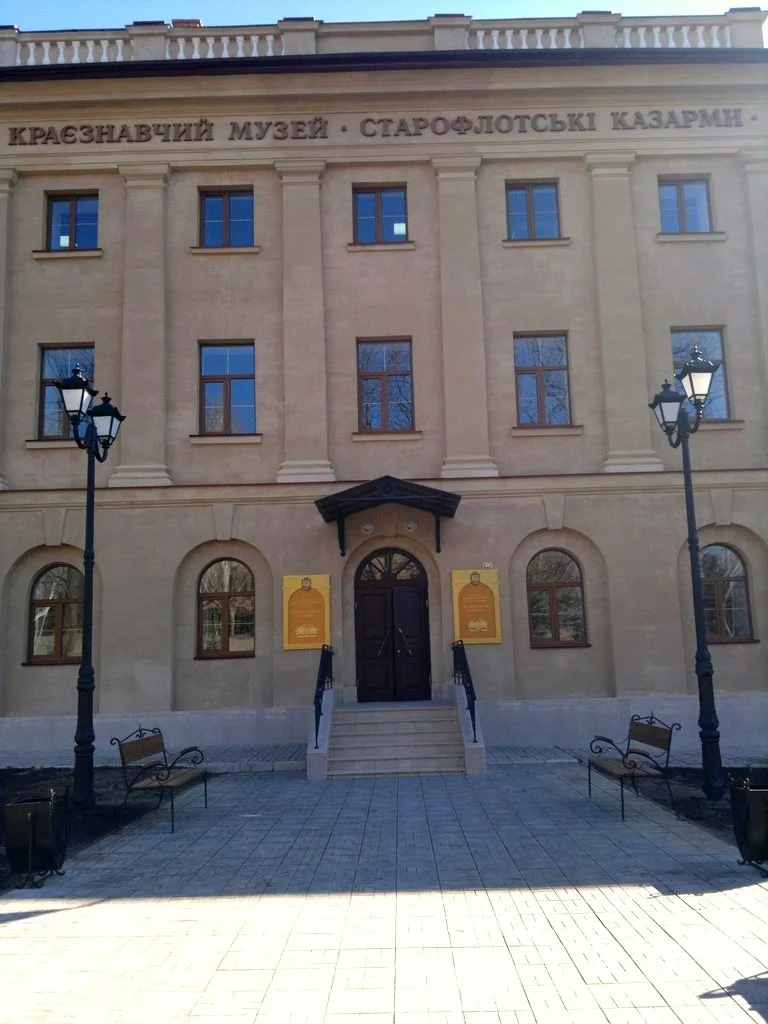

Mykolaiv Regional Museum of Local History
Some museums collect a subject; this one collects a place. Housed in the old Staroflotski Barracks in Mykolaiv, the Regional Museum of Local History is among the oldest museums in all of Ukraine, its formal founding dated to December 1913, though its roots reach back to 1803. For more than two centuries, people here have been quietly gathering everything that tells the story of this land, from Stone Age tools to Cossack crosses, from stuffed birds to Greek pottery pulled out of the earth. Behind the shelves and display cases lies a history as dramatic as anything on exhibit, including a director who paid for his scholarship with a quarter-century in the camps.
A Cabinet of the Whole Region
The museum grew from a very old habit of collecting. One of its early founders was Admiral de Traversay, and for decades the assembled holdings reflected the encyclopedic taste of the age, with minerals, seashells, and taxidermy displayed alongside ancient artifacts, city plans, and ship models, the natural world and the human past set side by side. The formal 1913 opening drew the mayor, the city council, and a crowd of guests. In the years that followed, the collection swelled with archaeology, documents, weapons, ethnography, and coins, funded in part by a city that clearly valued its own memory. When the great expedition to nearby Olbia began in 1920, more than sixteen hundred archaeological finds poured in, and the museum took on the character of a historical and archaeological institution.
The Director Sent to the Camps
The museum's most affecting story belongs to Feodosij Kaminsky, an archaeologist and passionate popularizer of the region's ancient monuments, who became director in 1923. He worked closely with the famous archaeologist Boris Farmakovsky on the Olbia excavations, helped establish the archaeological preserve there, and channeled the finds into the museum's collection. In March 1929 he proudly opened a grand new exposition. Six months later he was arrested, accused in a political case, and sent to Joseph Stalin's camps for twenty-five years. He was not alone; the repressions swept up other staff, including the scholar M. D. Lahuta. It is a sobering reminder that the people who preserved this region's past were themselves vulnerable to the cruelties of their own time, and that a museum's calm halls can hide real human suffering.
Still Gathering the Past
The museum endured, survived war and the plundering that came with occupation, and in 1950 merged its historical and natural-history collections into the institution known today. In 2012 it moved to its present home on the site of the historic Staroflotski Barracks, mid-nineteenth-century structures built by the architect K. Ackroyd. Russian shelling in 2022 tore through fifteen of the barracks' exhibition halls and forced staff to remove nearly ten thousand items to safety; the museum closed for the rest of that year and reopened its doors in March 2023. More than 180,000 items are now held here, spanning everything from the late Paleolithic and the Cossack era to ancient books, objects of worship, and old weapons. The collecting has never stopped. As recently as April 2025, museum staff began studying an ancient Greek burial site that came to light in an extraordinary way, discovered when soldiers building fortifications turned up a small amphora, the deep past surfacing once more in the midst of the present.
From the Air
The museum stands in central Mykolaiv at about 46.97 degrees north, 32.01 degrees east, in the historic Staroflotski Barracks on Admiralska Street near the city center. From the air the surrounding old-town grid and the Southern Bug riverfront are the main reference points. Nearest airport is Mykolaiv International (UKON) to the north; Kherson (UKOH) and Odesa International (UKOO) lie further along the coast.
Nearby Stories
- Ochakiv 17 km away
- Pontic Olbia 21 km away
- Yelanets Steppe Nature Reserve 44 km away
- Siege of Ochakov (1737) 46 km away
- Aktove Canyon 50 km away
- Skadovsk 73 km away
- ArcelorMittal Kryvyi Rih 85 km away
- Church of the Nativity of the Theotokos 110 km away