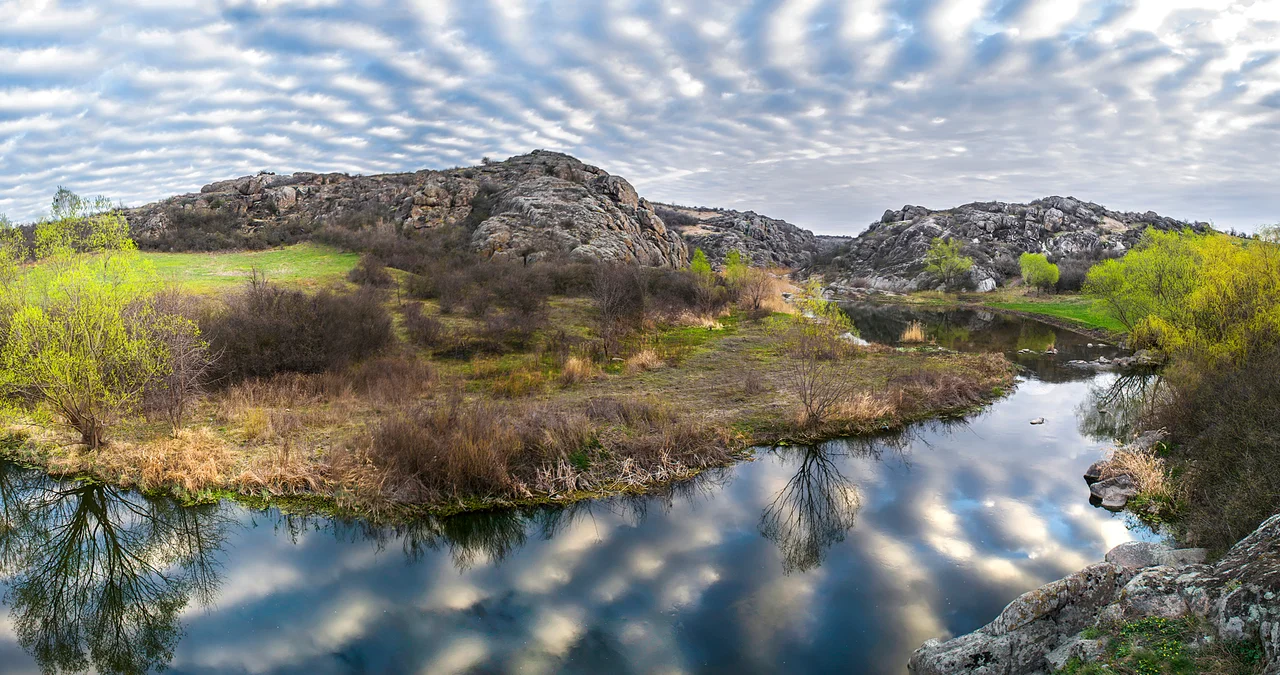

Aktove Canyon
The river that carved this place is called the Mertvovod, and the name reaches back through the steppe like a warning: in Ukrainian it means dead water. It hardly fits the scene. Near the village of Aktove, in the Voznesensk district of Mykolaiv Oblast, the Mertvovod has spent unimaginable stretches of time cutting a gorge more than fifty meters deep into raw granite, opening a sudden crevice of rock and green in a landscape that otherwise runs flat to the horizon. Locals and travelers come to walk its floor and scale its boulders, and some come as pilgrims. Whatever the river's name suggests, the canyon feels intensely alive.
Stone Older Than Almost Anywhere
The granite here is genuinely ancient. Aktove sits on one of the oldest parts of the Eurasian landmass, part of the crystalline shield that underlies this stretch of Ukraine, and the rock has been weathering into rounded boulders and sheer walls far longer than any human story could span. The canyon spreads across more than two hundred and fifty hectares, a tangle of granite outcrops, scattered stone, and the ribbon of the Mertvovod threading between them. Steppe grasses hold the rims while the shaded river bottom keeps its own cooler world below. It is a rare meeting of ecosystems: dry upland and moist gorge pressed together within a few vertical meters, so that stepping down into the canyon can feel like stepping into a separate climate.
A Grand Canyon in Miniature
Ukrainians sometimes call Aktove their own Grand Canyon, a fair boast for a country most people picture as endless plain. The comparison is not about scale, since fifty meters is modest against the American original, but about surprise: the way the earth simply opens where you least expect it. Photographers return in every season, and the gorge shifts character with the light and the calendar, its granite going gold at the height of summer and rust-colored under an autumn sky. Boulders the size of houses invite scrambling, and the river's edge offers cool footing on a hot afternoon. Few places in the region reward a simple walk so richly, and fewer still hide their drama so completely until you are standing right at the lip.
Protected Ground
Aktove's value was recognized long before it drew weekend crowds. Once set aside as its own nature reserve, it now forms part of the Bug Gard National Nature Park and the regional landscape park known as the Granite-Steppe Lands of Buh, a larger effort to protect this ancient rock country and the plants and animals that cling to it. That protection matters. The gorge is not a manicured attraction but a fragile survivor, its thin steppe soils and old stone easily scarred. Visitors who come with care, treading lightly and taking nothing but photographs, keep the place as it has been for far longer than anyone can remember, a quiet canyon holding its own weather deep in the Ukrainian steppe.
From the Air
Aktove Canyon lies at 47.71°N, 31.45°E, along the Mertvovod River near Aktove village, northwest of Mykolaiv. From about 3,000 to 5,000 feet, the sudden green gash of the gorge cutting through open steppe is the key landmark, distinct against the surrounding flat farmland. Ukrainian airspace is closed to civil aviation; the nearest operating airport is Chișinău (ICAO LUKK) in Moldova.
Nearby Stories
- Strategic Missile Forces Museum 30 km away
- Bug Gard National Nature Park 39 km away
- Admiral Makarov National University of Shipbuilding 53 km away
- Fortress of St. Elizabeth 60 km away
- Dykyi Sad Archaeological Site 66 km away
- Mykolayiv Shipyard 83 km away
- Kuialnyk Estuary 90 km away
- Battle of Uman 98 km away