
Mykolayiv Shipyard
"If the shipyard grows, so does the city." Admiral Mikhail Lazarev said it in 1833, and for a century and a half the reverse held just as true. The Nikolayev Admiralty, founded on the banks of the Ingul River in 1788, was never just a factory bolted onto Mykolaiv. It was the town's beating heart, the reason streets ran wide and workers came from across an empire. Set some eighty-nine kilometers inland from the open Black Sea, sheltered up a river yet close enough to matter, the yard would spend more than two centuries building the fleets of whoever happened to rule the coast.
A Cradle for the Black Sea Fleet
Prince Grigory Potemkin founded the admiralty a year before the city itself, part of a grand scheme to plant a fleet on the Black Sea and secure newly annexed lands for Catherine the Great. It was named for Saint Nicholas, protector of seafarers, and its first hull, the frigate St. Nicholas, launched in 1790. That ship went on to fight at the Battle of Cape Kaliakra against the Ottomans. Between 1816 and 1833 the yard turned out more than a hundred warships, and in 1820 and 1825 it launched the paddle steamers Vezuviy and Meteor, the second of which became the first naval steamship on the Black Sea. By mid-century, its warmer waters giving it an edge over the frozen Baltic yards of Saint Petersburg, Nikolayev had become the empire's true center of naval construction.
The Long Workday and the Circular Ship
Growth was measured in slipways and sweat. Lazarev's 1838 redevelopment added a rope factory, a foundry, three new building berths, and a great movable crane, and the plant poured everything into arming the Imperial Russian Navy. In 1861 the admiralty fixed a ten-hour workday beginning at five in the morning, a discipline of pre-dawn bells that shaped generations of families here. The yard also indulged in the strange. Following a Scottish shipbuilder's theory that a wider hull could carry heavier armor, Rear-Admiral Andrei Popov widened one design until it was literally circular, producing the monitor Vitse-admiral Popov, a warship shaped like a floating saucer. When the Treaty of Paris in 1856 briefly barred Russian warships from the Black Sea, the yard's vast capacity fell idle, its finished ships of the line quietly shipped off to the Baltic instead.
Battleships, Mutiny, and Many Flags
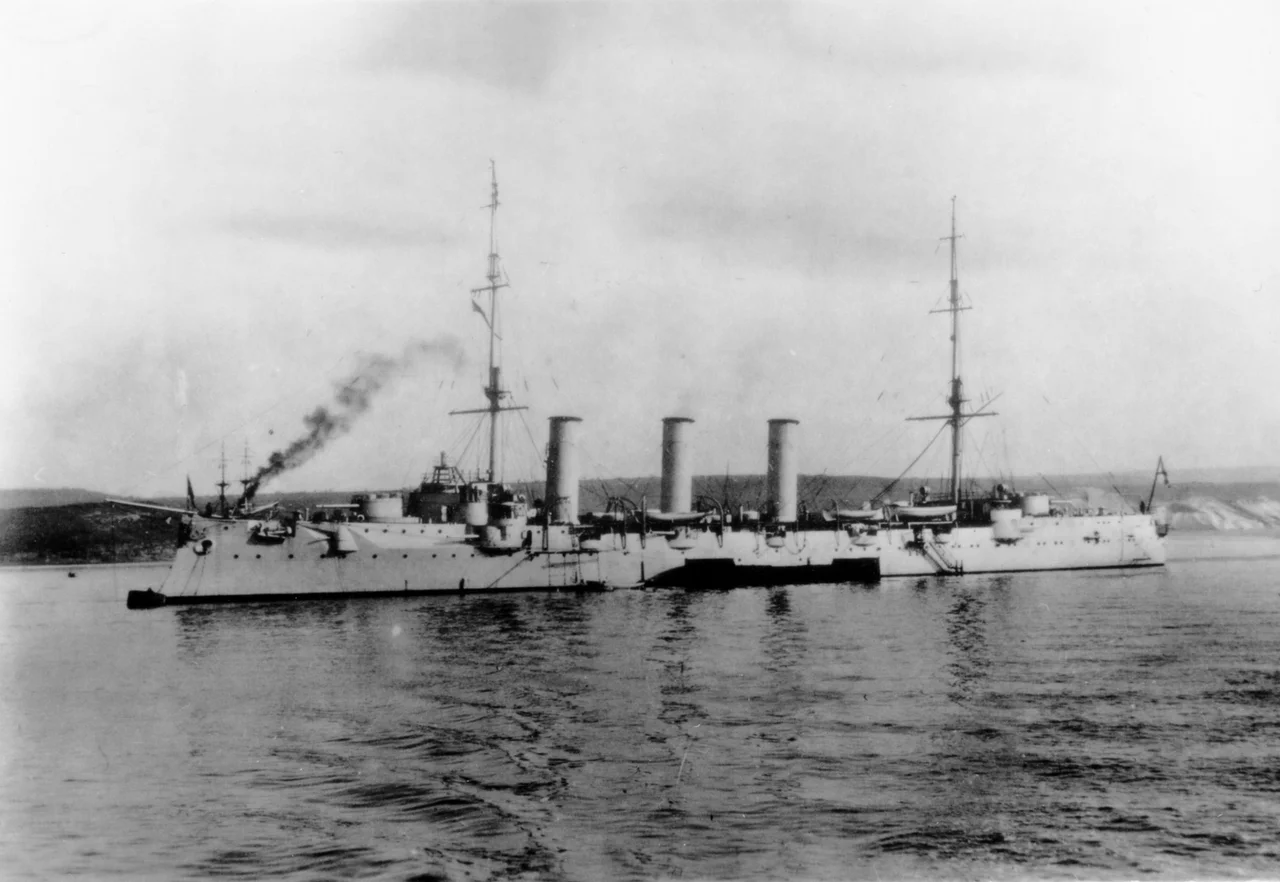
As sail gave way to steam and steel, the admiralty built battleships to rival the great European navies, beginning with Ekaterina II, laid down in 1883 with her guns clustered in a triangle for the shallow Black Sea. The most famous name to touch these slipways was Knyaz' Potemkin-Tavricheskiy, the battleship whose 1905 mutiny became legend. That same revolutionary year, unrest inside the yard delayed the cruiser Pamiat' Merkuria, a ship that would go on to sail under a bewildering succession of names and rulers, briefly Ukrainian, then Soviet, as power changed hands. Renamed for the 61 Communards under the Soviets and later restored to the Mykolayiv Shipyard, the yard fell into bankruptcy in 2020. Its slipways stand largely silent now, its halls derelict, the long pre-dawn shifts finally ended.
From the Air
The shipyard occupies the Ingul River's left bank at 46.98°N, 32.00°E, in the north of Mykolaiv. From about 6,000 to 9,000 feet the twin river channels and the tall gantry cranes over the building berths are the surest landmarks. Ukrainian airspace is closed to civil aviation; the nearest operating airport is Chișinău (ICAO LUKK) in Moldova, with Odesa (UKOO) the closest Ukrainian field.
Nearby Stories
- Ochakiv 17 km away
- Pontic Olbia 21 km away
- Yelanets Steppe Nature Reserve 44 km away
- Siege of Ochakov (1737) 46 km away
- Aktove Canyon 50 km away
- Skadovsk 73 km away
- ArcelorMittal Kryvyi Rih 85 km away
- Church of the Nativity of the Theotokos 110 km away