.jpg)
Battle of Uman
The forest is called Green Brama, and today it is a place of birdsong and memorial stones. In the first week of August 1941, it was the final refuge for tens of thousands of Soviet soldiers who had run out of everywhere else to go. They had been marching and fighting for three weeks, retreating across the black-earth farmland of central Ukraine as German columns closed around them from every direction but one. Near the town of Uman, that last direction closed too. What happened here has a clinical German name, Kesselschlacht, a cauldron battle, but the reality was a ring of steel drawn tight around exhausted men who had been promised help that never came.
The Ring Draws Tight
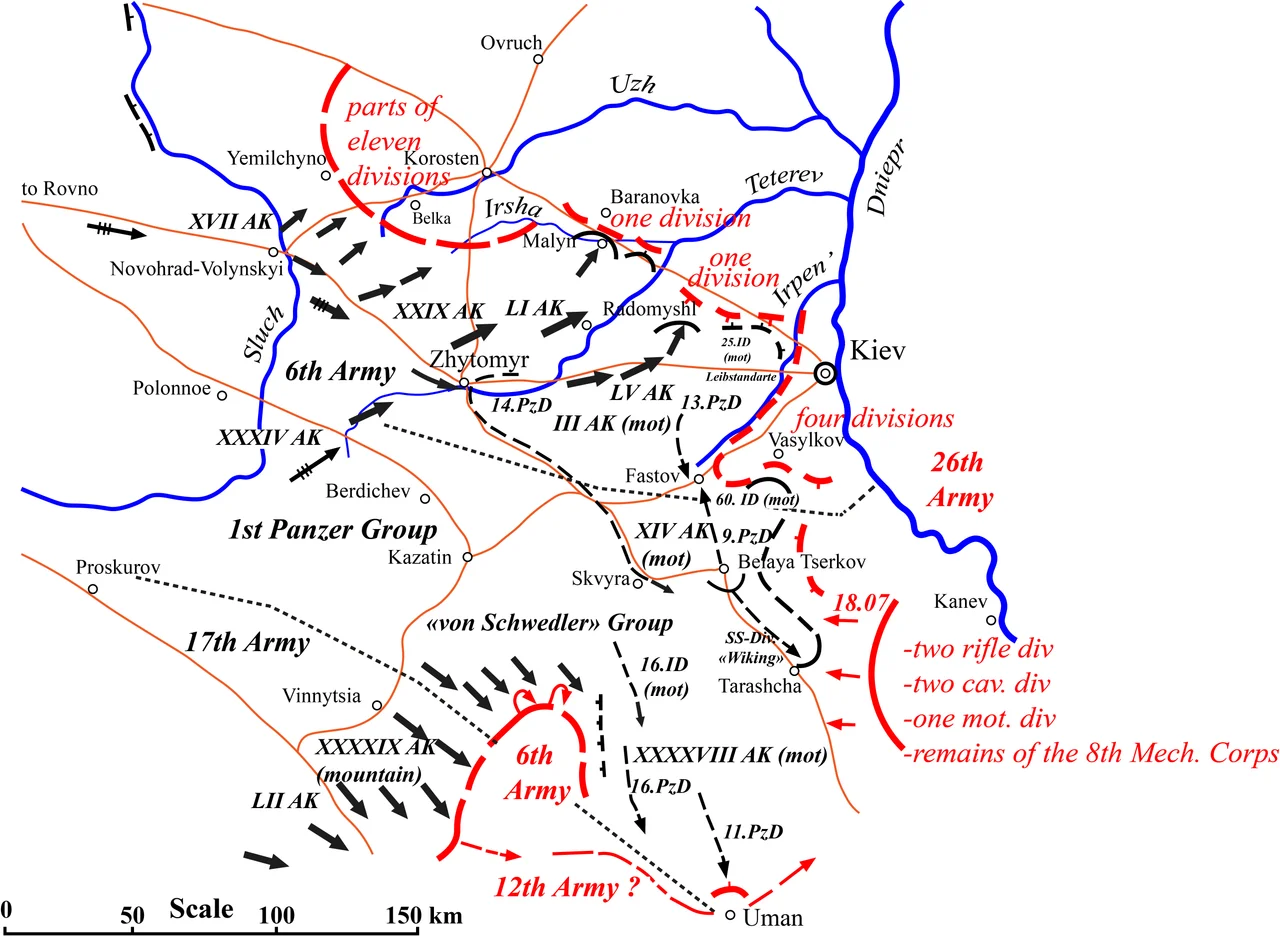
The Battle of Uman unfolded between 15 July and 8 August 1941, in the opening weeks of Operation Barbarossa. Germany's Army Group South, under Field Marshal Gerd von Rundstedt, had already shattered Soviet mechanized forces at the Battle of Brody in late June, and its fast-moving Panzer columns now raced ahead of the retreating Red Army. The Soviet 6th and 12th Armies, commanded by Lieutenant General Muzychenko and Major General Ponedelin, pulled back toward one defensive line after another. Each time, they arrived to find German tanks already there. On 31 July, Soviet troops abandoned Uman itself. By early August, the two armies were pressed into a patch of country roughly forty kilometers on a side, open only to the south, still ordered by distant commanders to attack northeast toward help that could not reach them.
A Message to Moscow
On the morning of 1 August, the encircled commanders sent a joint message up the chain, with a copy addressed to Stalin himself. The situation had become critical, they wrote. The encirclement was complete. There were no reserves, no ammunition, and the fuel was running out. It was as honest an assessment as men in their position could send. The reply amounted to reassurance and denial. The commander of the Southern Front assured Stalin that a fresh rifle division would break through from the northeast and relief would arrive from the south, and he brushed aside any talk of supply problems. The relief attacks failed one after another. The newly formed, inexperienced 223rd Rifle Division was scattered before it could even begin its assault. High command, focused on holding the Dnieper River far to the east, gradually stopped asking about the men inside the ring.
The Breakout
By 5 August, the pocket had shrunk to roughly ten kilometers across, and every part of it lay under fire. Around sixty-five thousand soldiers remained. On the night of 6 August they gathered their last tanks and struck south, believing they only had to punch through the mountain troops in their path to reach friendly lines. They marched twenty kilometers in the dark and even retook the town of Holovanivsk. But the friendly lines were gone, lost days earlier without word reaching them, and instead of rescue they met German infantry and armor. The following night the remnants tried again, breaking east and northeast. Only small groups without heavy weapons slipped free. Ponedelin was captured after his tank was hit. Alongside him, the other army commander and eleven division commanders were taken as well. On 7 August, the soldiers still sheltering in the forests around Green Brama began to lay down their arms.
What the Fields Remember
The numbers from Uman are staggering even by the standards of that terrible war, and it is easy to let them blur into abstraction. It helps to remember what they describe: hundreds of thousands of individual people, most of them very young, many of them Ukrainian and Russian conscripts who had been in uniform only weeks, dying or marching into captivity across a stretch of farmland no larger than a modern county. The chief of staff of the 6th Army, a man named Ivanov, reportedly drove two hundred kilometers through the German rear in a fast BT-7 tank to escape. Most were not so lucky. Today the countryside around Uman is quiet, given over again to sunflowers and grain, and the memorials in the Green Brama forest ask visitors simply to remember the men who spent their final days there.
From the Air
The battlefield centers near 48.58°N, 30.67°E, around the town of Uman in central Ukraine. From roughly 6,000 feet, the flat expanse of black-earth farmland reads as an endless quilt of cultivated fields, with the Green Brama forest and the meandering Syniukha River as the main natural landmarks. The nearest airfield is Uman (UKKM); Vinnytsia (UKWW) lies to the northwest.
Nearby Stories
- Uman 16 km away
- Strategic Missile Forces Museum 19 km away
- Khutir Nadiia 50 km away
- Battle of Korsun 70 km away
- Aktove Canyon 71 km away
- Kholodnyi Yar 75 km away
- Bila Tserkva 104 km away
- Tiraspol 172 km away