.jpg)
Strategic Missile Forces Museum
Turn the two keys at the same moment and the panel lights up, exactly as it would have during a real launch. Deep beneath a field near the town of Pobuzke, in a metal capsule buried in the earth, that ritual is now a tourist's souvenir. It was once the most consequential act a human being could perform. This is the Strategic Missile Forces Museum, built into a genuine Soviet command post that controlled intercontinental ballistic missiles, and it may be the only place on Earth where ordinary visitors can descend into the machinery of nuclear war and feel, in their own hands, the terrible simplicity of it.
The Arsenal a Country Gave Away
When the Soviet Union dissolved, newly independent Ukraine woke up holding the third-largest nuclear arsenal in the world. On its soil sat roughly 1,700 warheads: 130 UR-100N missiles carrying six warheads apiece, 46 RT-23 Molodets missiles with ten each, and 33 heavy bombers, along with the factories and expertise to build more. Few countries have ever possessed such power, and fewer still have chosen to surrender it. In 1994 Ukraine agreed to destroy the weapons and join the Non-Proliferation Treaty. Forty launch silos ringed the city of Pervomaisk, home to the 46th Rocket Division, each cluster of nine or ten wired to a common underground command post. Between 1994 and 1997 the missiles went back to Russia, and thirty of the forty silos were demolished with foreign help through the Nunn-Lugar threat-reduction program.
Life Inside the Tube
The command post is not a bunker in the usual sense but a capsule: a thirty-three-meter steel tube, three and a third meters across, weighing a hundred and twenty-five tons, suspended inside its silo on hydraulic actuators so it could sway and absorb the shock of a direct hit. Eleven compartments stack down its length, holding generators, air handlers, communications, and launch hardware, enough to run itself for forty-five days through a nuclear war without ever opening to the surface. Two officers sat on duty in the command compartment in six-hour shifts, while a second crew slept in the compartment below. Imagine the weight of those hours: the low hum of ventilation, the sealed metal walls, the knowledge of what the panel in front of you could do. This was the daily working life of the Cold War, lived out in a windowless cylinder underground.
A Monument to Restraint
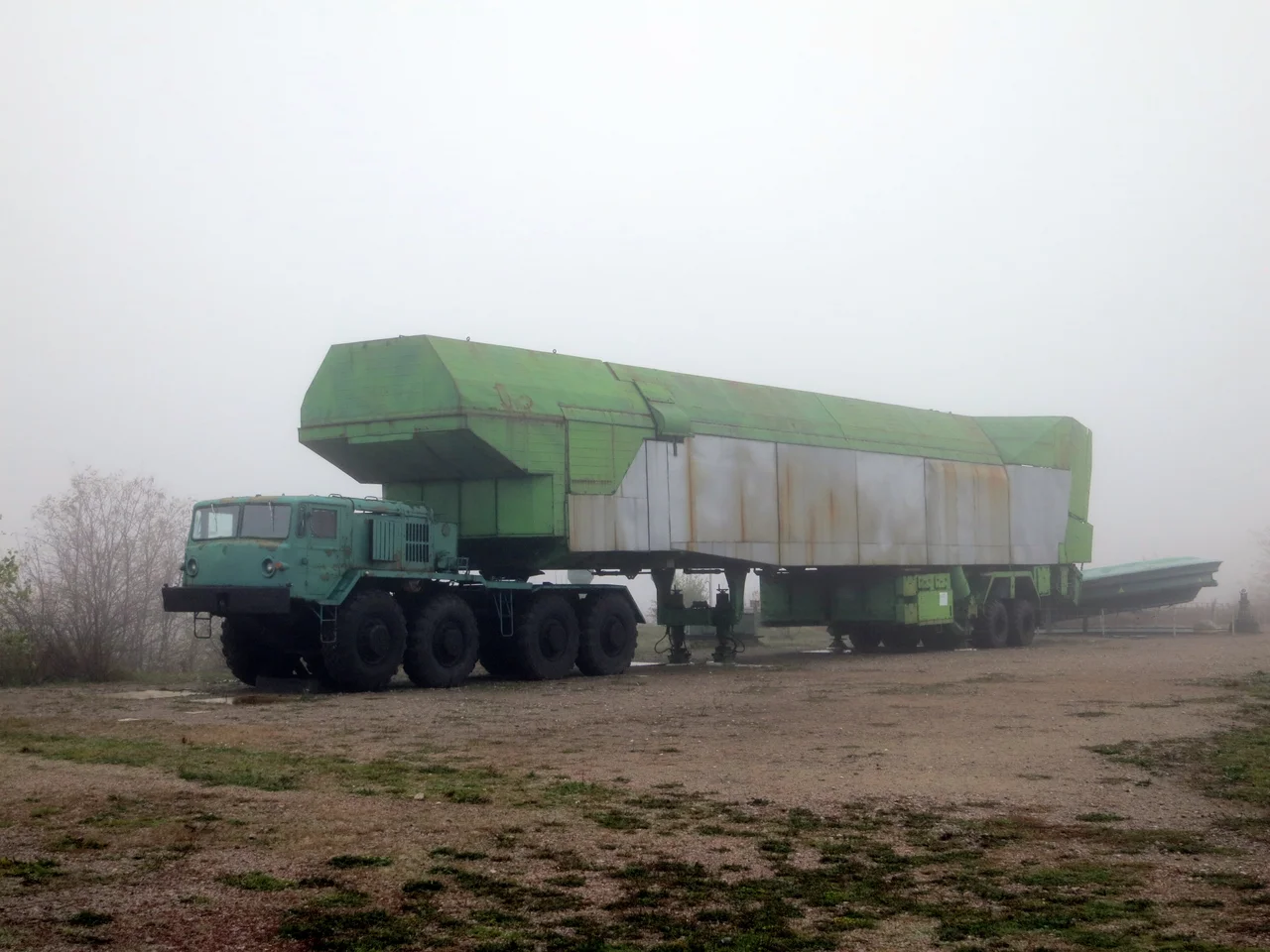
One of those command posts, near Pobuzke, opened as a museum on October 30, 2001, and is now part of Ukraine's National Military History Museum. Above ground, an outdoor field displays the hardware of deterrence, rocket engines, mock warheads, helicopters, and the enormous MAZ-537 tractors that hauled missiles across the country, alongside an R-36M, shown with its internal components exposed, and an R-12, the type famous from the Cold War's most dangerous confrontation over Cuba. Below ground, guided tours descend the elevator in pairs to the command compartment, where the launch panels have been rigged to light up harmlessly at the turn of the keys. The place preserves the instruments of unimaginable destruction, yet its deepest subject is the decision not to use them, a rare monument to a nation that chose to lay its most fearsome weapons down.
From the Air
The museum lies at 48.19°N, 30.67°E, near Pobuzke in Kirovohrad Oblast, about 250 km south of Kyiv. From about 3,000 to 6,000 feet, look for the fenced compound with its outdoor display of missiles and vehicles and the distinctive silo cap set among open farmland. Ukrainian airspace is closed to civil aviation; the nearest operating airport is Chișinău (ICAO LUKK) in Moldova.
Nearby Stories
- Battle of Uman 10 km away
- Granite-Steppe Lands of Buh 26 km away
- Uman 26 km away
- Aktove Canyon 33 km away
- Khutir Nadiia 55 km away
- Sofiyivka Park 57 km away
- Melgunov Kurgan 83 km away
- Tiraspol 134 km away