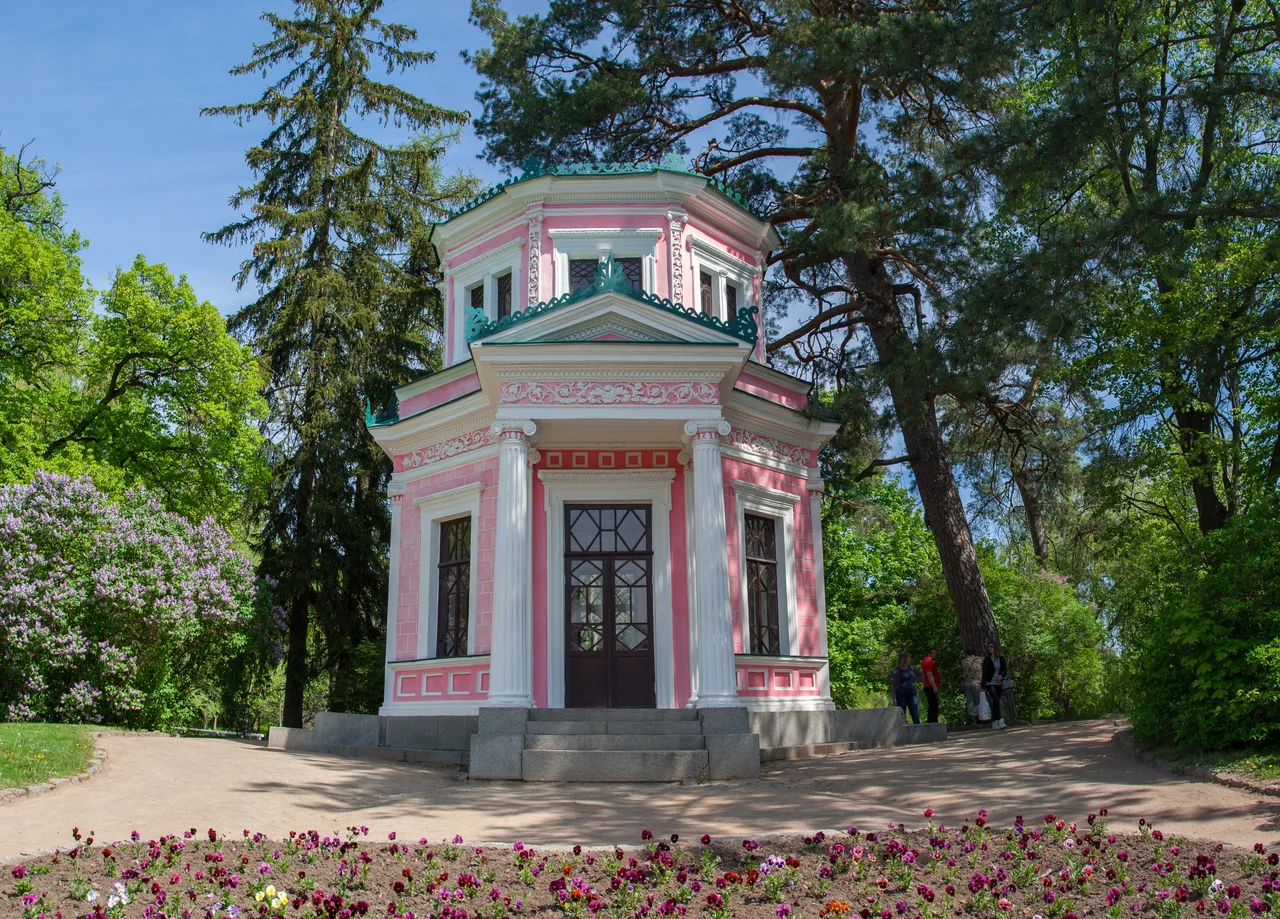

Sofiyivka Park
It began as a birthday present, though few gifts have ever cost so much or lasted so long. In 1796, Count Stanisław Szczęsny Potocki commissioned an entire landscape for his Greek wife, Sofia, transforming a tangle of ravines and the Kamianka River near Uman into a garden meant to be walked like a poem. The price ran to fifteen million złoty, a staggering fortune, and the result still draws some 300,000 visitors a year to its waterfalls, ponds, and grottoes. Sofiyivka is romance rendered in stone and water, one of the great landscape gardens of its age, and it carries her name at every turn.
A Garden Written in Myth
The engineer Ludwik Metzel, a Polish military man, was given the wild, ravine-cut land and a vision to match it: a park that would retell scenes from Homer's Odyssey and Iliad as visitors moved through it. He imported rare plants from across Europe, and today the arboretum holds more than two thousand kinds of trees and shrubs, among them marsh cypress, tulip trees, plane trees, and ancient ginkgo. Water is the park's true medium. Metzel shaped artificial basins and ponds, a waterfall fourteen meters high, and a subterranean river named the Acheron, after the underworld river of Greek myth, that runs 224 meters through the dark before returning to daylight. Grottoes named for Calypso and other figures, antique statues, and artificial cliffs turn a simple walk into a passage through the classical imagination.
The Hands That Built It
Behind the poetry lay hard labor. The grand vision of Potocki and Metzel was realized by local serfs, the bound peasants of the estate, who moved the earth, quarried the granite, and dug the channels that made the illusion possible. The count had rebuilt Uman itself in the aftermath of the Koliyivshchyna, a bloody peasant uprising that had convulsed the region a generation earlier, and the park rose in a landscape still marked by that violence. It is worth remembering, as you stand before a fourteen-meter waterfall meant to evoke a Greek nymph's home, that the waterfall exists because unnamed men and women shifted its stones by hand. The beauty was genuine, and so was the toil that produced it, and the two are inseparable in Sofiyivka's story.
Confiscated, Renamed, Renowned
The park did not stay a private gift for long. After the Polish November Uprising in 1832, the authorities confiscated Sofiyivka and transferred it to imperial hands, and that same year Tsar Nicholas I presented it, in turn, to his own wife, Alexandra Feodorovna, a garden passed from one royal marriage to another. Under the Military Settlements Administration it was substantially reworked in the decades that followed. Today it belongs to the National Academy of Sciences of Ukraine, functioning as both a beloved park and a serious research arboretum. It was voted one of the Seven Wonders of Ukraine in 2007 and sits on the country's tentative list for World Heritage status. There is even a piece of it in the sky: in 1985, a minor planet, number 2259, was named Sofiyivka, so that the count's gift now orbits the sun.
From the Air
Sofiyivka Park lies at 48.76°N, 30.22°E, in the northern part of Uman, Cherkasy Oblast, along the Kamianka River. From about 3,000 to 5,000 feet, the wooded park with its chain of ponds stands out as a green enclave at the edge of the city grid. Ukrainian airspace is closed to civil aviation; the nearest operating airport is Chișinău (ICAO LUKK) in Moldova.
Nearby Stories
- Maidanetske 9 km away
- Strategic Missile Forces Museum 37 km away
- Battle of Korsun 61 km away
- Multimedia Fountain Roshen 79 km away
- Bila Tserkva 84 km away
- Bug Gard National Nature Park 84 km away
- Vinnytsia 93 km away
- Battle of Vaslui 251 km away