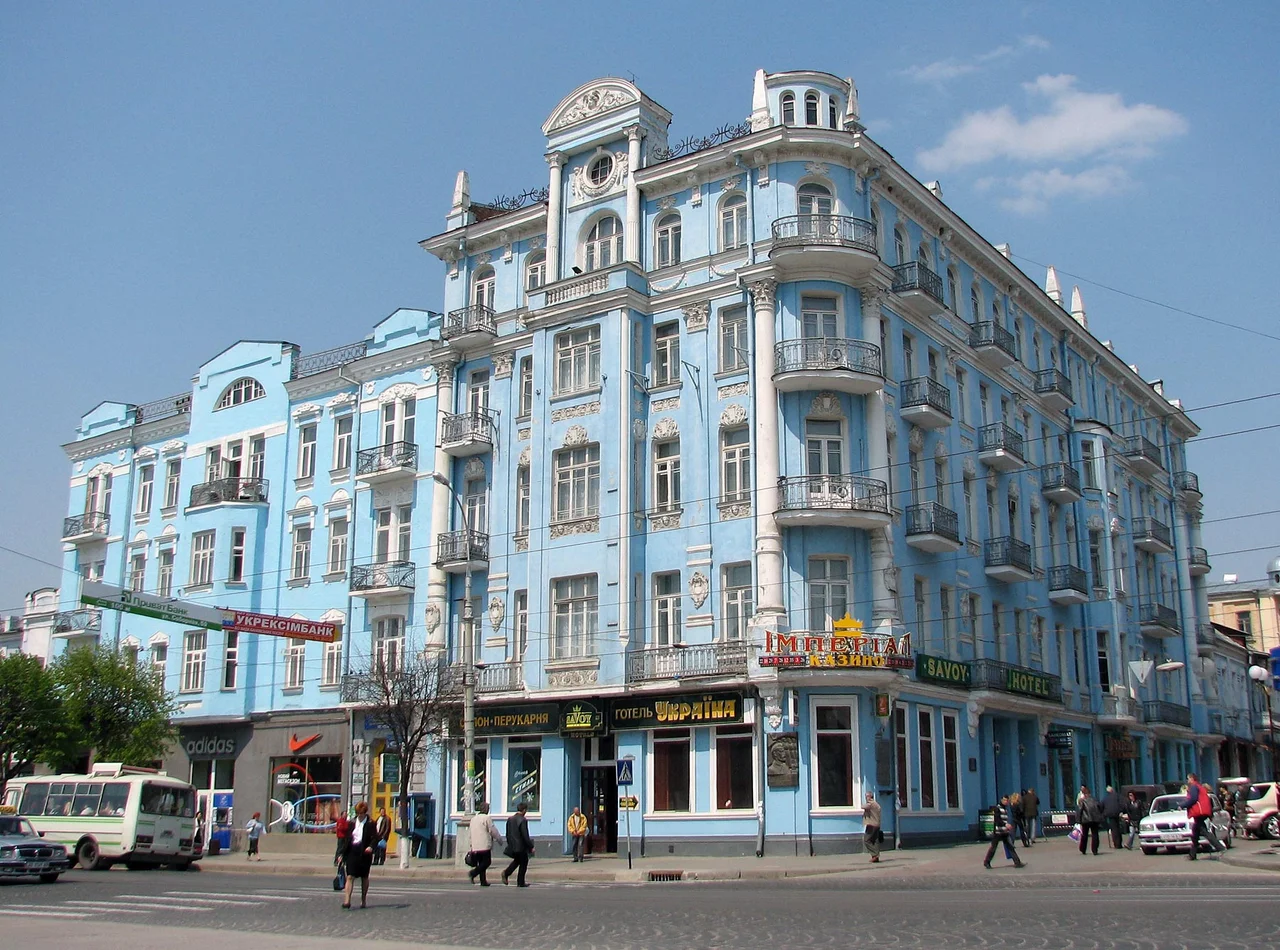

Vinnytsia
The river cuts straight through the middle of Vinnytsia, and on summer evenings the water itself becomes the show. Along the Southern Bug, jets rise and fall in time to music while light plays across the spray, a fountain famous across Ukraine. It is a strangely tender centerpiece for a city that has spent most of its long history on a frontier, passed from hand to hand between empires, and marked by some of the twentieth century's cruelest episodes. Two hundred and sixty-seven kilometers southwest of Kyiv, Vinnytsia today is a place of confectionery and quiet resilience, an old border town still learning how to be at peace.
A Fortress Against the Raiders
Vinnytsia's story begins with a wall. In 1363, Fedir Koriatowicz, nephew of the Lithuanian Grand Duke, built a fortress here on the banks of the Southern Bug, a defense against the Tatar raiders who swept the open steppe to the south and east. That single act of fortification made Vinnytsia a trade and political center, and for the next several centuries it belonged to a bewildering succession of powers: Lithuania, then the Polish-Lithuanian Commonwealth, the Ottoman Empire, the Cossack Hetmanate, and finally the Russian Empire, which annexed the city and its region after the Second Partition of Poland in 1793. Each ruler left a mark. Russia moved to suppress the Roman Catholic faith, and Catholic churches, including what is now the Transfiguration Cathedral, were converted to Russian Orthodox worship. The remains of old fortress walls, built around a Dominican monastery in the early seventeenth century, still stand as 'the Mury,' stone witnesses to the town's guarded youth.
The Weight of the Twentieth Century
For a brief moment in the early twentieth century, Vinnytsia served as a temporary capital of the independent Ukrainian People's Republic, a flicker of self-rule soon extinguished. What followed was harder to speak of. During the Stalinist repression of 1937 and 1938, thousands were killed and buried in mass graves outside the town in what became known as the Vinnytsia massacre; the graves were exhumed in 1943. In the Second World War, Adolf Hitler placed his easternmost headquarters, code-named Werwolf, near the town and spent months there in 1942, returning again in early 1943. Nazi atrocities carried out in and around Vinnytsia claimed as many as 28,000 lives and included the near-total annihilation of the city's large Jewish community. These were neighbors, families, and children, generations of a community erased. Vinnytsia carries that memory without spectacle, in the way a place learns to hold grief that never fully leaves it.
Chocolate, Air Bases, and Everyday Life
The modern city wears a lighter face. Vinnytsia is the home base of the Roshen corporation, whose confectionery makes this something of a chocolate town, and it has grown into a center for information-technology work as well. It is also the main base of the Ukrainian Air Force, and once hosted a Soviet Cold War airbase. Getting around is easy and pleasantly old-fashioned: six tram routes, more than twenty trolleybus lines, and a web of buses and marshrutkas thread the streets, and there are more than ninety kilometers of bicycle infrastructure for those who prefer to pedal. In 2021, roughly 370,000 people lived here. Life keeps its rhythms, warm summers and short winters, mist rising off the Bug in the cold months, the ordinary business of a working city.
Landmarks and Neighbors
The old water tower in the city center, now serving as a belfry, has become an unofficial emblem of Vinnytsia, its silhouette recognizable to every resident. Grand hotels from the imperial twilight, such as the Savoy of 1913, still line the main street, and the Roshen Fountain draws crowds to the riverbank. Around the city, the flat and fertile country of central Ukraine spreads in every direction. Uman lies about 150 kilometers east, Khmelnytskyi a hundred to the west, gateway to the country's western reaches, and Zhytomyr rises to the north. Since 2022, Ukraine's airspace has been closed to civil flights, and the city's airport was damaged early in the wider war, so for now Vinnytsia is reached by road and rail, the way travelers have always come to this crossroads on the Bug.
From the Air
Vinnytsia lies at 49.24 N, 28.47 E in central Ukraine, on the Southern Bug River about 267 km southwest of Kyiv. From cruising altitude the river's meanders through the city and the old water tower are the clearest visual anchors, set amid the flat steppe farmland of the region. The former Vinnytsia International Airport (UKWW) sits nearby but Ukrainian airspace is closed to civil aviation.
Nearby Stories
- Zhitomir–Berdichev Offensive 41 km away
- Arboretum Oleksandriya 93 km away
- Sofiyivka Park 107 km away
- Bila Tserkva 108 km away
- Uman 144 km away
- Chernivtsi 159 km away
- Chernivtsi University 176 km away
- Olyka Castle 190 km away