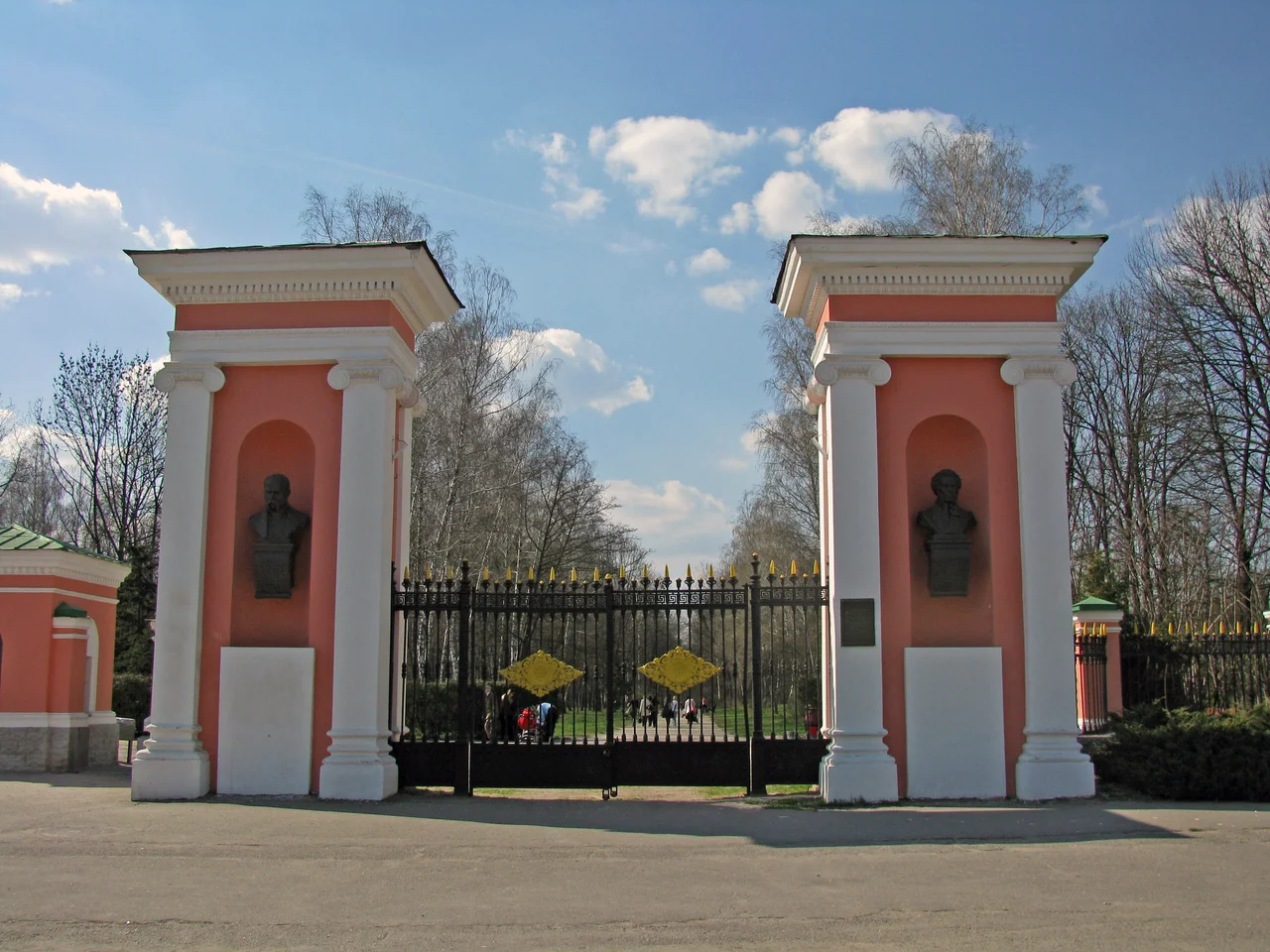

Arboretum Oleksandriya
The park is called Alexandria, but not for the Egyptian city of libraries and lighthouses. It was named for a woman, Countess Alexandra Branicka, who received this stretch of land along the Ros River as a gift from her husband in 1784 and set about turning it into one of the great romantic landscapes of Eastern Europe. More than two centuries later, her Alexandria survives as Arboretum Oleksandriya, the second-largest park in all of Ukraine, a place where classical colonnades and a bright golden footbridge appear among the trees like memories of a vanished aristocratic world.
A Reward and Its Shadow
The park's origins lie in a hard chapter of Ukrainian history. In December 1774, the Polish king Stanisław August Poniatowski granted the Bila Tserkva estate to the Hetman Franciszek Ksawery Branicki, a reward for his role in crushing the Koliivshchyna, a violent Ukrainian uprising. The gift was enormous: the towns of Bila Tserkva and Skvyra along with 134 villages and more than forty thousand people, all of it now the private property of the Branicki counts. The family split their year between the glittering court of Catherine the Great in Saint Petersburg and their Ukrainian estates, where they most loved to summer. When Countess Branicka took the land in hand in 1784, she began building the park that would carry her name.
Designed Like a Dream
The master plan came from a French architect known as Muffo, and a succession of gardeners and designers, with names like Botani, Stange, and Witt, brought it to life over the following decades. What they created was a landscape in the fashionable romantic style, its architecture in the mode of late classicism, meant to feel less like a garden than a series of unfolding scenes. Alleys were adorned with bronze and marble sculptures and elegant vases. The land itself, a flat floodplain terrace sloping gently to the Ros, was shaped into vistas and secret corners. Among its celebrated structures are the Echo Colonnade, a graceful golden Chinese bridge, the open sweep of the Big Glade, and a set of artful, deliberately built Ruins, the kind of romantic folly that European parks of the age adored.
The Company It Kept
For a park in provincial Ukraine, Alexandria drew a remarkable roll of visitors. In the middle of the nineteenth century its paths were walked by the poets Gavrila Derzhavin and Alexander Pushkin, and by Taras Shevchenko, the towering figure of Ukrainian literature. It welcomed Decembrists, the idealistic officers who dreamed of reforming the Russian Empire, among them members of the Southern Society such as Sergey Muravyov-Apostol and Pavel Pestel. Polish poets and artists came too. The Russian imperial family visited more than once; a corner known as the Tsar's Garden, planted with larch and seven American lime trees, is said to have been set by the emperors Alexander I and Nicholas I together with the future empress Alexandra Feodorovna.
A Living Collection
Today Alexandria is far more than a relic of noble leisure. It serves as the state arboretum of the National Academy of Sciences of Ukraine and is recognized as a monument of landscape art. Set in a moderate continental climate with a growing season of some 170 to 180 days, the park weaves together living plant collections with its architecture, sculpture, and the shining water of the Ros and its ponds. To wander here is to move through more than two centuries at once: past a countess's romantic vision, past the poets and revolutionaries who once strolled the same alleys, and into a working scientific garden that keeps the whole ensemble green, tended, and alive.
From the Air
The arboretum lies at 49.81°N, 30.07°E, on the Ros River at the edge of Bila Tserkva in Kyiv Oblast, Ukraine. From about 3,000 feet, look for the large wooded park along the river's floodplain southwest of the city center, its ponds catching the light. The nearest major airport is Kyiv's Zhuliany (UKKK) to the north; Bila Tserkva has its own airfield (UKBC).
Nearby Stories
- Boryspil 38 km away
- Khotiv Hillfort 40 km away
- Battle of Korsun 45 km away
- Radomysl Castle 48 km away
- Trakhtemyriv 56 km away
- Berdychiv 67 km away
- Werwolf (Wehrmacht Headquarters) 81 km away
- Battle of Korsun-Cherkassy 90 km away