
Berdychiv
There was a time when a letter addressed simply to Berdychiv would find almost anyone. Merchants from across Poland, Lithuania, Ukraine, and beyond passed through this town so reliably, drawn by its famous fairs, that it became the great postal exchange of the region. "Pisz na Berdyczów!" people said, "Write to Berdychiv!", knowing your correspondent would turn up within a couple of months. Later, after a poet used the phrase, it soured into a brush-off, a way of saying "write to me at nowhere, leave me alone." That double life, indispensable crossroads and byword for nowhere, is Berdychiv all over: a place the world once could not do without, and then largely forgot.
The Fair That Made a City
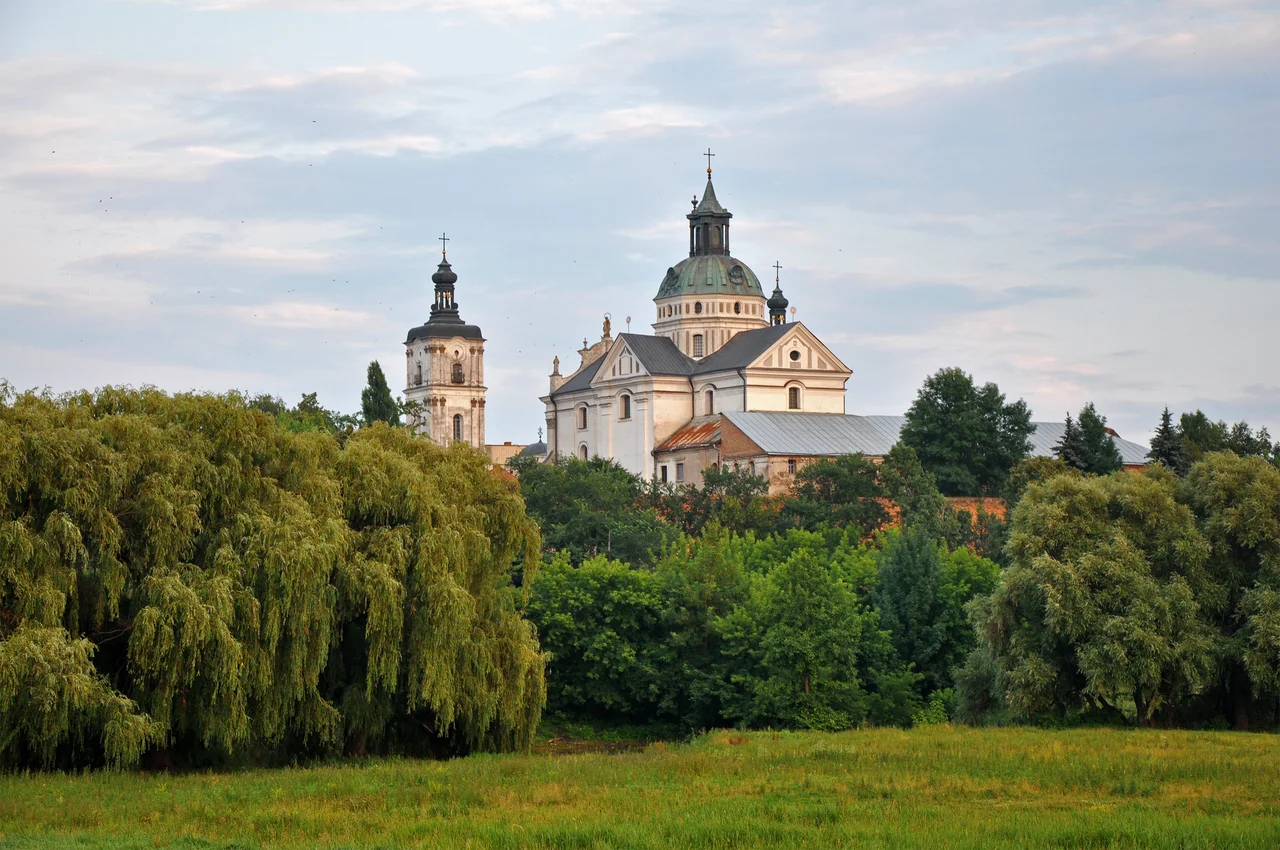
Berdychiv's roots reach back to the 1430s, but its golden age came under the Polish-Lithuanian Commonwealth. A fortified Carmelite monastery, funded by the magnate Janusz Tyszkiewicz Łohojski and built in the mid-seventeenth century, made the town a Catholic pilgrimage site and a stronghold on the eastern frontier. What truly transformed it was commerce. King Stanisław August Poniatowski, pressed by the powerful Radziwiłł family, granted Berdychiv the unusual right to hold ten fairs a year. Merchants poured in from all over eastern and central Europe, and the town became one of the great trading and banking centers of the Commonwealth and, later, the Russian Empire. The boom did not last forever. When the banking industry decamped for the port of Odesa around the middle of the nineteenth century, Berdychiv slipped quickly back into poverty.
A Capital of Jewish Life
For centuries Berdychiv was one of the most profoundly Jewish cities in Europe. By the census of 1789, Jews already made up three-quarters of its population; on the eve of the Holocaust, the figure was around eighty percent. It became a heartland of Hasidism, its most beloved figure the tzadik Levi Yitzchok of Berditchev, author of the Kedushat Levi, who taught here until his death in 1809 and is remembered for arguing tenderly with God on behalf of his people. Around 1900 the town counted some eighty synagogues and study houses and was famous throughout the Yiddish-speaking world for its cantors. The great Yiddish writer Sholem Aleichem lived here in the 1880s, gathering material for his stories. This was a place thick with prayer, music, argument, and learning, a whole civilization concentrated in one provincial town.
Conrad, Balzac, and a Leaning Town
Berdychiv sent unexpected names into the wider world. In 1857 the novelist Joseph Conrad, later regarded as one of the greatest writers in the English language, was born here, a Polish child in a Ukrainian town under Russian rule. Seven years earlier, the French novelist Honoré de Balzac had come to Berdychiv to marry, and he left a memorable impression of its haphazard streets, writing that the buildings leaned this way and that like dancers mid-polka. The city also produced Vasily Grossman, the Soviet writer whose novel Life and Fate would become one of the twentieth century's great books, and whose own story would bind him forever to the tragedy that overtook his hometown.
What Was Lost
The German army occupied Berdychiv from July 1941 until January 1944. Within weeks a ghetto had been established, and on 5 October 1941 it was liquidated and its inhabitants murdered. Estimates of the Jewish dead in the town range into the tens of thousands. Among them was Vasily Grossman's mother, killed in the massacre; her son, then a war correspondent, later wrote a searing account of what happened here and wove her fate into his fiction. The Jewish Berdychiv of eighty synagogues and famous cantors was destroyed in a matter of months, and it is that vanished world, more than any monument, that a visitor comes to remember. To walk the town today, past the Carmelite monastery and the old Jewish cemetery, is to feel the absence as much as the history, and to understand why some places ask to be visited slowly, with attention, and with grief.
From the Air
Berdychiv sits at 49.89°N, 28.60°E, about 44 km south of Zhytomyr in central Ukraine, on the Hnylopiat River. From roughly 4,000 feet, the fortified Carmelite monastery is the most recognizable landmark rising above the town. The nearest airport is Zhytomyr (UKKV) to the north.
Nearby Stories
- Serhiy Pavlovych Korolyov Museum of Cosmonautics 17 km away
- Werwolf (Wehrmacht Headquarters) 31 km away
- Radomysl Castle 42 km away
- Arboretum Oleksandriya 64 km away
- Sofiyivka Park 118 km away
- Olyka Castle 178 km away
- Chernivtsi 214 km away
- Holy Trinity Orthodox Cathedral, Lutsk 223 km away