
Werwolf (Wehrmacht Headquarters)
The forest floor here is littered with shattered concrete, great gray blocks lying at odd angles among the pines, as if something enormous had been blown apart and left where it fell. That is more or less what happened. This quiet stretch of woodland about twelve kilometers north of Vinnytsia was once Führerhauptquartier Werwolf, a secret military command post built for Adolf Hitler in occupied Ukraine and used between 1942 and 1943. It was the most easterly headquarters he ever occupied in person. To understand these ruins is to hold two things at once: the elaborate care taken to keep one man safe and comfortable, and the enormous human cost paid so that he could be.
A Name from the Woods
The codename came from the German Werwolf, or werewolf, part of a pattern that ran through Hitler's field headquarters. His own nickname was Wolf, and his headquarters carried names to match, most famously the Wolfsschanze, the Wolf's Lair, in East Prussia. The Ukrainian complex was hidden in a pine forest between the villages of Stryzhavka and Kolo-Mikhailovka, on the highway toward Kyiv. Its construction was a state secret, given the innocuous project name Anlage Eichenhain, Camp Oak Grove. Observation posts were hidden on platforms in the oak trees, and the whole site was ringed with barbed wire, anti-aircraft guns, tanks, anti-tank ditches, and minefields. The choice of location may have been tied to a grandiose Nazi plan for a highway reaching all the way to the Crimean Peninsula, which was meant to connect with the site.
Built by the Doomed
The bunkers were raised between December 1941 and June 1942 by Organisation Todt, using some local Ukrainian workers but mainly Soviet prisoners of war. These were men worked in secrecy, in a hidden compound, at the edge of a war that had already swallowed their armies. When the construction was finished, the roughly four thousand forced laborers were lined up and shot. The reason was as cold as it was simple: dead men cannot describe what they have built or where it lies. Their killing was not incidental to the project. It was part of the plan, a means of keeping the secret. Nearby, at Stryzhavka, a memorial now marks the grave pits where the Nazis buried thousands of laborers and others. It is the first thing a visitor should carry into the forest.
Comfort Amid Catastrophe
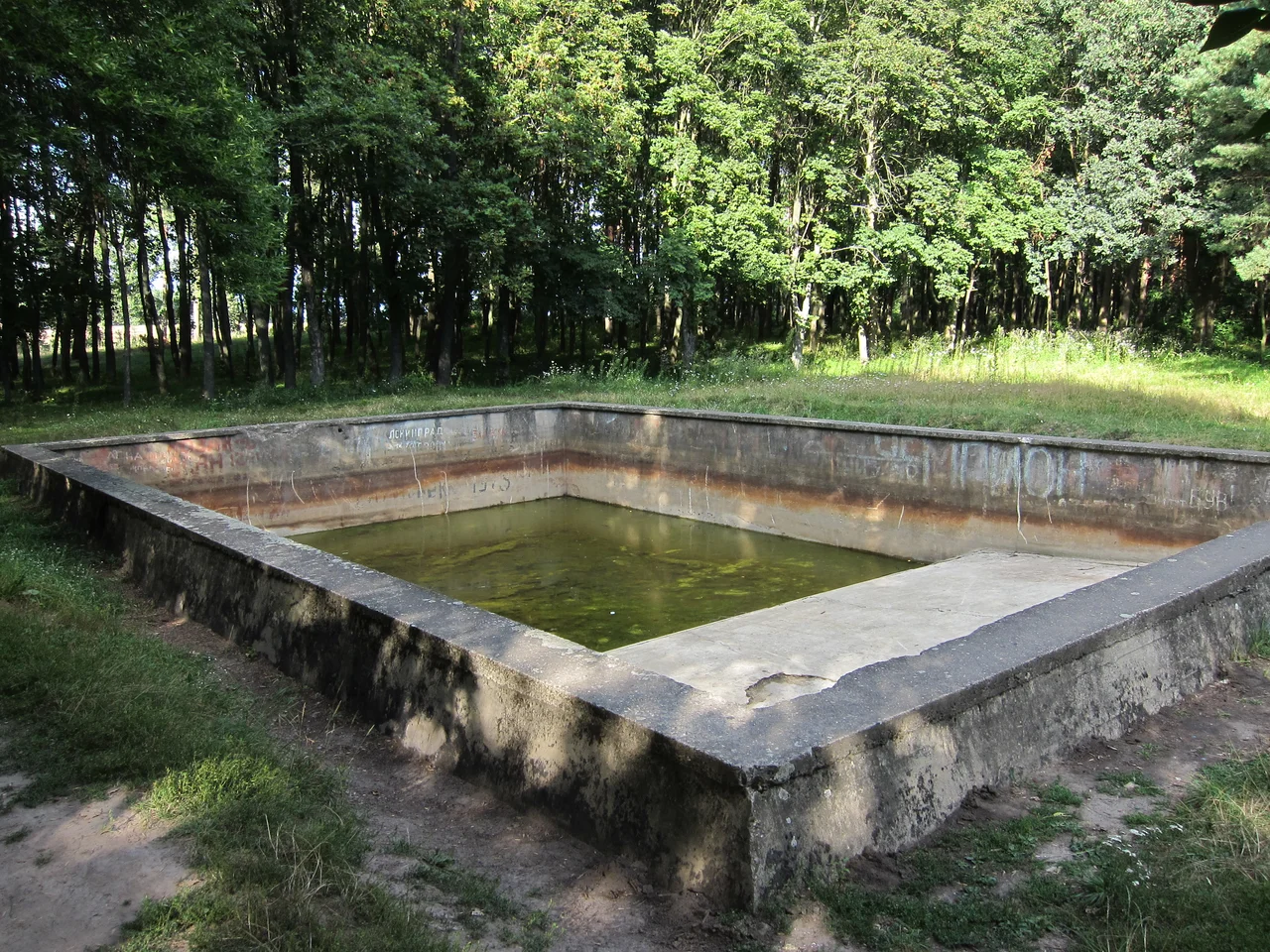
For all the barbed wire, the compound was designed to be livable, even pleasant, for its intended occupant. Hitler's own quarters, the Führerhaus, were a modest log cabin arranged around a private courtyard with its own concrete bunker. Around it stood about twenty wooden cottages and barracks and up to three heavy bunkers. There was a tea house, a barber shop, a bathhouse, a sauna, and a cinema. There was even a swimming pool, built primarily for Hitler, who never used it. A large vegetable garden, tended by a German horticultural firm, supplied food that was still tasted for poison before it reached his table, a precaution driven by his fears. Oxygen tanks were kept on hand at his insistence, water drawn from artesian wells, power supplied by a generator. Hitler, who spent most of the Eastern campaign at the Wolf's Lair, stayed at Werwolf three times.
The Weight of the Region
The ruins cannot be separated from what the occupation did to the land around them. According to official figures, more than 200,000 civilians in the region were killed during the Nazi occupation, including some 25,000 in Vinnytsia itself in 1941 and 1942. Around 1,800 psychiatric patients were shot, starved, or poisoned. The regime built eighteen camps for Soviet prisoners of war and established ghettos, labor camps, and prisons for the region's Jewish residents, who were murdered by the occupiers. Tens of thousands of people, many of them young women, were deported to forced labor in Germany. Today the site can be visited, though a full museum has long been slow to materialize. What stands here is not a monument to power but a warning, its concrete deliberately broken, the forest slowly reclaiming the rest.
From the Air
The site lies at roughly 49.31°N, 28.49°E, in a pine forest about 12 km north of Vinnytsia, near Stryzhavka on the Kyiv highway. From about 4,000 feet, look for the dark band of forest breaking the surrounding farmland just north of the city, with the highway threading past. The nearest airport is Vinnytsia/Havryshivka (UKWW).
Nearby Stories
- Berdychiv 36 km away
- Arboretum Oleksandriya 69 km away
- Sofiyivka Park 82 km away
- Bila Tserkva 87 km away
- Uman 119 km away
- Chernivtsi 181 km away
- Chernivtsi University 196 km away
- Olyka Castle 209 km away