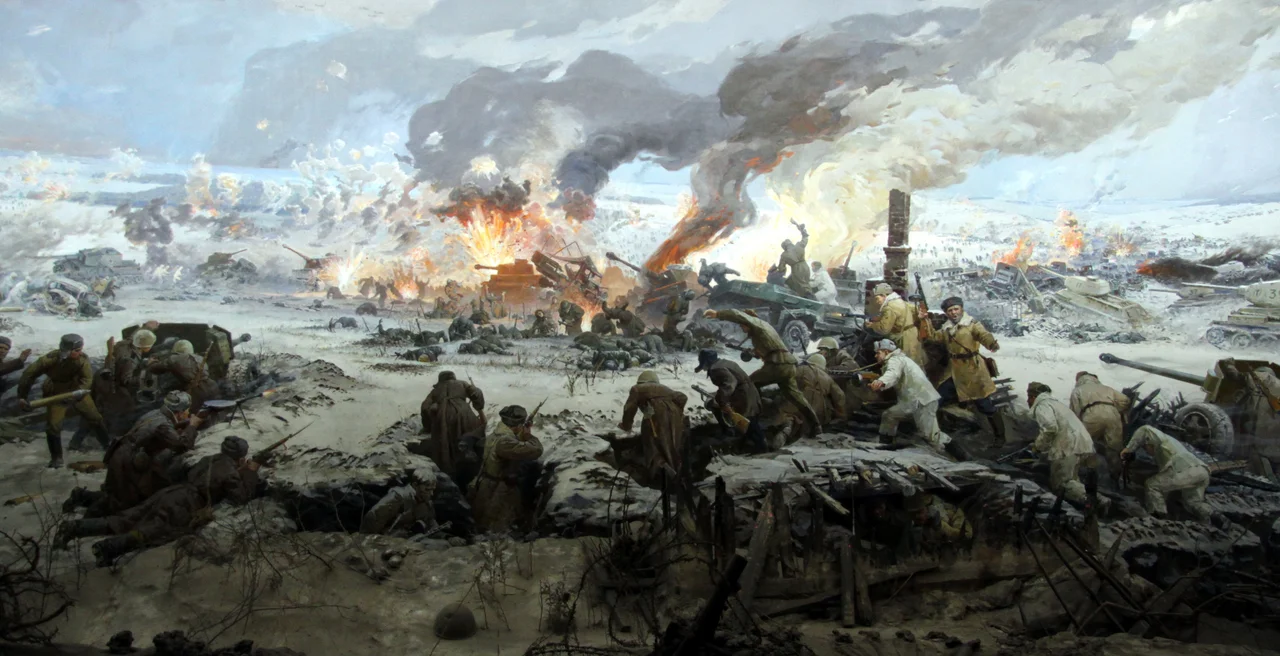

Battle of Korsun-Cherkassy
The soldiers called it the Cauldron. In the last week of January 1944, on the frozen and then thawing farmland west of the Dnieper, two Soviet fronts snapped shut around nearly sixty thousand German troops near the Ukrainian town of Korsun. What followed over three weeks was a battle decided as much by weather and wheels as by tanks and rifles, and it ended in a nightmare retreat across a swollen river that survivors would remember for the rest of their lives. This was the Korsun-Cherkassy Pocket, one of the great encirclements of the Second World War on the Eastern Front.
The Trap Springs
By late 1943 the German front in Ukraine had been driven back to the Dnieper, and a salient bulged westward near Cherkassy, with Korsun near its center. Marshal Zhukov saw in it the chance for a second Stalingrad. On 24 January 1944, the 2nd Ukrainian Front under Ivan Konev struck from the southeast; the next day tanks poured through the breach. From the northwest came Nikolai Vatutin's 1st Ukrainian Front. Within days the two armored spearheads met near Zvenyhorodka, drawing a thin outer ring and a tighter inner one around the German corps. Konev wired his confidence to Stalin: the encircled enemy would not escape. Inside the pocket, six understrength German divisions, placed under General Wilhelm Stemmermann, found themselves cut off with dwindling fuel and food.
Mud, Wheels, and a Failed Rescue
Field Marshal Erich von Manstein moved panzer corps to break the ring, but Hitler's meddling turned a straightforward rescue into a scheme to counter-encircle the Soviets, and the effort faltered. When the tanks finally drove straight for the pocket in February, the thaw defeated them. Roads dissolved into deep mud, and here a quiet advantage told: the Red Army rolled on American lend-lease trucks with four- and six-wheel drive that could claw through the mire, while many German vehicles, built for two-wheel drive, simply bogged down. The German air force flew in supplies by the ton, but never enough to meet the trapped divisions' needs. Day by day the pocket shrank, collapsing toward a cluster of villages and a hamlet called Shanderovka that the soldiers came to know as Hell's Gate.
The Breakout
On the night of 16 February, without waiting for Hitler's word, Manstein signaled the breakout: password Freedom, objective Lysyanka. The trapped men formed columns in the dark and pushed toward the German lines seven kilometers away. Some reached safety before dawn. Then the plan unraveled. A key height, Hill 239, was still held by Soviet tanks, forcing the retreat to veer south toward the Gniloy Tikich, a stream swollen to two meters deep by melting snow. As daylight came, Soviet armor and artillery fell on the intermingled, disorganized columns, and men and horses struggled across the icy water. Stemmermann chose to stay with the rearguard and was killed when a shell struck his command car. Engineers threw up bridges, and thousands did make it across to the German lines, but they left nearly all their heavy weapons behind.
What the Cauldron Cost
Historians still argue over the exact numbers, and both sides shaded them for their own reasons; the Soviets claimed a second Stalingrad, the Germans a heroic rescue. What is clear is the human weight of it. Of the roughly sixty thousand men caught in the ring, many escaped, but close to a third were killed or wounded, and six German divisions were shattered as fighting formations. Soviet losses ran to tens of thousands as well. Amid the fighting, Ukrainian civilians were caught between the armies on the muddy roads of their own home ground. Today Korsun-Shevchenkivskyi keeps a museum to the battle, and the quiet fields and the little river carry no sign of the desperate crossing that once turned them into a place of drowning, fire, and escape.
From the Air
The pocket lay around 49.42 degrees north, 31.28 degrees east, on the farmland west of the Dnieper near Korsun-Shevchenkivskyi in Cherkasy Oblast, central Ukraine. From altitude, follow the winding Ros River and the small watercourse of the Hnylyi Tikych; the town and its battle museum sit on the Ros. The nearest major airfield is Bila Tserkva to the north, with Cherkasy to the east.
Nearby Stories
- Trakhtemyriv 30 km away
- Cherkasy 31 km away
- Bila Tserkva 34 km away
- Kholodnyi Yar 45 km away
- Talianki 46 km away
- Arboretum Oleksandriya 52 km away
- Maidanetske 55 km away
- Kachanivka Palace 141 km away