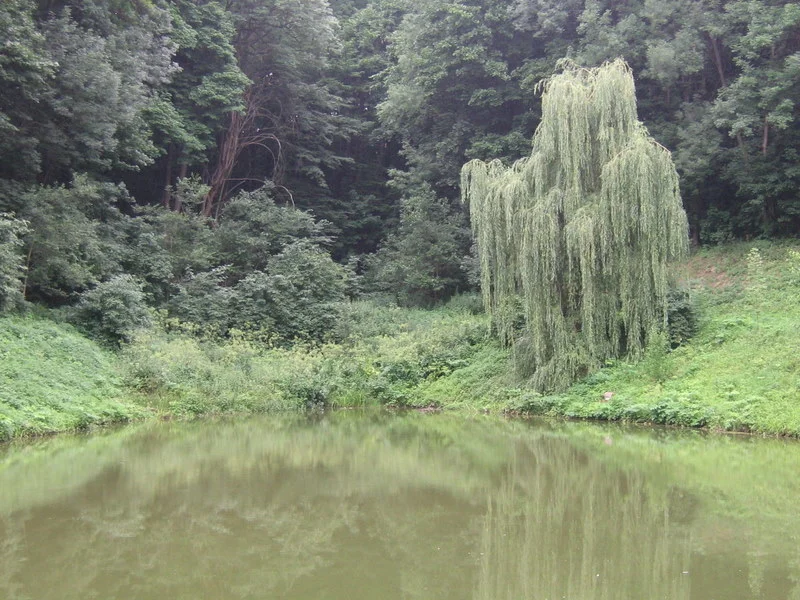

Kholodnyi Yar
The name means Cold Ravine, and the forest earns it - a shadowed tract of old oaks where five gullies converge and the air holds a chill the surrounding steppe never knows. For most of history, ordinary people avoided this place. The Wild Fields pressed too close, and nomad raids made settlement a gamble few would take. So the ravines stayed wild, and into that wildness people ran when they had nowhere else to go. Kholodnyi Yar has been a refuge for the desperate, a base for rebels, and, beneath its leaf litter, a library of the deep past that has no equal in Ukraine.
A Forest Full of Time
Kholodnyi Yar ranks first in all of Ukraine for the sheer density of its archaeological, historical, and scientific treasures - more than 150 catalogued sites scattered through the woods and the fields around them. Burial mounds from the Scythian era and later rise among the trees. Archaeologists have traced nearly every culture the region ever held, back to the Trypillian farmers who worked this forest-steppe some five to six thousand years ago, in the millennia before the common era. The tract covers 6,804 hectares, and oak dominates it - roughly four-fifths of the wooded area. Around 150 species of herbaceous plants grow beneath the canopy, several of them rare enough to appear in Ukraine's Red Book of protected life.
The Haidamak Refuge
The first written mention of Kholodnyi Yar comes from chroniclers describing battles fought here in the 1360s, when soldiers of Lithuania and the old Rus' lands clashed with the Horde near the waters they called the Blue Water. For centuries afterward, only fortified towns and well-walled monasteries survived in this dangerous belt between Kaniv, Cherkasy, and the Dnieper rapids. The forest itself became something else: a hiding place that turned into a headquarters. In the 1730s a Sich - a Cossack encampment - was organized within Kholodnyi Yar, and for decades the woods served as the principal base of the Haidamaks, the bands of rebels who rose again and again against the landowners and powers that ruled these lands.
The Republic Under the Oaks
The forest's long habit of sheltering resistance reached its most remarkable moment in the aftermath of the First World War. Between 1919 and 1922, amid the chaos that followed the collapse of empires, Kholodnyi Yar became the seat of a self-proclaimed state - the Kholodny Yar Republic, a partisan movement that governed and fought from within the trees. It was a small thing measured against the great armies wheeling across the continent, and it did not last. But it drew on something the ravines had held for centuries: the conviction that this particular forest was a place where people could refuse to be ruled, and that the woods themselves would keep their secret.
A Living Monument
The forest is protected now, and formally cherished. As early as 1968 a large stand was designated a natural monument of national significance, and on the first day of 2022 the whole tract became the Kholodnyi Yar National Nature Park. To walk here is to move through layers that refuse to separate - the mounds of vanished peoples, the trails of rebels, the quiet of a working forest. The chill that gave the ravine its name still settles among the oaks. So does the sense, hard to shake, that this ground remembers more than it shows, and that its long history of shelter is not yet finished.
From the Air
Kholodnyi Yar lies at 49.134N, 32.239E in Cherkasy Oblast, central Ukraine, west of the Dnieper. From 2,500 to 4,000 feet the tract reads as a dense, dark block of oak forest cut by ravines, sharply bounded by the paler farmland around it; the city of Cherkasy sits to the northeast. The nearest airport is Cherkasy (UKKE).
Nearby Stories
- Cherkasy 9.6 km away
- Melgunov Kurgan 22 km away
- Korsun-Shevchenkivskyi 26 km away
- Battle of Kurukov Lake (1625) 41 km away
- Battle of Korsun-Cherkassy 42 km away
- Battle of Blue Waters 67 km away
- Battle of Zhovti Vody 80 km away
- Velyki Sorochyntsi 114 km away