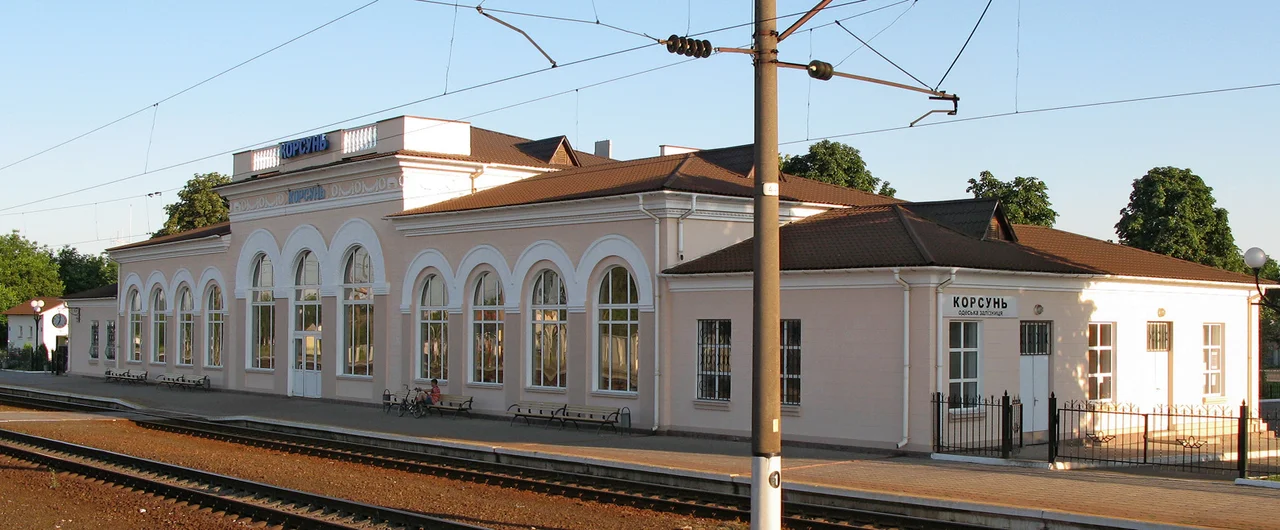

Korsun-Shevchenkivskyi
The Ros River does something unusual at Korsun-Shevchenkivskyi: it breaks over granite. Islands of pink stone split the current into channels, and on those rocks stands a town that has watched a thousand years of Ukrainian history flow past. Founded as a frontier fortress in 1032 to shield Kyiv from the horsemen of the steppe, Korsun has been a Rus stronghold, a Cossack battleground, a nobleman's paradise garden, and the setting for one of the fiercest encirclements of the Second World War. Few small towns carry so much on so pretty a stretch of water.
A Guard on the Steppe
The fortress came first, raised in 1032 by the great Kyivan Rus prince Yaroslav the Wise as a shield against nomads riding up from the southern grasslands. The town's name reaches even further afield: Korsun is the old Slavic form of Chersonesos, the ancient Greek city on the far-off Crimean Peninsula, a name that traveled north and settled here on the Ros. Korsun appears in the written record by 1169, already old when most of Europe's cities were young. For centuries it stood where the settled world met the open steppe, a border post on a river that marked the edge of safety, its walls facing the horizon from which danger always came.
Where Armies Met
That frontier position made Korsun a place armies could not ignore, and twice the town gave its name to a battle. In May 1648, during the Khmelnytsky Uprising, Bohdan Khmelnytsky's Cossacks and their Crimean Tatar allies lured a retreating Polish-Lithuanian army into a wooded ravine nearby and destroyed it, capturing both of the Commonwealth's commanding Hetmans. Nearly three centuries later, in the winter of 1944, the same countryside became the Korsun-Cherkassy Pocket, where two Soviet fronts encircled tens of thousands of German troops and a desperate breakout unfolded across the fields and rivers. The town remembers this second battle in a dedicated museum, holding the memory of soldiers and civilians caught in a struggle that swept over their homes.
A Palace on the Rocks
Between and beyond its wars, Korsun grew something gentler. In 1782 a grand palace and landscape park rose on the granite islands of the Ros, later held by the Lopukhin and Demydov families and long considered among the finest Romantic-style gardens in Ukraine. Paths wind among the pink boulders and over the river channels; in the mid-nineteenth century the grounds were enriched with sculptures and small pedestrian bridges arching from rock to rock. The palace now houses a museum, one of several in town alongside the historical and military collections. To walk the park is to see why generations chose this rocky bend of the river as a place of beauty rather than only of defense.
The Poet's Name
For most of its history the town was simply Korsun. Then, in 1944, it took a second name in honor of Taras Shevchenko, Ukraine's national poet, whose homeland lies in this part of the Dnieper country, and became Korsun-Shevchenkivskyi. Today it is a working town on the Kyiv rail line, with factories turning out machinery, building materials, textiles, and wine, and a population that lives among the granite and the greenery. It has given the country actors and composers, including the choreographer Vasyl Avramenko and the composer Kyrylo Stetsenko. Ancient fortress, twice-fought battlefield, and riverside garden all at once, Korsun-Shevchenkivskyi wears its long history lightly on the rocks of the Ros.
From the Air
Korsun-Shevchenkivskyi sits at about 49.43 degrees north, 31.28 degrees east, on the Ros River in Cherkasy Oblast, central Ukraine. From altitude, the clearest marker is the Ros itself breaking over rocky islands through the town, with the wooded palace park along its banks. The nearest major airfield is Bila Tserkva to the north, with Cherkasy to the east.
Nearby Stories
- Trakhtemyriv 30 km away
- Cherkasy 31 km away
- Bila Tserkva 34 km away
- Kholodnyi Yar 45 km away
- Talianki 46 km away
- Arboretum Oleksandriya 52 km away
- Maidanetske 55 km away
- Kachanivka Palace 141 km away