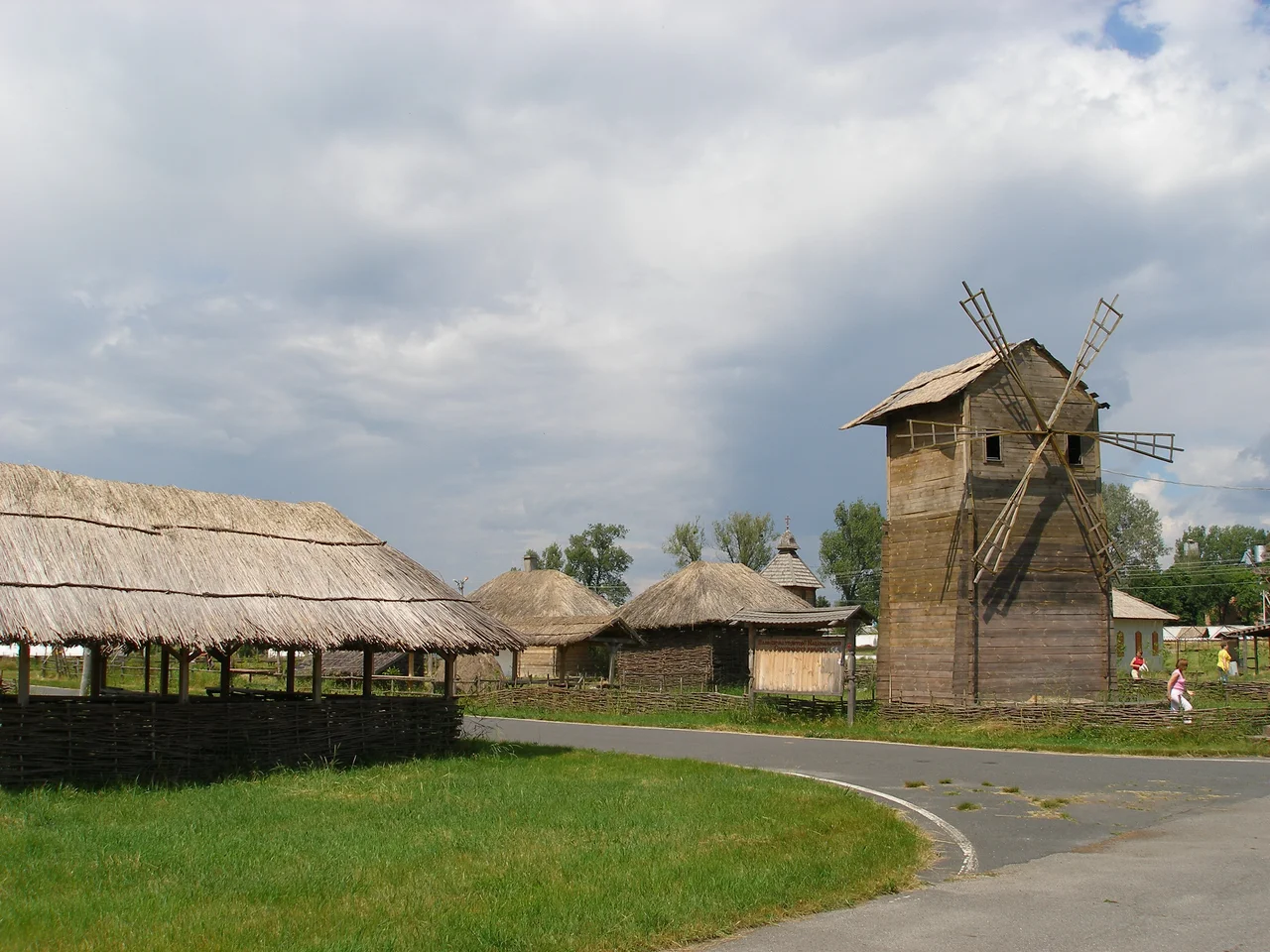

Velyki Sorochyntsi
Once a year, a small village in the Poltava countryside becomes one of the liveliest places in Ukraine. The Sorochyntsi Fair, held in Velyki Sorochyntsi since the middle of the eighteenth century, fills the streets with embroidered linens, hand-thrown pottery, woven rugs, and actors who reenact scenes from old Ukrainian stories. That the fair is famous at all owes everything to a boy born here in 1809: Nikolai Gogol, whose short story The Fair at Sorochyntsi turned a provincial market day into a scene the whole literary world could picture. The village even carries a hint of magic in its name, drawn either from soroka, the Slavic word for magpie, or sorochka, a shirt, and local legend spins tales of a Magpie's kingdom and a magical garment to explain it.
The Hetman's Village
Sorochyntsi first appears in the records of the 1620s as a sloboda, a frontier settlement, and in 1646 it passed to a Polish prince of the powerful Wiśniowiecki family. By the turn of the eighteenth century it had become the seat of a Cossack district government, and its most consequential son was already shaping its future. Danylo Apostol, born here and destined to become Hetman of the Zaporizhian Host, founded the Sorochyntsi St Michael's Monastery in 1670. Decades later, in 1732, he built the Church of the Transfiguration in the Ukrainian Baroque style, and was buried there two years afterward. That same church would witness another beginning nearly eighty years on, when the infant Gogol was brought to its font to be baptized.
A Market Made Immortal
The Sorochyntsi Fair grew into an institution. Under the Russian Empire it convened five times a year, a great regional gathering of trade and spectacle. Soviet rule imposed a forty-year silence on it, but the fair was revived and now runs annually, and since a 1999 presidential decree it holds the status of a national trade fair. It remains a showcase for the crafts of the region: the intricate white-on-white embroidery of nearby Reshetylivka, the ceramics of Opishnia, woven rugs, and the theatrical performers who bring Gogol's own scenes back to life among the stalls. To walk it is to step, for a day, into the world Gogol described, where every transaction carries a whiff of comedy and the crowd itself is half the show.
The Writer and His Monuments
The village has never let go of its most famous native. On August 23, 1911, a monument to Gogol by the sculptor Ilya Ginzburg was unveiled here, and a Gogol Memorial Museum keeps his memory close. The recognition reached national scale in 1983, when the Soviet Union issued a postage stamp depicting both the monument and the museum. Gogol is not the only writer the village claims; the poet Volodymyr Samiylenko was also born here. And in 1845 the great Ukrainian poet Taras Shevchenko passed through on behalf of an archaeological commission surveying the history and architecture of the Poltava region, an errand commemorated by a street that has borne his name here for well over half a century.
A Name That Changed and Changed Back
History left its marks on the village's identity as well as its buildings. From 1925 to 1931 it was renamed Neronovychi, after Yevhen Neronovych, a revolutionary figure who had been executed in the town amid the chaos of 1918, a grim episode from the years when the region changed hands repeatedly. The old name returned, and Velyki Sorochyntsi, once granted town status and later reclassified as a village, settled back into being what it fundamentally is: a small rural community of a few thousand people, its population around 3,809 by 2013. Yet for one crowded, colorful week each year, the fair Gogol immortalized proves that a village's fame need not depend on its size.
From the Air
Velyki Sorochyntsi sits at about 50.03°N, 33.95°E in the Myrhorod district of Poltava Oblast, on gently rolling farmland. From 3,000 to 6,000 feet the domed Baroque Church of the Transfiguration and the clustered village core are the clearest landmarks against surrounding fields and river meadows. The nearest airfield of note is Myrhorod, with Poltava International Airport (UKHP) farther south-east.
Nearby Stories
- Hadiach 12 km away
- Poltava Museum of Long-Range and Strategic Aviation 15 km away
- Gelonus 16 km away
- Okhtyrka 32 km away
- Poltava 48 km away
- Battle of Kurukov Lake (1625) 73 km away
- Kachanivka Palace 82 km away
- Cherkasy 115 km away