
Hadiach
On a quiet bend of the Psel River, pilgrims arrive at an old cemetery to stand before a single grave. It belongs to Shneur Zalman of Liadi, the founder of Chabad Hasidism, and his resting place has made this modest Ukrainian city one of the important stops for Hasidic Jews traveling through the country. Hadiach wears its history lightly, but that history runs deep: granted city rights in 1634, it has belonged in turn to a Polish voivodeship, the Cossack Hetmanate, and a Russian governorate, and it once lent its name to a treaty that dreamed of redrawing the map of Eastern Europe. Few towns of its size have been present at so many hinge points.
Seat of Hetmans
Hadiach came into its own during the age of the Cossack Hetmanate, when it served as a seat of power. It was the residence of Hetman Ivan Briukhovetsky, whose contested election helped split the Hetmanate along the Dnieper River during the long, ruinous period Ukrainians call the Ruin. In 1661 the Sejm of the Polish-Lithuanian Commonwealth granted the town to Yurii Khmelnytsky, son of the great hetman Bohdan. To hold Hadiach in those decades was to hold a piece of a land pulled between Warsaw, Moscow, and the Cossacks' own ambitions, a strategic prize in a region where borders and loyalties shifted from year to year. The city fielded its own Cossack regiment, one of the military-administrative units through which the Hetmanate governed itself, and its position on the Psel made it a natural strongpoint in the constant maneuvering of the age.
The Treaty That Might Have Been
The city's largest place in history was fixed in September 1658, when the Treaty of Hadiach was signed within it. The agreement proposed something remarkable: to transform the Polish-Lithuanian Commonwealth into a commonwealth of three nations by adding a Grand Principality of Ruthenia, giving the Cossacks and Ruthenians a standing equal to Poles and Lithuanians. Historians have called it one of the great what-ifs of Eastern European history, a road not taken that might have created a Ukrainian state centuries before one appeared. It was ratified in amended form, but its boldest vision collapsed amid Cossack divisions and Russian arms. The name of this small city on the Psel is bound forever to that lost possibility.
A City of Thinkers and Writers
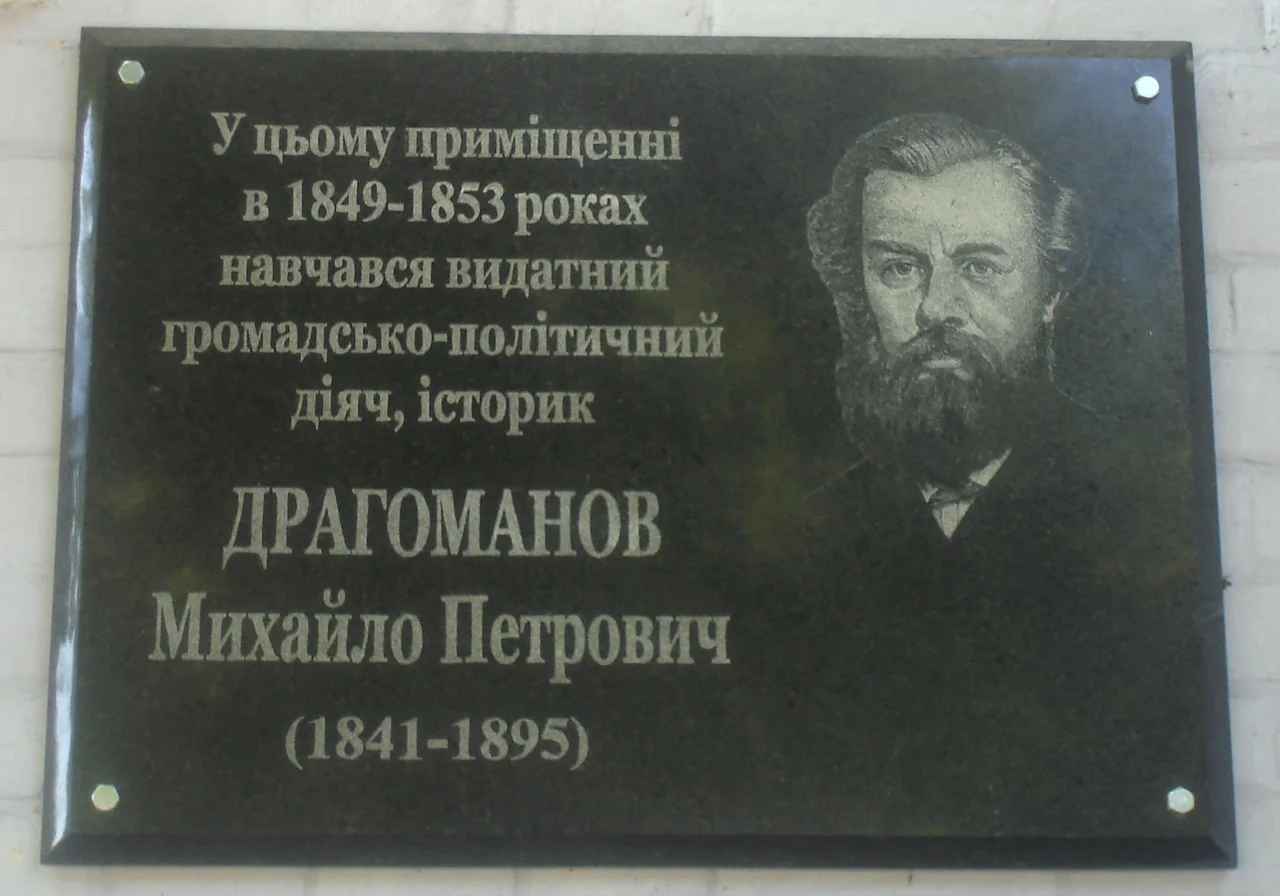
Hadiach has given Ukraine minds as well as battles. It was the birthplace of Mykhailo Drahomanov, the nineteenth-century political theorist, historian, and ethnographer whose ideas shaped Ukrainian intellectual life, and of his sister Olena Pchilka, herself a writer and the mother of the celebrated poet Lesya Ukrainka. Literature touched the city in other ways too: Nikolai Gogol set his comic tale of Ivan Fyodorovich Shponka and his aunt among characters from Hadiach, weaving the town into the same Poltava-region world that fills so much of his early work. For a provincial city, it has kept unusually distinguished company in the pages of books.
The Weight of the Wars
The modern centuries brought harder chapters. During the Second World War, in the late summer of 1943, the German occupiers ran a transit prisoner-of-war camp, Dulag 124, in the town, one of countless such camps that scarred occupied Ukraine and cost many lives. More recently, during the Russian invasion that began in 2022, the fighting reached the area, with skirmishes reported near the city and a Russian tank said to have been spotted in the Psel itself. Through it all, Hadiach endures on its riverbank, a place where a Hasidic grave, a Cossack treaty, and the memory of great writers coexist, holding a great deal of the past in a small footprint of land.
From the Air
Hadiach lies at about 50.37°N, 34.00°E on the Psel River in the north of Poltava Oblast. From 3,000 to 6,000 feet the winding, tree-lined Psel and the compact riverside town are the main visual references against the surrounding plain. Poltava International Airport (UKHP) is the nearest major field, well to the south.
Nearby Stories
- Velyki Sorochyntsi 8.2 km away
- Gelonus 13 km away
- Lebedyn 25 km away
- Sumy 40 km away
- Kachanivka Palace 57 km away
- Konotop 85 km away
- Battle of Konotop 97 km away
- Battle of Kurukov Lake (1625) 111 km away