
Battle of Konotop
The decade after the death of Bohdan Khmelnytsky in 1657 has a name in Ukrainian history: the Ruin. It was an apt one. The hetmanate Khmelnytsky had wrested out of Polish rule was now caught between Moscow, Warsaw, the Crimean Khanate, and its own divided Cossack elite, and every faction was willing to invite a foreign army to settle a domestic quarrel. On 29 June 1659, near the small fortress town of Konotop in what is now northeastern Ukraine, the Cossack hetman Ivan Vyhovsky and the Crimean Khan Mehmed IV Giray sprang a trap on a Russian cavalry force under Prince Semyon Pozharsky. What happened on the field was a tactical victory. What happened to the prisoners afterward was something else, and it remains one of the most painful episodes in the long, tangled story of the eastern steppe.
A treaty no one liked
Vyhovsky had inherited an impossible job. As Khmelnytsky's chancellor and successor, he was supposed to protect Cossack autonomy from Moscow's tightening grip - and from rival hetmans whom Moscow was openly funding to undermine him. In September 1658 he signed the Treaty of Hadiach with the Polish-Lithuanian Commonwealth, which would have made the central Ukrainian voivodeships of Kyiv, Bratslav, and Podolia an equal third partner in a reconstituted Polish-Lithuanian-Ruthenian Commonwealth, under the name Grand Principality of Rus. The Polish Sejm ratified the treaty in a watered-down version that left out most of what had made it attractive to the Cossacks. Moscow declared open war. In the spring of 1659 a Russian army marched south to crush Vyhovsky and install a more compliant hetman.
Seventy days at the walls
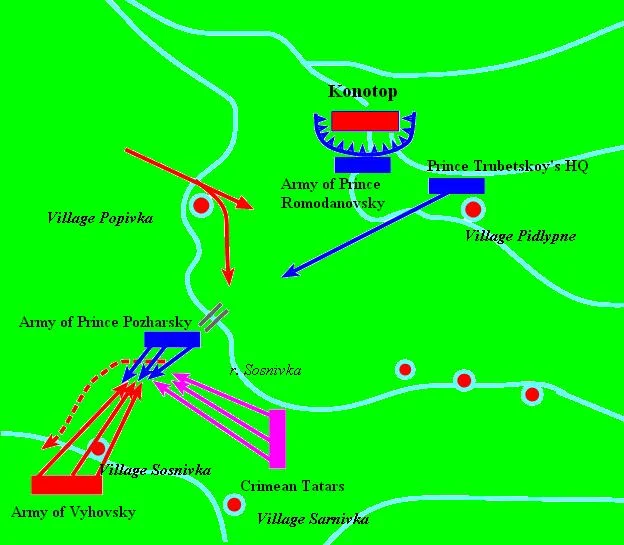
Hryhoriy Hulyanytsky, the Cossack colonel of Nizhyn, held Konotop with a garrison of about four thousand men. Prince Aleksey Trubetskoy, commanding the Russian expedition, expected to take the place in days. Instead the siege dragged on for seventy. Trubetskoy's first assault on 21 April was repulsed at heavy cost - around four hundred Russian dead and three thousand wounded - and his subsequent attempts to fill in the moat were undone every night by the defenders, who used the dirt to thicken their own walls. The garrison even sortied out to harass the besieging camp. Trubetskoy was forced to move his headquarters ten kilometers back, splitting his force. Every day Konotop held was a day Vyhovsky used to bring up his allies.
The trap at Sosnivka
By late June, Vyhovsky had concentrated his Cossack regiments alongside thirty thousand Crimean Tatar horsemen under Khan Mehmed IV Giray and a four-thousand-man Polish detachment with Serbian, Moldavian, and German mercenaries. The plan was simple and old. On 28 June, the hetman's brother-in-law and a small Cossack detachment lured Pozharsky's Russian cavalry south of the Sosnivka River, away from Trubetskoy's main camp. The Tatars waited in ambush. When Pozharsky's horsemen crossed and engaged, the Khan's wings closed behind them. The Russian cavalry, caught against the river, was destroyed. Pozharsky himself was captured, brought before the Khan, and according to the Tatar chronicler killed on the spot for an insult. Modern Russian archival research, drawn from the Ambassadors' Chancellery records that the Tsar himself reviewed, lists the Russian dead at 4,769 men - 2,830 across the Sosnivka, plus 1,896 in the parallel attack on Trubetskoy's wagon fort. Older Polish and Ukrainian narrative sources gave figures up to ten times larger; Western and Russian historians regard those numbers as inflated.
What followed, and what should be remembered
After the battle the Tatars took their prisoners and, by the accounts of multiple sources, killed several thousand of them - some sold into slavery, some executed outright. It was an atrocity by the standards of any century, and it was not committed in the heat of fighting but in cold deliberation, days later. Even contemporaries who hated the Russians found it hard to defend. The political result was equally bitter for Vyhovsky himself. The Khan was called home to deal with a Zaporozhian Cossack raid on the Crimea. City after city in the hetmanate revolted against Vyhovsky's pro-Polish line. Within months he was forced to resign and flee to Poland. The Cossack chronicler S. Makhun called it "a bitter victory - one that did not have any significant impact on the course of Ukrainian history." That assessment is too harsh; what Konotop did was demonstrate, with terrible clarity, that the Cossack project of an independent Ukraine could not succeed by playing Moscow against Warsaw against Bakhchysarai. The Ruin would grind on for another generation. The poets and the kobzars - the blind itinerant musicians of Ukraine - would carry songs of Konotop down the centuries. The bandurist Hryhory Kytasty composed a choral work about the battle in 1966 in exile. The fields outside Konotop are quiet farmland now.
From the Air
The battlefield lies at 51.22 N, 33.16 E in Sumy Oblast of northeastern Ukraine, in the wide black-earth steppe just south of the Russian border. From altitude in clear weather, the Sosnivka and the Seim river systems trace silver lines across the flat agricultural land, with Konotop town visible as a compact grid. Nearest international airport is UKKK Kyiv-Boryspil, about 200 km west; UKHH Kharkiv lies 200 km southeast. The region's airspace has been heavily affected by the war that began in 2022.
Nearby Stories
- Kachanivka Palace 16 km away
- Hlukhiv 22 km away
- Mezine 36 km away
- Kruty Heroes Memorial 41 km away
- Glinsk Hermitage 46 km away
- Lebedyn 68 km away
- Sedniv 80 km away
- Treaty of Hadiach 87 km away