
Mezine
Fifteen thousand years ago, the people who camped on this bend of the Desna River lived in houses built from mammoths. Their walls were curving tusks and stacked skulls, their frames great bones lashed and roofed with hide, raised on the cold loess plains north of the Black Sea. When archaeologists first uncovered the village near the small Ukrainian settlement of Mezine, they found not just these astonishing shelters but something rarer: art that seems to reach across the millennia and touch the very beginnings of human symbol-making. Among the finds was a small bird carved from mammoth ivory, and etched onto it, the earliest known example of the meander, the endless interlocking key pattern that would ornament civilizations for thousands of years to come.
Houses Made of Mammoths
The Mezine site, discovered in 1908 in the Desna valley, belongs to the Epigravettian, the late Ice Age culture of the eastern European steppe. Here the mammoth was everything. In an open landscape with little timber, its enormous bones became architecture: at the shelter now catalogued as Mezin 22, archaeologists found a dwelling constructed from mammoth bones and skin, a house engineered entirely from the animal that also provided food, fuel, and raw material. These were the homes of mobile hunters at the edge of the retreating ice, and they testify to a people who read their harsh world with precision and turned its largest creature into shelter. Mezine has yielded more Paleolithic artifacts than any other site in Ukraine, a density of finds that has made it a touchstone for understanding life on the mammoth steppe.
The Oldest Meander
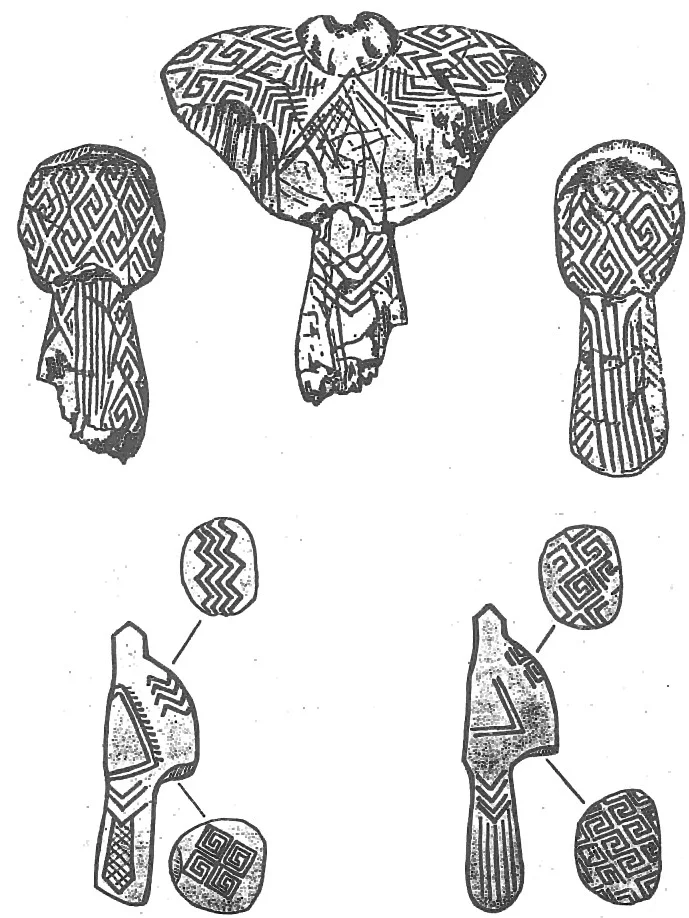
It is the art that makes Mezine unforgettable. The site's most celebrated object is a figure carved from mammoth tusk in the form of a bird, decorated with a geometric meander pattern that the scholar Marija Gimbutas identified as the earliest known example of that motif, dated to around 10,000 BCE. The meander, that unbroken running spiral of right angles, is one of the deepest ornamental patterns in human culture, and here it appears already fully formed. Alongside it, archaeologists found a set of engraved bracelets whose careful marks may record the cycles of the moon, an attempt, perhaps, to reckon time itself. The choice of a bird was likely no accident. In the belief systems of hunting peoples the bird is a spirit creature, a symbol of the soul and of flight beyond death.
A Window into the Deep Past
Mezine caught the imagination of thinkers far beyond archaeology. The mythologist Joseph Campbell, surveying these mammoth-hunting stations on the plains between the Dnieper and the Don, sensed a world profoundly different from that of the painted caves of western Europe. The cave painters worked in flowing, impressionistic images; the artists of the eastern steppe worked in stern geometry. Where the caves gave pride of place to the masked shaman, Campbell saw here the recurring figure of the fertile female standing guardian of the hearth, surrounded by motifs, the meander, the bird, the fish, that would echo down into the mythologies of much later ages. Today the Mezine bird is famous enough to have appeared on a Ukrainian coin, a fragment of Ice Age imagination minted into the currency of a modern nation.
From the Air
The Mezine site lies at 51.82°N, 33.07°E on the bank of the Desna River in Novhorod-Siverskyi Raion, northern Chernihiv Oblast. From about 2,500 to 3,000 feet, look for the wooded river terraces and the meandering Desna itself cutting through farmland; the village of Mezine is small and easily overflown. The nearest sizable airfields are in the Chernihiv area to the southwest, with Kyiv's Boryspil (UKBB) the closest major airport.
Nearby Stories
- Siege of Hlukhiv 15 km away
- Baturyn Fortress Citadel 29 km away
- Principality of Chernigov 48 km away
- Sedniv 79 km away
- Sumy 99 km away
- Battle of Lesnaya 206 km away
- Mogilev Ghetto 264 km away
- Grace Darling 461 km away