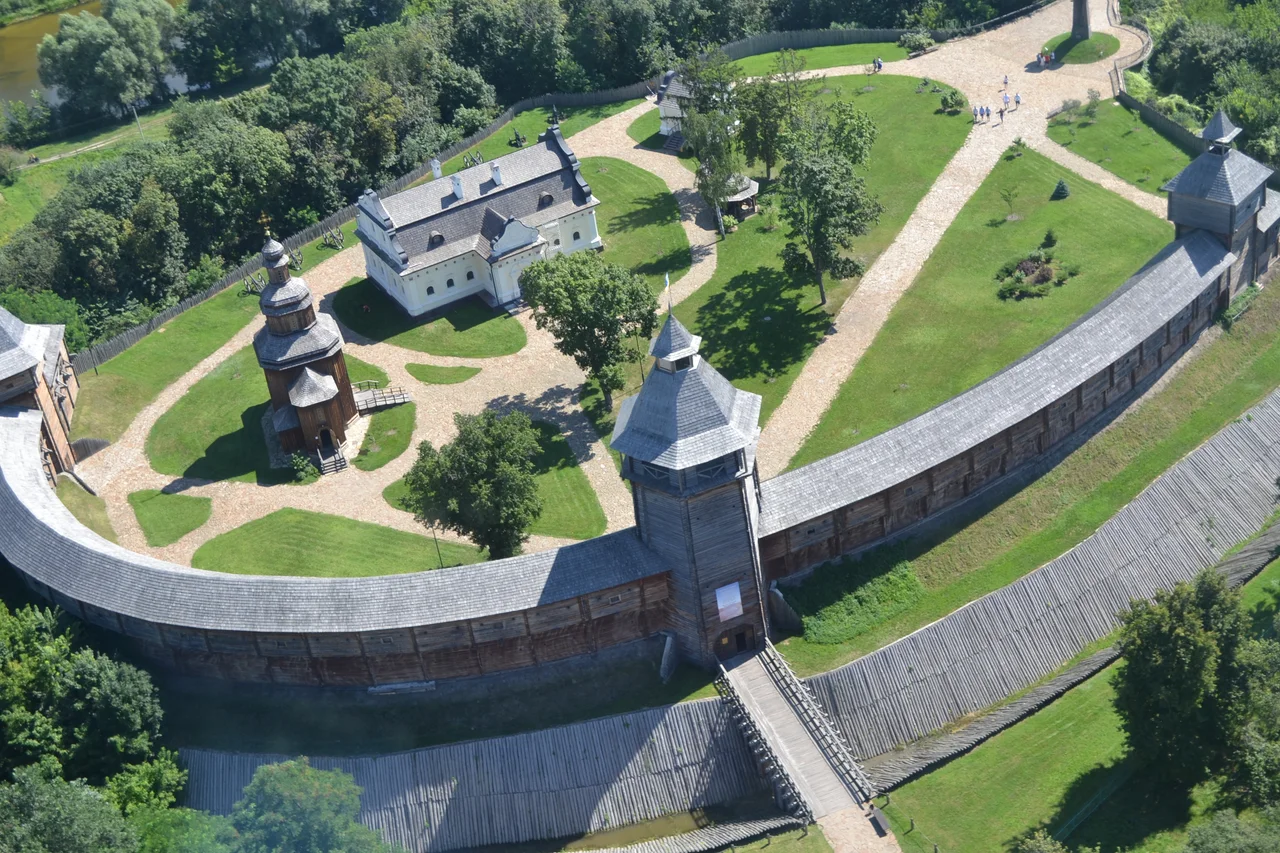

Baturyn Fortress Citadel
During the excavations, they found her in a burial: a woman with a split skull, killed in the storming of the fortress, and beside her an icon of the Mother of God with the Infant. That icon now forms part of a memorial at Baturyn, its image lifted from a grave. This is the Citadel of the Baturyn Fortress, rebuilt on the Seim River in northern Ukraine, and it stands over one of the darkest days in the country's history - the destruction of the Cossack capital in 1708, a truth kept silent for almost three centuries and only spoken aloud in our own time.
The Hetmans' Stronghold
The citadel was the fortified heart of Baturyn, the city that served as the capital of Ukraine's Cossack hetmans in the 17th and 18th centuries. First raised in the early 1600s as a Polish outpost, it became from 1669 to 1708 the official residence of a line of hetmans - Demian Mnohohrishny, Ivan Samoilovych, and most famously Ivan Mazepa. From behind its walls and towers the leaders of the Cossack Hetmanate governed the autonomous republic of Left-Bank Ukraine. It was a seat of real power, a working capital with a garrison and cannon, until the autumn of 1708, when a single fateful decision brought the full weight of an empire down upon it.
November 1708
The chain of events reached back to 1700, when the Great Northern War set a Muscovite-led coalition against the Swedish Empire, and the Cossacks were made to fight the tsar's war on every front, bleeding men and treasure. In the autumn of 1708 Hetman Ivan Mazepa made his choice: he allied with the Swedish king Charles XII. Tsar Peter I answered by ordering the capital destroyed. He sent Alexander Menshikov to take Baturyn, and at first the twenty-thousand-strong army could not storm the fortified city. Only after a secret way in was betrayed did the attackers overwhelm the defenders. Historians estimate that between thirteen and fifteen thousand people were killed - soldiers, yes, but mostly civilians, women and children among them. The victors looted what they could carry, then burned Baturyn and the villages around it to the ground.
The Silence, and the Cross
The main fighting, archaeology has shown, raged inside the citadel and the fortress walls - and for almost three centuries, what happened there went deliberately unspoken. Only with Ukraine's independence did it become possible to speak and write openly about the tragedy. Excavations began in 1996, and in 2008, on the initiative of President Viktor Yushchenko, the citadel was rebuilt in situ - the only open-air archaeological park of its kind in Ukraine. Its towers and walls do not claim to be the originals; they offer a generalized image of the Baturyn castle as it stood in the early 18th century. At the centre rises an eleven-metre cross of dark granite, raised in 2004 to the thousands who died, bearing a bronze crucifix - a symbol, its makers said, of a Baturyn crucified and resurrected. Here the fortress remembers not a battle so much as the people it could not save.
From the Air
The citadel stands at 51.3427 N, 32.8868 E on the high bank of the Seim River in Baturyn, Chernihiv Oblast. From 2,000 to 3,500 feet, look for the reconstructed timber towers and earthwork ramparts on the bluff above the river, with the tall granite memorial cross nearby. Nearest major airport is Kyiv Boryspil (UKBB) well to the west; Chernihiv Shestovytsia (UKRR) lies to the northwest.
Nearby Stories
- Kruty Heroes Memorial 15 km away
- Mezine 20 km away
- Principality of Chernigov 26 km away
- Siege of Hlukhiv 36 km away
- Kachanivka Palace 38 km away
- Hlukhiv 46 km away
- Battle of Listven 59 km away
- Treaty of Hadiach 97 km away