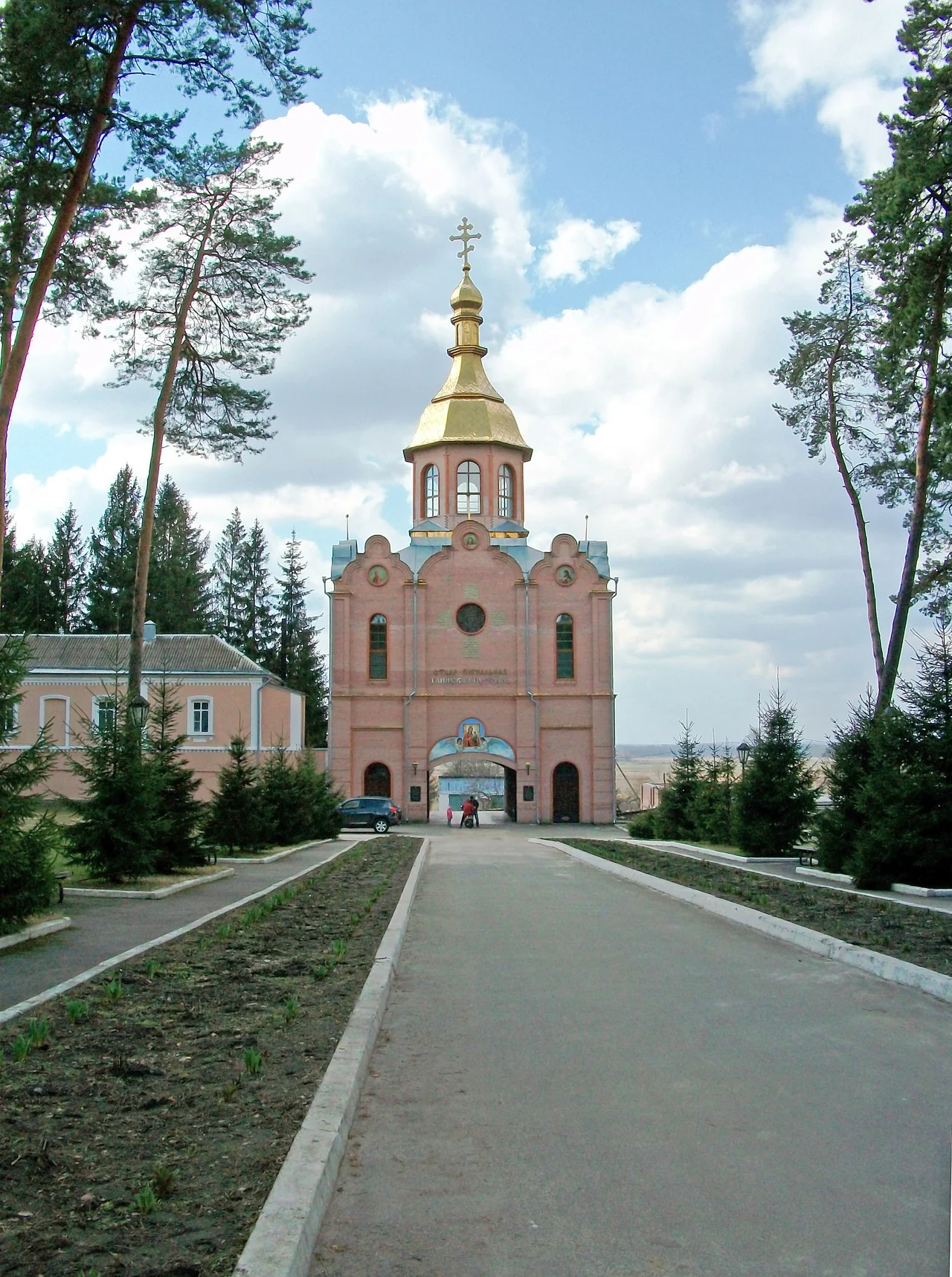

Glinsk Hermitage
The story begins, as the monks tell it, with beekeepers in a thicket of pines. Working the woods near Putivl sometime in the seventeenth century, they looked up and found an icon of the Nativity of the Theotokos resting high in a tall pine tree. Word spread, pilgrims came, and monks from a monastery in Putivl settled at the spot and founded a hermitage there in 1648. The thicket had long been dug for potters' clay, and so the place took an earthy nickname that stuck: the Glinsk Hermitage, from the Slavic word for clay. From a single icon in a tree grew one of the most revered spiritual centers of the Russian Orthodox world.
Tsars, Elders, and a Wide Reputation
The hermitage did not stay obscure for long. By the late seventeenth century its existence was confirmed by formal decrees, when Patriarch Joachim and the co-tsars Peter the Great and Ivan V affirmed the monks' right to live there. In 1764 it became fully independent, and its rule of monastic life grew so admired that fourteen other monasteries across Imperial Russia imitated it in whole or in part. Glinsk became known above all for its elders, its startsy, spiritual guides to whom pilgrims travelled for counsel much as they did to the famous Optina Monastery, with which Glinsk kept a close bond. From its brotherhood came missionaries who carried Orthodoxy far afield, among them Makarii Glukharev, who in the early nineteenth century became the great transmitter of the faith to the peoples of the Altai.
Beets Instead of Bread
The twentieth century fell hard on the hermitage. After the Russian Revolution, the new government moved to erase religion, and the local Soviet closed the monastery in September 1922. The Glinsk icon of the Nativity was carried to a nearby village and there vanished without a trace, never recovered. Monks were killed or imprisoned; seven of the eight churches were pulled down, and the one that remained was turned into a club. The grounds became by turns a playground, a collective farm, and an industrial works. And yet the monastic life flickered back. From 1942 to 1961 the hermitage reopened and quietly revived, though the monks lived without electricity or plumbing and, in the leanest stretches, subsisted on beets when they had no bread. Pilgrims still came to pray and to help rebuild, until a renewed campaign against the faith under Nikita Khrushchev closed the monastery once more in 1961.
A Return, and New Saints
Only with the reforms of the late Soviet years and the collapse of the state that had tried to suppress it did the hermitage rise again. It reopened in 1994, and in 1996 regained its stavropegial standing, a special direct status within the church hierarchy. The most remarkable chapter of its revival, though, has been the recognition of its own dead. Many of the elders who had made Glinsk famous for spiritual depth were formally canonized as saints in the twenty-first century. In May 2008 thirteen of them, including Abbot Philaret, were glorified together, and in the summer of 2010 three more followed. The men who once counseled pilgrims in a clay-thicket monastery are now venerated in the churches they helped keep alive through the hardest of centuries.
From the Air
The Glinsk Hermitage stands in wooded country near Putivl at about 51.60 degrees N, 34.08 degrees E, in Sumy Oblast. From altitude, look for the cluster of white monastic buildings and church roofs set against surrounding forest and farmland; the town of Hlukhiv lies to the north. The nearest airfields serve Sumy (ICAO: UKHS) to the east.
Nearby Stories
- Konotop 17 km away
- Principality of Novgorod-Seversk 17 km away
- Mezine 34 km away
- Maryino Estate 34 km away
- Novhorod-Siverskyi 48 km away
- Sumy 53 km away
- Battle of Konotop 55 km away
- Grace Darling 446 km away