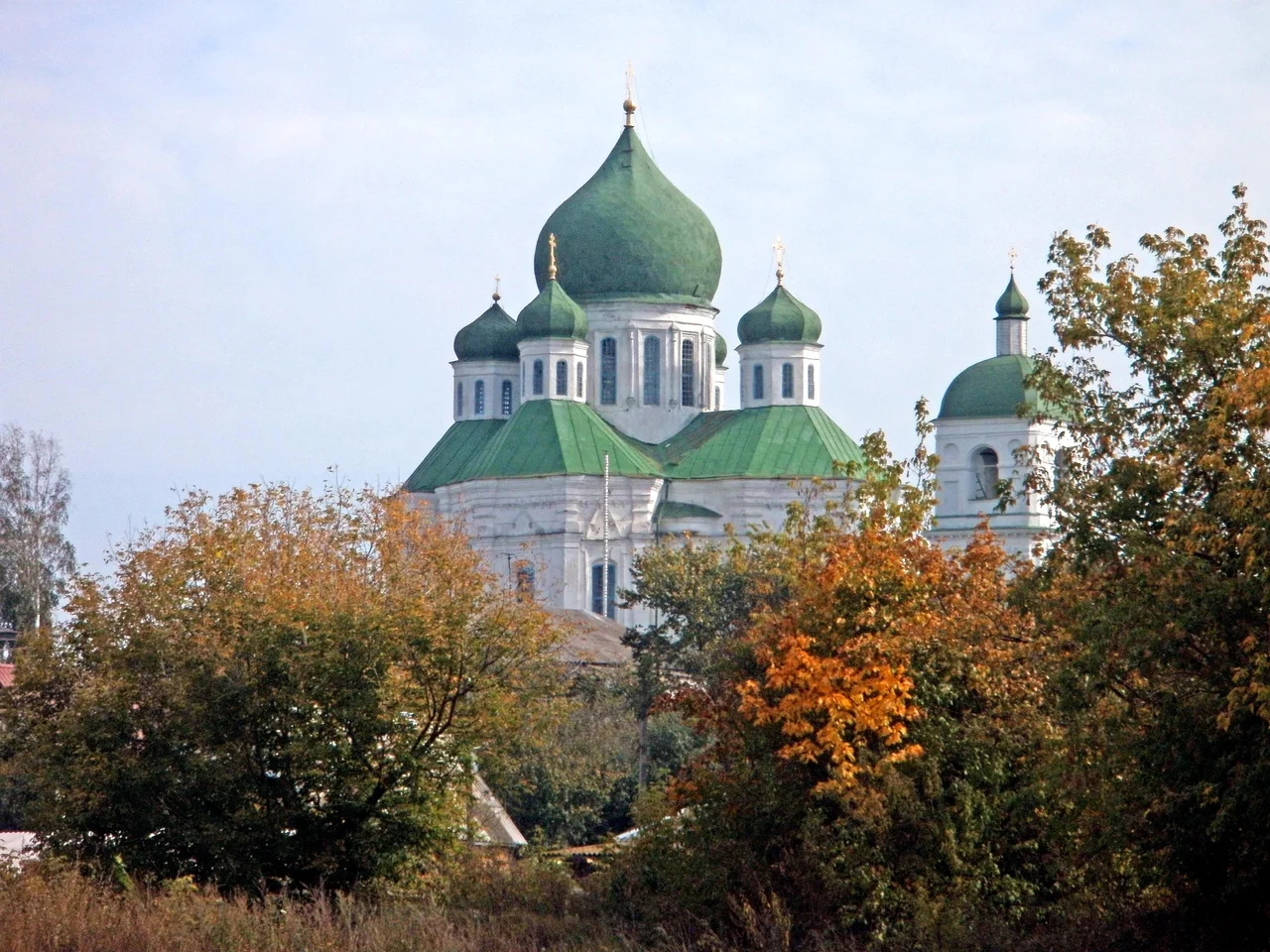

Novhorod-Siverskyi
The most famous thing that ever happened at Novhorod-Siverskyi was a defeat. In 1185, Prince Igor rode out from this city on the Desna River against the Cuman horsemen of the southern steppe and lost, and out of that failed campaign came The Tale of Igor's Campaign, the great masterwork of early East Slavic literature. Nearly nine centuries later, a monument to Prince Igor still stands in the town he set out from, and the whole city has taken the poem as its emblem, its historical reserve named in the tale's honor. Few small towns anywhere carry a literary legacy so heavy, or wear it so openly.
Chronicled Since 1044
Novhorod-Siverskyi first appears in the chronicles in 1044, and by 1098 it was the capital of the Siverian Principality, a frontier realm whose task was to shield the Rus' lands against the Cumans and other peoples of the steppe. That role gave the town its enduring fame through Prince Igor's campaign. Then came a thousand years of changing masters. The Mongols destroyed the town in 1239; afterward it passed to the princes of Bryansk, then to the Grand Dukes of Lithuania, ruled at one point by Dymitr Korybut, a son of Algirdas. Moscow won the area after the Battle of Vedrosha in 1503, lost it to Poland during the Time of Troubles, and regained it in the war of the mid-seventeenth century. In 1620 the Polish king Sigismund III Vasa granted the town Magdeburg rights, making it the easternmost county seat of Poland.
Monasteries on the Bluffs
Despite centuries of upheaval, Novhorod-Siverskyi has kept a remarkable stock of architecture, scattered across high river capes divided by ravines. The crown of it all is the Monastery of the Saviour's Transfiguration, once the residence of the Chernihiv metropolitans. Within its seventeenth-century stone walls, and above foundations reaching back to the sixteenth century, rises a cool neoclassical cathedral built between 1791 and 1796 to a design by Giacomo Quarenghi, the Italian architect who shaped so much of imperial St. Petersburg. Elsewhere in town stand the Cossack Baroque Assumption Cathedral, a triumphal arch raised in 1787, and the wooden church of St. Nicholas from 1760, its timber walls a survivor of the region's older vernacular. Streets of eighteenth- and nineteenth-century houses fill in between, giving the old center an unplanned, organic shape.
A City of Names and Memory
For a modest city, Novhorod-Siverskyi has sent a striking number of figures into the wider world. The Cossack Baroque poet and archbishop Lazar Baranovych worked here in the seventeenth century; the writer Panteleimon Kulish and the historian Mykhailo Maksymovych were born here; so, improbably, was Zino Davidoff, who would leave to found the Davidoff cigar and cigarette house in the West. The twentieth century brought harder history. The town was occupied by the German Army from 1941 to 1943, and its Jewish community was murdered during the Holocaust, a loss now documented among the untold stories at Yad Vashem. In 2022 the city was again occupied and its people forced to endure a humanitarian crisis before it was retaken. Through every one of these chapters, the monasteries have kept their place on the bluffs above the Desna.
From the Air
The city sits at 51.997°N, 33.267°E on the high right bank of the Desna River in northern Chernihiv Oblast, about 330 km from Kyiv. From roughly 3,000 to 4,000 feet the domed Transfiguration Monastery and the river's broad wooded bends are the clearest landmarks, with the old town spread over capes cut by ravines. Kyiv's Boryspil (UKBB) is the nearest major airport, well to the southwest.
Nearby Stories
- Hlukhiv 11 km away
- Siege of Hlukhiv 31 km away
- Baturyn Fortress Citadel 44 km away
- Principality of Chernigov 52 km away
- Battle of Listven 84 km away
- Battle of Lesnaya 191 km away
- Mogilev Ghetto 251 km away
- Grace Darling 447 km away