
Gelonus
Around 2,400 years ago, the Greek historian Herodotus wrote of a city deep in the wild north that few Greeks would ever see: a great wooden city called Gelonus, its walls and homes and temples all built of timber, standing among a blue-eyed, red-haired people in the forests beyond the steppe. Whether it truly existed, and if so where, has intrigued scholars ever since. Gelonus is at once a place in a history book, a legend of Greek mythology, and, quite possibly, a real archaeological site in central Ukraine whose ramparts still ridge the land. It is one of the oldest urban ghosts in Europe, described in detail by the man often called the father of history, then lost.
Herodotus's Wooden City
In the fourth book of his Histories, Herodotus placed Gelonus among the Budini, whom he described as a large and powerful nation, all deep blue-eyed and bright red-haired, living in a densely wooded country. The Geloni, he wrote, had once been Greeks who settled inland away from the coastal trading posts and now spoke a tongue partly Scythian and partly Greek. Their city was extraordinary: each side of its wall thirty stades long, everything made of wood, its shrines built and adorned in the Greek manner with statues and altars, where the people held triennial festivals in honor of Dionysus. It is a vivid, specific portrait, a Greek writer reporting a half-Greek world at the very edge of the one he knew.
Free as the Wind
Gelonus enters the great drama of the ancient world during the Persian campaign against Scythia in the late sixth century BC. When the army of Darius the Great pushed north into these lands, it reached the fortified settlement of Gelonus only to find it already burned to the ground; the Budini had abandoned and torched it rather than defend it. The Scythians answered the mighty empire with defiance and evasion rather than battle, reportedly sending Darius a message that has echoed down the centuries: we are free as the wind, and all you can catch in our land is the wind. Burning the grass ahead of the advancing Persians, leaving earth without pasture, they denied the invaders any fight worth having. Darius withdrew without a single victory.
The Search for a Legend
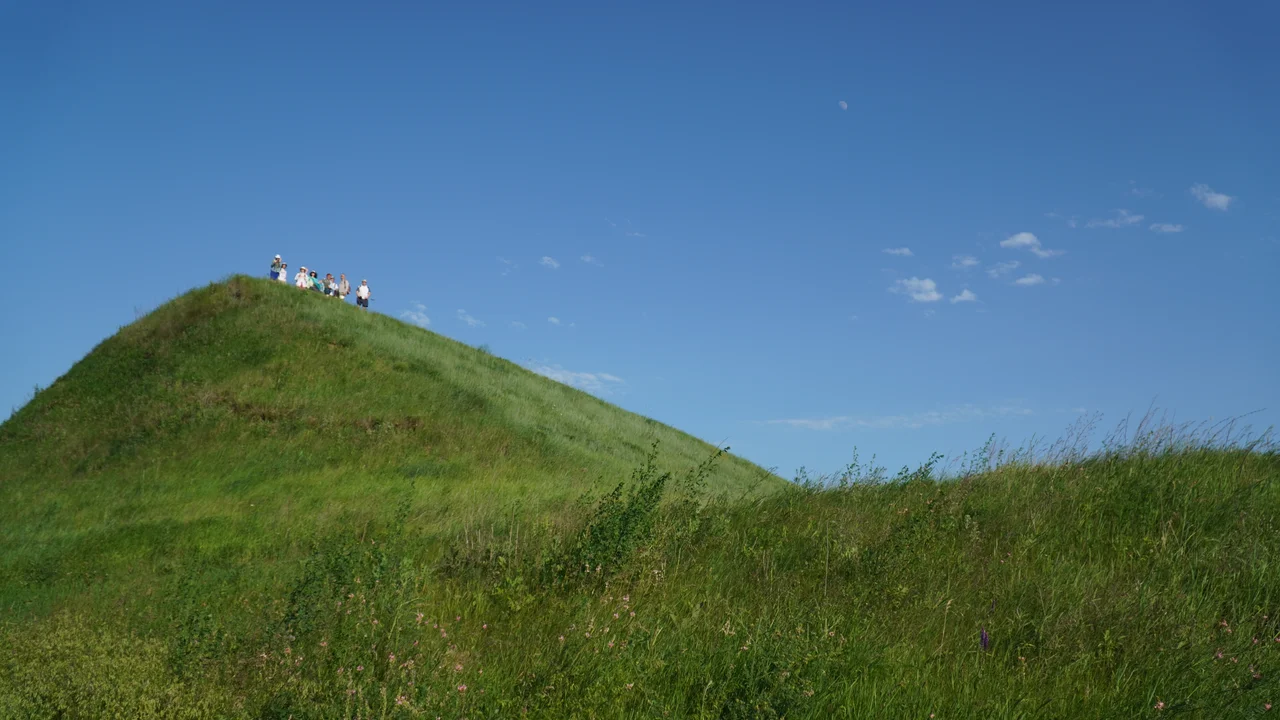
Where was Gelonus, if it stood at all? The leading candidate lies at the Bilsk hillfort near Poltava, an immense Scythian-era complex that the archaeologist Boris Shramko and others have argued is the very city Herodotus described. Its position fits the account, poised on the exact boundary between steppe and forest-steppe, and its scale is staggering. Herodotus gave Gelonus sides of thirty stades, roughly thirty square kilometers; the fortifications at Bilsk enclose some forty, with ramparts totaling thirty-three kilometers and earthen walls still standing up to sixteen meters high. Other scholars have proposed sites far to the east, near Saratov or the Don, and the identification remains debated. But at Bilsk, a visitor can at least stand where a wooden city of Herodotus's imagination might really have burned.
A Son of Heracles
Gelonus lived a second life in Greek myth. In the legends the Greeks of the Black Sea told, Gelonus was a son of the monstrous Echidna and the hero Heracles, brother to Agathyrsus and to Scythes, from whom the Scythians were said to descend. The story placed Echidna's cave somewhere in the misty geography of Scythia, tying these distant peoples into the family tree of Greek heroes. That a remote northern nation should be given a Greek ancestor reveals how the classical world made sense of the strangers at its margins, folding them into its own stories. Between the myth, the history, and the ramparts in the ground, Gelonus endures as a place that may be legend, fact, or, most hauntingly, both at once.
From the Air
Gelonus is most often identified with the Bilsk hillfort at about 50.09°N, 34.63°E, in the interfluve of the Vorskla and Sukha Hrun rivers on the Poltava-Sumy border. From 2,500 to 5,000 feet the ancient earthen ramparts trace long lines across the forest-steppe, running roughly north-south along the Vorskla. Poltava International Airport (UKHP) is the nearest sizable field, to the south-west.
Nearby Stories
- Krasnokutskyi Arboretum 8.2 km away
- Velyki Sorochyntsi 11 km away
- Hadiach 13 km away
- Poltava Museum of Long-Range and Strategic Aviation 17 km away
- Okhtyrka 20 km away
- Borki Train Disaster 70 km away
- Kremenchuk 91 km away
- Central Black Earth Nature Reserve 119 km away