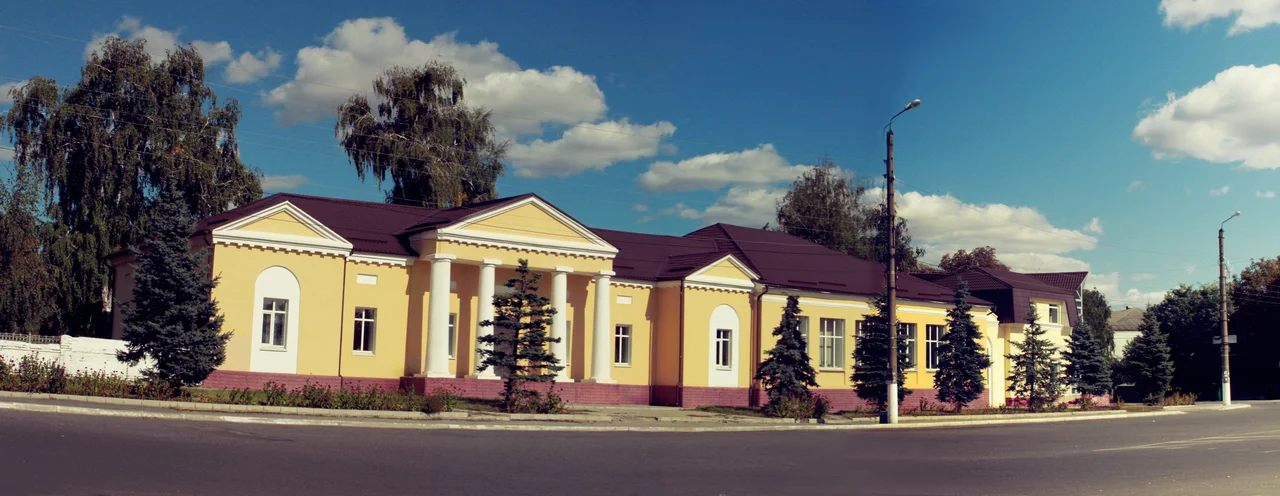

Okhtyrka
In the winter of 1707, Peter the Great rode into a small fortress town on a looping bend of the Okhtyrka River to inspect its garrison and hold a council of war. The wooden ramparts he examined, five stone towers and fifteen wooden ones, drawbridges over a water-filled moat, are long gone, but the town they protected is still here. Okhtyrka sits at the center of a triangle drawn by Sumy, Kharkiv, and Poltava, on the left bank of the Vorskla, the river locals call the Blue Pearl. Founded by settlers fleeing westward from the Polish-Lithuanian Commonwealth into the frontier region of Sloboda Ukraine, it grew from a border outpost into a Cossack stronghold, a place of pilgrimage, and eventually the oil capital of Ukraine.
The Regiment That Marched to Paris
For a town its size, Okhtyrka has left an outsized mark on military history. The Okhtyrka Cossack Regiment, formed in the 1650s, spent more than a century defending this frontier before Catherine the Great dissolved the Cossack regiments in 1765. It reformed as a hussar regiment, and it was these Okhtyrka Hussars who rode against Napoleon in 1812, fighting at Smolensk, Vyazma, and Borodino. Their service earned them a singular honor: leading the victory parade as allied troops entered Paris in 1814. The regiment's ranks drew remarkable men, among them the poet and partisan leader Denis Davydov and the composer Alexander Alyabyev. The town's later history stayed martial; by the late Soviet period Okhtyrka housed several army regiments, and monuments to the World War II dead still stand in its parks.
The Icon That Healed a Fever
Okhtyrka's spiritual fame rests on a single painting. In 1739, according to the story handed down here, a priest named Vasyl Danylov was mowing grass near the Protection Church when he uncovered an old icon of the Virgin Mary that seemed to give off light. After a series of dreams and unexplained recoveries from fever, word of the image's healing power spread all the way to the imperial court. Empress Elizabeth, moved by the accounts, funded a stone cathedral to be built on the very spot the icon was found; the Holy Synod recognized it as miraculous in 1751. The original was stolen in 1903 while traveling to St. Petersburg for restoration and eventually surfaced, remarkably, in San Francisco. The Cathedral of the Holy Virgin that Elizabeth paid for still commands the town center, a jewel of Sloboda Ukrainian Baroque topped with an unusual three-tiered belltower.
Oil, Churches, and a River Called Blue Pearl
The modern town wears two faces. Since oil and gas were struck nearby in 1961, Okhtyrka has been the oil capital of Ukraine, its surrounding region producing more crude than anywhere else in the country, and its football club, Naftovyk-Ukrnafta, still carries the trade in its name. But wander its streets and an older town shows through: wooden and brick churches, a men's gymnasium, a merchant's trading house, a Palace of Culture. On Monastery Hill, a few kilometers north above the Vorskla, the Holy Trinity Monastery has been founded, ruined, and rebuilt so many times that its most recent restoration is counted the fourth in its life. It survives, as it always has, on donations and the labor of a few determined monks and volunteers, watching over the blue river below.
Hero City
In late February 2022, the invasion reached Okhtyrka. Over the weeks that followed the town was shelled and bombed repeatedly, its power plant destroyed, its residential neighborhoods struck, its people killed. By late April, only about 24,000 of the town's roughly 48,000 residents remained. Yet the invading forces never took Okhtyrka, and the defense held them back from the larger cities of Poltava and Dnipro beyond. On March 24, 2022, Ukraine awarded the town the honorary title Hero City. Today its residents mark their City Day on August 25, the anniversary of an earlier liberation, when the town was freed in 1943, layering one hard-won survival atop another. It is a place that has been fortified, besieged, blessed, and rebuilt more times than most, and is still standing.
From the Air
Okhtyrka lies at roughly 50.31 degrees north, 34.90 degrees east, on the left bank of the Vorskla River in Sumy Oblast. From altitude, the wooded river valley and the town's Baroque cathedral belltower serve as the clearest landmarks against the surrounding fertile farmland. The nearest major airport is Sumy (UKHS) to the north; Kharkiv (UKHH) lies to the southeast. The town retains a former military airfield, the Okhtyrka air base.
Nearby Stories
- Krasnokutskyi Arboretum 13 km away
- Hryhorii Skovoroda Literary Memorial Museum 29 km away
- Hadiach 32 km away
- Sumy 34 km away
- Velyki Sorochyntsi 37 km away
- Derzhprom 52 km away
- Central Black Earth Nature Reserve 75 km away
- Konotop 111 km away