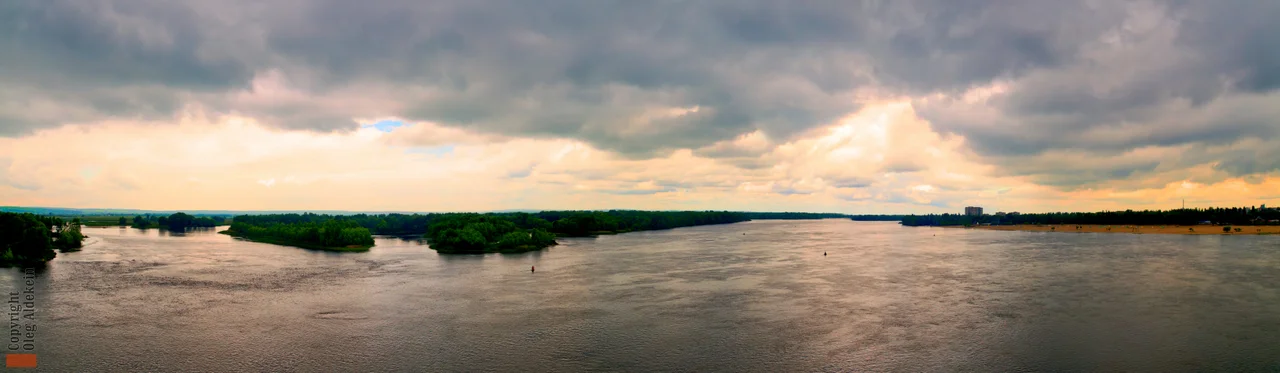

Kremenchuk
Kremenchuk sits on a giant plate of flint. The city takes its very name from it, from kremen, the stone that throws sparks, and there is something fitting in that, because few places in Ukraine have been struck so hard and so often and kept catching fire back into life. Founded as a fortress in 1571 on the banks of the broad Dnieper, this is a working city of truck plants and railcar works and refineries, ranked among the great industrial centers of Eastern Europe. It is not the prettiest town on the river. It is one of the toughest.
The Fortress on the Flint
The name has two stories, and both suit the place. One traces Kremenchuk to the flint bedrock beneath it; the other calls it Turkic for small fortress. Either way, the town began as a strongpoint on a river that has carried armies and trade through Ukraine for a thousand years. In 1625 the nearby Lake Kurukove gave its name to the Treaty of Kurukove, signed here between Cossacks and Poles. When the Cossack Hetmanate rose, Kremenchuk belonged first to the Chyhyryn regiment and later, after the Treaty of Andrusovo, passed to the Tsardom of Russia and the Left Bank. In 1786 the veteran Russian general Alexander Suvorov, already decades into a storied career, took command of the local garrison ahead of the war with the Ottomans, one more soldier passing through a town that has seen so many.
Rails, Trucks, and Iron
Kremenchuk's modern character was forged in metal. After the Crimean War, railways spread across the empire, and in 1869 the Kriukiv works opened on the far bank, one of the oldest railcar-building and repair factories in Eastern Europe. In 1872 a bridge stitched Kriukiv to Kremenchuk across the Dnieper; by 1899 trams ran through the streets. The twentieth century deepened the pattern. The city became home to KrAZ, one of Eastern Europe's largest truck makers, to a major oil refinery, a wheel plant, a steelworks, and factories turning out everything from road machines to Roshen confectionery. Today Kremenchuk stands as one of Ukraine's leading industrial centers and a vital rail junction and river port, its economy built on the same qualities as its name: hard, useful, and hard to break.
A Community Remembered
For more than a century, Kremenchuk was among the great Jewish cities of Ukraine. Jews began settling here in 1782, and by the 1897 census they numbered nearly thirty thousand, close to half the city's population, drawn from across the Pale of Settlement. It was a community of merchants and craftspeople, poets and musicians; the film composer Dimitri Tiomkin and Alexander Pechersky, a leader of the Sobibor uprising, both had roots here. The Second World War brought catastrophe. Under Nazi occupation the Jews of Kremenchuk were stripped of their rights, forced to wear the yellow star, driven from the city in the autumn of 1941, and murdered. The vibrant world recorded in the old census was destroyed in a matter of months, a loss the city still carries.
Rubble and Return
War has visited Kremenchuk more than once, and each time the city has come back. During the Second World War, occupation from 1941 to 1943 left more than ninety percent of its buildings in ruins, and the day of its liberation, the twenty-ninth of September, is still marked every year as City Day. The postwar decades rebuilt it from the ground up into the industrial powerhouse it remains. The city has known other hard days too, including strikes on its refinery and a shopping mall during the fighting of recent years, when civilians lost their lives. Through all of it, the Dnieper keeps flowing past the flint plate, and Kremenchuk keeps doing what its name suggests it always has: taking a hard blow and striking back to light.
From the Air
Kremenchuk lies at about 49.06 degrees north, 33.40 degrees east, on the Dnieper River in Poltava Oblast, central Ukraine. From altitude, the enormous width of the Dnieper and the Kremenchuk Reservoir upstream are unmistakable, along with the bridges and industrial districts spanning both banks. The nearest major airfield is Poltava to the north.
Nearby Stories
- Battle of the Vorskla River 25 km away
- Russo-Turkish War of 1672-1681 28 km away
- Battle of Zhovti Vody 29 km away
- Poltava Museum of Long-Range and Strategic Aviation 38 km away
- 1979 Dniprodzerzhynsk Mid-Air Collision 51 km away
- Melgunov Kurgan 51 km away
- Cherkasy 72 km away
- Poltava 74 km away