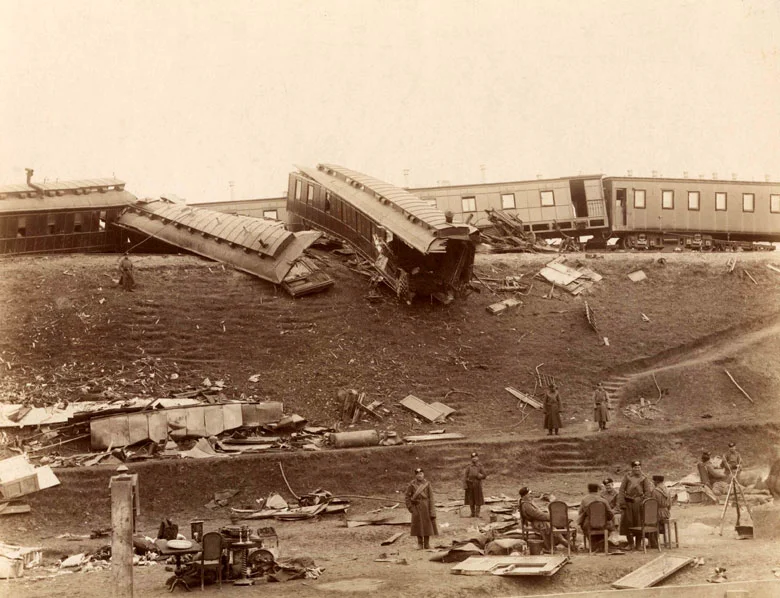

Borki Train Disaster
On the afternoon of October 29, 1888, a fifteen-carriage train carrying the entire imperial family of Russia was thundering north from Crimea toward Saint Petersburg when it left the tracks near a small station called Borki, in what is now Birky, Ukraine, about 295 kilometers south of Kursk. In an instant the dining car in which the Romanovs were finishing their meal was crushed. Twenty-one people died on the spot, two more later, and dozens were injured. From the wreckage rose one of imperial Russia's most enduring legends: that Tsar Alexander III himself, a famously powerful man, held the collapsing roof of the carriage on his shoulders long enough for his wife and children to crawl free. Whether or not it happened that way, the story became gospel.
A Train Built to Fail
The disaster was, in the cold view of the investigators who came afterward, an accident waiting to happen. Railway rules of the day capped commercial passenger trains at 42 axles. The imperial train had 64. Its weight was really that of a freight train, yet it was being run at express speeds, hauled by two steam locomotives coupled together, a combination that set up violent vibrations along the track. The railway official Sergei Witte, who had managed imperial journeys across this line and knew its faults, believed those vibrations shook the train off substandard rails. Two months before the crash, an irritated Alexander had publicly berated Witte for insisting on slower speeds, dismissing his caution with a bigoted remark about the line's Jewish owners. The Tsar wanted speed. The rails could not give it safely.
The Miracle at Kazan Cathedral
When Alexander reached Saint Petersburg alive, the empire treated his survival as a sign from heaven. He went to the Kazan Cathedral to give thanks, and the crowd of university students grew so fervent they wanted to unharness the horses and pull his carriage through the streets by hand. The Orthodox Church leaned into the drama, its clergy linking the family's deliverance to the miracle-working icons that had protected Russia during the plague of the 1650s. A special commemorative icon, God's Grace on the 17th of October, was created and circulated in photographs across the country. Churches were raised near the crash site to glorify the emperor's escape. A derailment caused by overloading and reckless speed had been transfigured, in the public imagination, into divine favor upon the throne.
Twenty-One Names Beneath the Legend
Lost in the glow of the miracle were the people who did not walk away. Twenty-one died where the carriages folded, two more of their injuries afterward, and many others were hurt, the servants, staff, and railway workers whose deaths never earned commemorative icons or thanksgiving cathedrals. Their end was not divine intervention but the ordinary, preventable consequence of a train run past the limits of its track. The tragedy at Borki is a study in how a single event can be remembered two ways at once: as a sovereign's providential survival, and as a mass casualty caused by hubris. Both are true. The cathedrals honor the first. It is worth pausing, at the site, to remember the second.
The Man Who Rose From the Wreck
The Borki crash launched one of imperial Russia's most consequential careers. Anatoly Koni, a brilliant and independent-minded lawyer, was dispatched to investigate, and the inquiry split three ways: Witte blamed speed, another expert blamed rotting wooden ties, Koni blamed the railway's management outright. Unable to settle it cleanly, Alexander chose to close the case quietly, retired the officials in charge, and elevated Witte, the one man who had warned him, to director of the Imperial Railways. From that post Witte climbed to become one of the empire's great reformers and, eventually, its first prime minister. A wandering fault in the rails near a Ukrainian village had, improbably, helped set the course of a nation's politics for the decades that followed.
From the Air
The disaster site lies near Birky at roughly 49.69 degrees north, 36.13 degrees east, in Kharkiv Oblast on the historic Kursk-to-Kharkiv rail line. From the air, look for the rail corridor and the memorial church built to commemorate the imperial family's survival. The nearest major airport is Kharkiv (UKHH) to the northeast.
Nearby Stories
- Intercession Cathedral, Kharkiv 16 km away
- Chuhuiv 22 km away
- Verkhnii Saltiv Museum-Reserve 29 km away
- Krasnokutskyi Arboretum 30 km away
- Second Battle of Kharkov 45 km away
- Poltava Governorate Zemstvo Building 69 km away
- Trinity Cathedral, Samar 87 km away
- Samar 103 km away