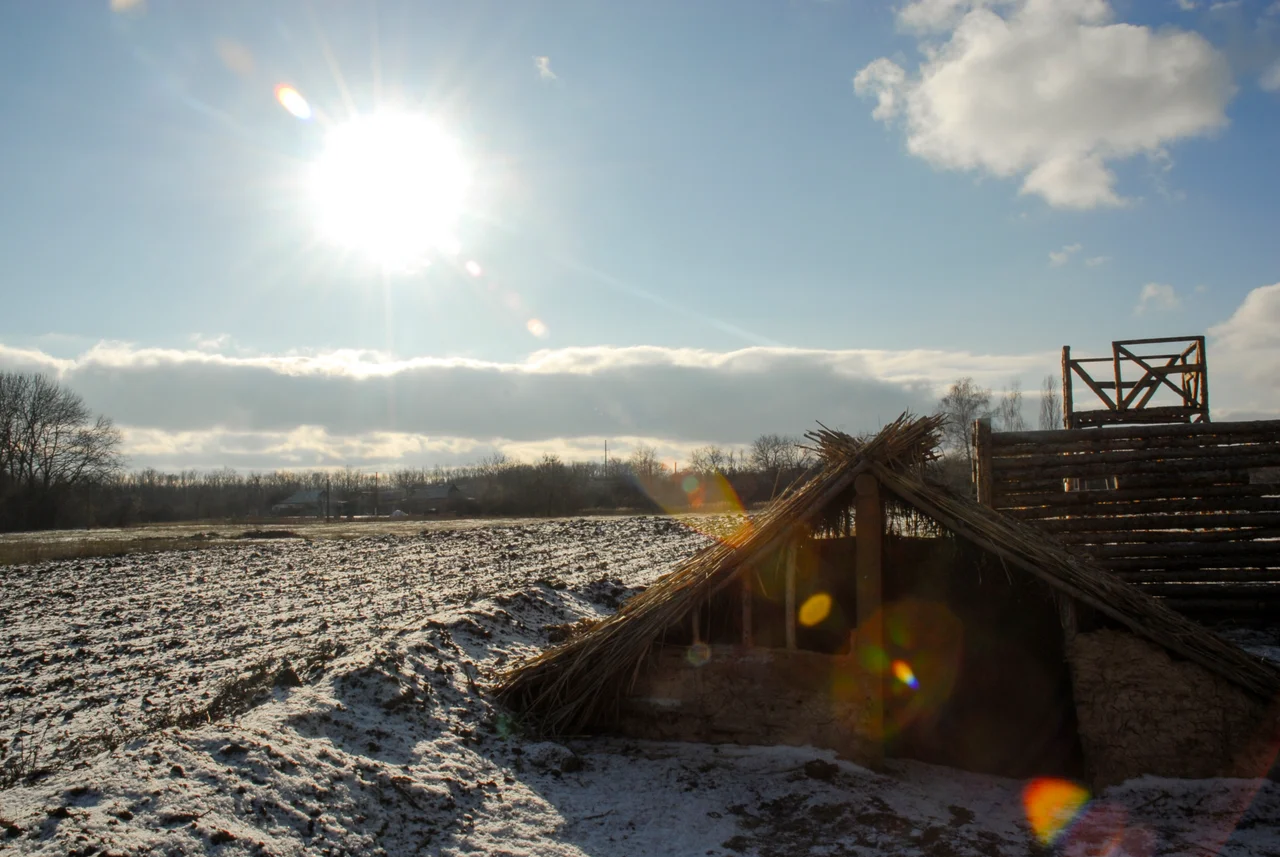

Verkhnii Saltiv Museum-Reserve
In 1900, a schoolteacher named Vasyl Babenko was asked a simple question: were there any old ruins near his village worth reporting to an archaeological congress? He went looking, and near Verkhnii Saltiv, on the high right bank of the river, he found a cemetery. Not just a few graves, but the edge of something enormous, an entire buried civilization that had left no name in the local memory. What Babenko had stumbled into would give its name to an entire culture spanning half a continent. The fields above the Siverskyi Donets, it turned out, held the type site of the Khazars, the medieval steppe empire that once loomed between Byzantium and the Arab caliphates.
A Fortress on the High Bank
Stand on the bluff where the settlement once rose and you are thirty-five meters above the floodplain, with the water winding below. The people who lived here chose the position for defense and held it with earth and stone. The main stronghold formed an irregular trapezoid, its ramparts reinforced with masonry, and beyond it the town spread north along the river in lines of houses and workshops. This was no village. The complex at Verkhnii Saltiv gathered together fortifications, a sprawling settlement, and four separate catacomb burial grounds, with still more sites facing it across the reservoir. A written trace survives from the seventeenth century, when a Russian geographic register, the Book of the Great Map, noted the ruined earthworks and called the place Saltanovskoye, a fortress already ancient and abandoned.
The Culture That Got Its Name Here
Archaeologists call it the Saltovo-Mayaki culture, and Verkhnii Saltiv is one of its two defining sites, the yardstick against which finds across the steppe are compared. It was the material world of the Khazar Khaganate, a confederation of Turkic peoples whose ruling elite, famously, adopted Judaism, making the Khazars one of history's most intriguing polities. The catacomb graves gave up the evidence of ordinary lives: weapons and horse gear, ornaments, the craftsmanship of a society that traded and fought along the river roads. So rich was the site that its finds were dispersed to museums across Europe, from Kyiv and Kharkiv to Odesa, Moscow, Saint Petersburg, and Sofia, a scattering of a single people's memory across many capitals.
A Century of Careful Digging
From Babenko's first spadework, the excavations never really stopped. In 1901 formal research began, and between 1905 and 1927 commissions from a half-dozen museums combed the region. After the Second World War, scholars turned to the defensive works themselves, cutting cross-sections through all three lines of the old ramparts and opening dozens of catacomb burials. A 1959 expedition found an entirely new settlement and cemetery on the opposite bank. From 1984 the Kharkiv Historical Museum made the site a standing commitment, sending expedition after expedition. The state recognized what was here, granting protection in 1965, declaring the whole complex a reserve in 1987, and founding the Verkhnii Saltiv historic-archaeological museum-reserve in 1989, so that the buried Khazar world above the Donets could be studied and remembered rather than plowed away.
From the Air
The museum-reserve lies near the village of Verkhnii Saltiv at about 50.13 degrees N, 36.79 degrees E, on the high right bank of the Pechenih Reservoir on the Siverskyi Donets, roughly 40 kilometers northeast of Kharkiv. From altitude, follow the broad silver reservoir; the site sits on the bluff along its western edge. The nearest major airport is Kharkiv International (ICAO: UKHH).
Nearby Stories
- Chuhuiv 10 km away
- Borki Train Disaster 27 km away
- Hryhorii Skovoroda Literary Memorial Museum 32 km away
- Central Black Earth Nature Reserve 66 km away
- Trostianets 88 km away
- Chalk Flora Nature Reserve 125 km away
- Yunkom Coal Mine 230 km away
- Grace Darling 514 km away