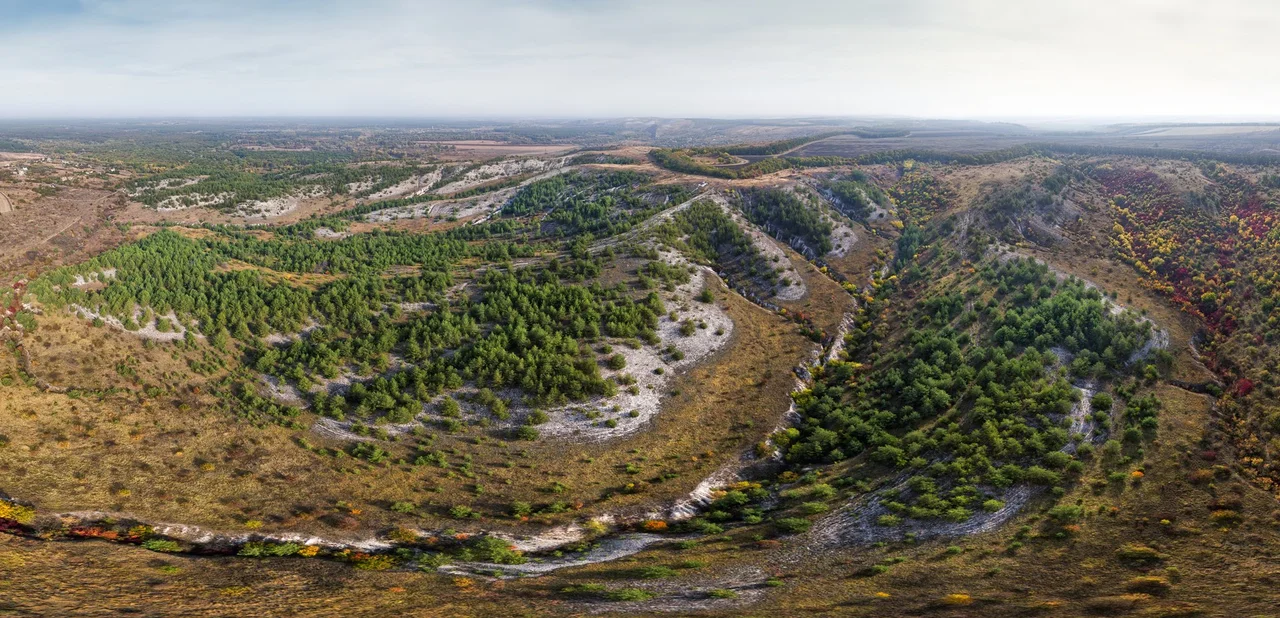

Chalk Flora Nature Reserve
The hills here are white. Along the Donets River in eastern Ukraine, the ground gives way to steep, pale slopes of chalk - the compressed remains of a Cretaceous sea that covered this land tens of millions of years ago. On these bright bluffs, which rise fifty to seventy meters and pitch as steeply as seventy degrees, grows a community of plants found almost nowhere else: specialists that have adapted to root in bare chalk, in blazing sun, on soil so alkaline and thin that most greenery cannot survive. This is the Chalk Flora Nature Reserve, and its very name announces what makes it precious - a flora that belongs to the chalk itself.
A Sea Turned to Stone
The chalk that defines this place is the fossilized floor of an ancient ocean, laid down during the Cretaceous period from the shells of countless microscopic creatures. Over ages, the sea vanished and the land rose, and rivers cut down through the soft white rock to expose it in steep escarpments. The reserve occupies these outcrops on the hills above the Donets, in the Kramatorsk area of Donetsk Oblast. It is a small place - about 1,134 hectares - and a sub-unit of the larger Ukrainian Steppe Nature Reserve. There is a certain poetry to standing on ground that was once a seabed, on white slopes made of life so old it has turned entirely to stone, now clothed in a thin green fuzz of the living present.
Plants That Love the Chalk
What grows on chalk is a botany all its own. The mineral-rich, alkaline, fast-draining soil demands special tolerances, and over long stretches of time distinctive chalk-loving plants evolved to meet them - low, tough, often silvery-leaved species that thrive where ordinary plants would wither. Clinging to the slopes are relict stands of chalk pine, a hardy variety of Scots pine that has held on here since ancient times, alongside birch and, all around, the multi-grass steppe typical of central Ukraine. About a third of the reserve is forest; the rest is open grassland running across the white hills. It is a living museum of adaptation, a place where the plants are as unusual as the ground they grow on.
Saved by Its Own Steepness
This landscape survives for a blunt and telling reason: it was never worth plowing. The chalk slopes are too steep, the soil too poor and stony, for any farmer to make a field of them. Across the fertile black-earth belt of Ukraine, one of the most agriculturally productive regions on Earth, natural steppe has almost entirely been converted to cropland over the centuries. What remains untouched tends to be exactly the land that agriculture rejected - and so these harsh white bluffs, useless to the plow, became an accidental refuge for wild plant communities that vanished nearly everywhere else. The reserve's protection since 1988 has formalized what geography began.
A Place Left Alone
The Chalk Flora Nature Reserve is a strict reserve of the highest protective class, which means it is not a park in any usual sense. Public access is prohibited. Its purpose is not recreation but preservation and scientific study - to leave this fragile chalk ecosystem as undisturbed as possible so researchers can learn from it and the rare flora can persist. There are no trails to walk, no visitor centers, no crowds. There is only the white hillside above the river, the relict pines gripping the slope, and the quiet, specialized plants that have made their home on the bones of an ancient sea. Some places matter most precisely because we leave them alone.
From the Air
The reserve lies at 48.87°N, 37.89°E on the hills above the Siverskyi Donets River in Donetsk Oblast, eastern Ukraine. From 2,500-4,500 feet the bright white chalk escarpments stand out sharply against the surrounding green steppe and the winding river valley - an unusually pale scar on the landscape. Nearest sizable airport is Kharkiv International (UKHH) to the northwest; note Ukrainian airspace is closed to civil aviation.
Nearby Stories
- Second Battle of Kharkov 10 km away
- Merheleva Ridge 56 km away
- Yunkom Coal Mine 63 km away
- Giant Ukrainian Radio Telescope 77 km away
- Battle of Dibrivka 99 km away
- Chuhuiv 107 km away
- Taganrog Aviation Museum 195 km away
- Grace Darling 643 km away