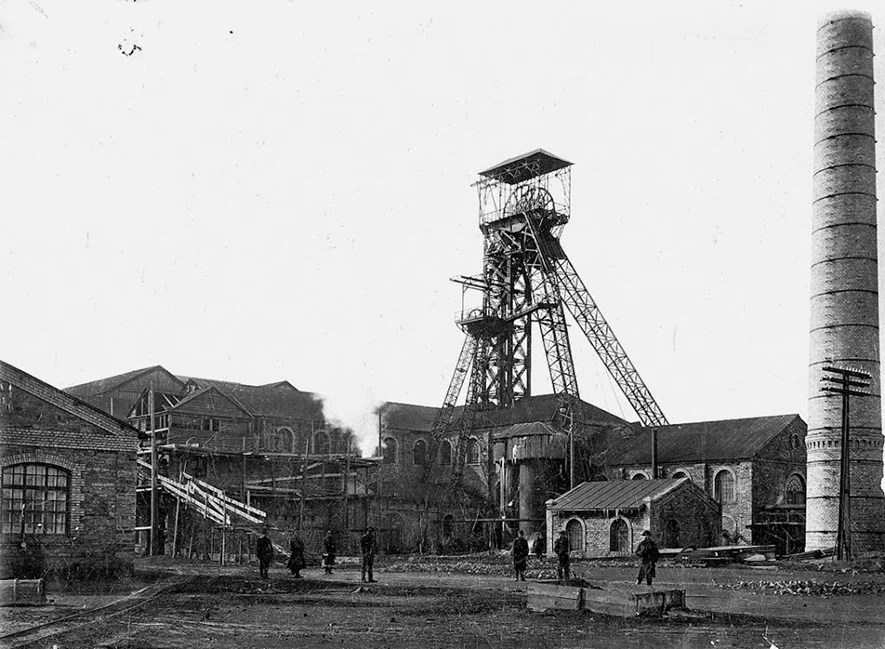

Yunkom Coal Mine
In 1912, miners first went down into the coal beneath the town of Bunhe, in the heart of the Donbas coalfield, and the Yunkom mine - short for Yuny Kommunar, the Young Communard - began its long working life. Two years later, in 1914, a jackhammer chattered against the coal face here for the first time. For over a century this mine gave a Donbas town its livelihood, its rhythm, and its name. But Yunkom would become famous for something no other coal mine could claim: a nuclear explosion set off deep within it, and the slow-rising water that now threatens to turn that buried blast into a poison.
A Century Underground
Coal is the story of the Donbas, and Yunkom was one small chapter of it - a working mine like hundreds of others, sending men down into the dark to cut the fuel that powered an empire. Through the Soviet decades it employed the people of Bunhe, its shafts descending hundreds of meters and its galleries branching for tens of kilometers beneath the steppe. Mining here was hard and often dangerous; the coal seams were riddled with gas and prone to sudden, violent releases. This was skilled, perilous labor, passed through generations of families for whom the mine was not a curiosity but a way of life. For most of the twentieth century, Yunkom was simply where the town went to work.
The Blast in the Depths
In 1979, at a point 903 meters below the surface, Soviet authorities detonated a nuclear device inside the Yunkom mine - the operation code-named Klivazh, part of a state program that used atomic explosions for industrial ends. The purpose was practical: to shatter the stressed rock and relieve the gas pressure that made the mine so deadly, reducing the coal-and-gas outbursts that had long endangered the miners. In its immediate aim it succeeded, and for years monitoring showed radiation held safely within the rock. But it left a legacy sealed in the earth - a contaminated cavity whose safety depended entirely on the mine around it staying dry, tended, and under careful watch. The atom had been brought underground to help the miners; it would outlast the mine itself.
The Long Decline
When the Soviet Union collapsed, Yunkom collapsed with it. The numbers tell a stark story of a community's unraveling: daily production fell from around 1,446 tons in 1990 to roughly 330 by 1999, the length of working tunnels shrank from 84 kilometers to under 29, and the workforce dropped from 1,755 people to just 662 in the same nine years. A mine that had anchored a town for most of a century was hollowing out, shift by shift and family by family. The wider region fell into conflict after 2014, and control of the mine passed to separatist authorities. In 2018, more than a hundred years after it opened, Yunkom was closed for good - and then the decision was made to let it flood.
The Water That Remembers
Draining a deep mine takes constant pumping, and when the pumps were removed, water began climbing through the workings toward the old blast cavity. Scientists had warned of exactly this. The hydrogeologist Yevgeny Yakovlev estimated that the radioactivity of the site, dominated by cesium and strontium with half-lives near thirty years, had fallen by roughly half over four decades - from about 100 curies to 50 - but that was still far from harmless. By 2020, officials reported the mine had filled with radioactive water. In the summer of 2024, samples taken five kilometers away found elevated radionuclides in local aquifers, a sign that contaminated water had reached sources people rely on. A mine that gave a town its life for a century now poses a lingering question to everyone downstream, its story unfinished beneath the rising water.
From the Air
The Yunkom mine lies at 48.23°N, 38.27°E at Bunhe in Donetsk Oblast, eastern Ukraine, in the dense industrial landscape of the Donbas coalfield - a terrain studded with mine headframes, spoil heaps, and rail spurs. From 3,000-5,000 feet the conical slag tips and mining structures mark the area. Note that Ukrainian airspace is closed to civil aviation.
Nearby Stories
- Merheleva Ridge 26 km away
- Chalk Flora Nature Reserve 44 km away
- Battle of the Kalka River 83 km away
- Taganrog Aviation Museum 84 km away
- Second Battle of Kharkov 87 km away
- Battle of Dibrivka 91 km away
- Beriev 102 km away
- Alexandrov Kremlin 877 km away