_phased_array._Kharkiv_oblast,_Ukraine.jpg)
Giant Ukrainian Radio Telescope
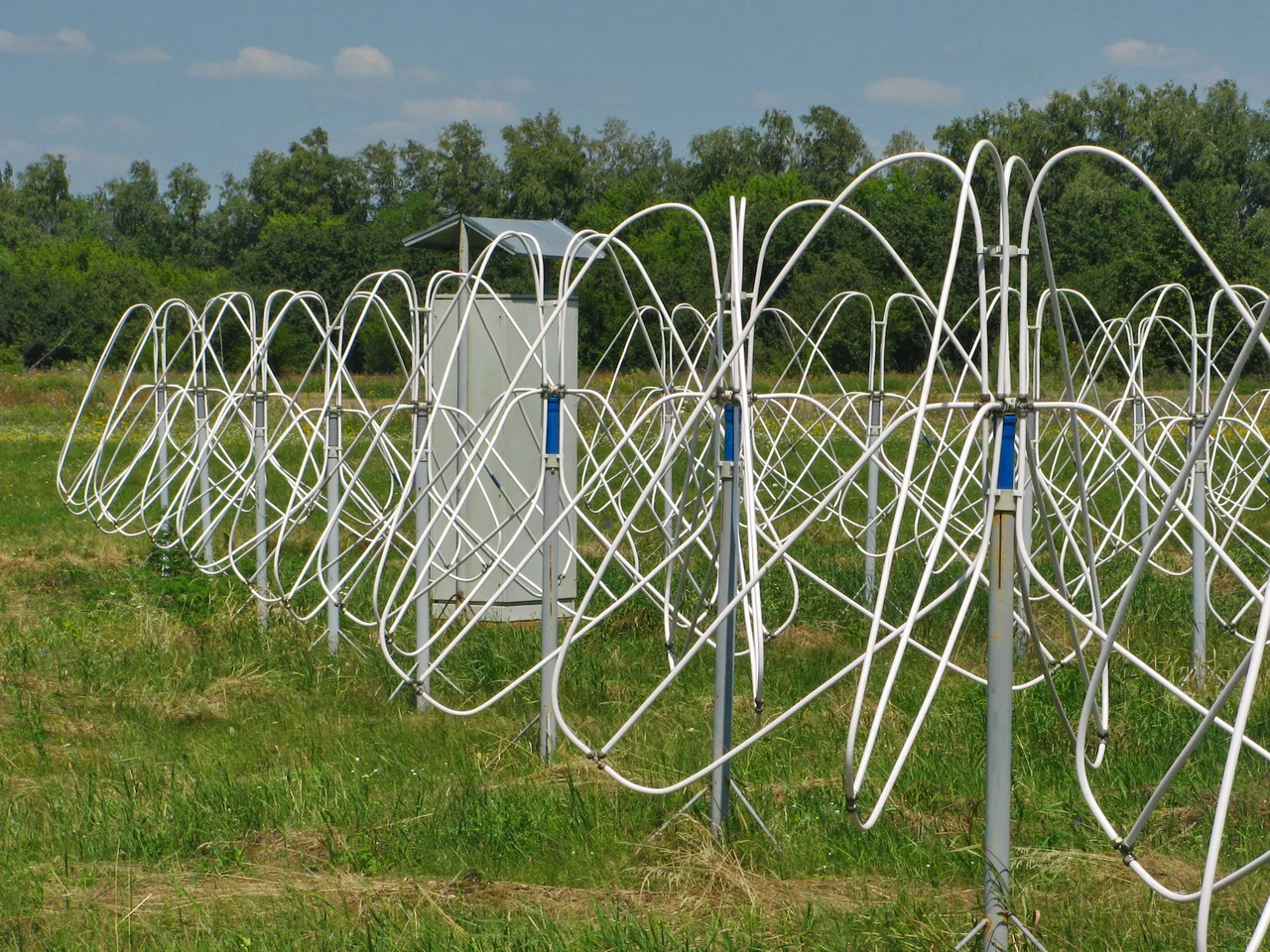
There is nothing to see here that looks like a telescope. No white dish tilts toward the sky, no dome swivels on a hilltop. Instead, rows of thin copper rods stand in neat grids barely higher than your knee, spread across the fields of the S. Y. Braude Radio Astronomical Observatory in Kharkiv Oblast. To the eye it could be a strange kind of vineyard. But these crossed dipoles are tuned to the lowest notes the cosmos plays, radio waves at 8 to 80 megahertz that a curved metal dish could never gather. The instrument is called GURT, the Giant Ukrainian Radio Telescope, and it is patiently teaching itself to hear the whole sky at once.
Listening at the Bottom of the Spectrum
Most famous observatories chase the high frequencies, where a parabolic dish can focus faint signals to a sharp point. GURT works at the opposite extreme, in the decametre range where wavelengths stretch for meters and no reasonable dish could ever be built large enough. The solution is a phased array: thousands of small antennas whose signals are combined electronically, so the whole field behaves like one enormous ear. Each element is a pair of wideband dipoles of copper tubing, set at right angles and mounted about 1.6 meters above the ground. Twenty-five of them cluster into a square five-by-five subarray. Combine enough subarrays, steer them by adjusting the timing of their signals rather than by moving any metal, and the array can point itself across the heavens without a single motor turning.
A Sky Full of Static With Meaning
The low-frequency universe is loud in ways the human world rarely notices. GURT's subarrays have already caught the crackle of solar radio bursts, the strange decametric radiation Jupiter emits when its moon Io threads through the planet's magnetic field, the shimmer of Earth's own ionosphere, and the metronome pulses of distant pulsars. This is a corner of the spectrum long neglected because it is so difficult, drowned in terrestrial interference and warped by the atmosphere. The engineers built the dipole amplifiers with enormous dynamic range precisely so a passing radio station wouldn't blind the instrument. Even a handful of subarrays, with a modest collecting area of a few hundred square meters, has proven it can pull real astrophysics out of the noise.
The Elder Beside the Newcomer
GURT does not stand alone on this ground. Sharing the observatory is the UTR-2, a colossal T-shaped array of thousands of dipoles that has been one of the world's premier low-frequency instruments since the Soviet era. GURT was conceived as its extension and its successor, and the neighbourly arrangement is a gift: the veteran array, vast and well understood, becomes a ruler against which the young one can be measured and calibrated. The plan is ambitious. Where four subarrays hum today, the finished GURT is designed to grow toward one hundred, some 2,500 antenna elements spread across more than a square kilometer, added patiently as resources allow. Piece by copper piece, a great ear is taking shape in the Ukrainian fields.
From the Air
The S. Y. Braude Radio Astronomical Observatory sits at roughly 49.64 degrees N, 36.94 degrees E, in flat farmland southeast of Kharkiv. From altitude the site reads as pale rectangular grids of low antennas rather than any tower or dish; the long T-shaped UTR-2 array nearby is the clearest landmark. The nearest major field is Kharkiv International Airport (ICAO: UKHH), about 50 kilometers to the northwest.
Nearby Stories
- Second Battle of Kharkov 19 km away
- Khartron 24 km away
- Borki Train Disaster 31 km away
- Verkhnii Saltiv Museum-Reserve 32 km away
- Chalk Flora Nature Reserve 61 km away
- Trinity Cathedral, Samar 127 km away
- Yunkom Coal Mine 166 km away
- Grace Darling 569 km away