.jpg)
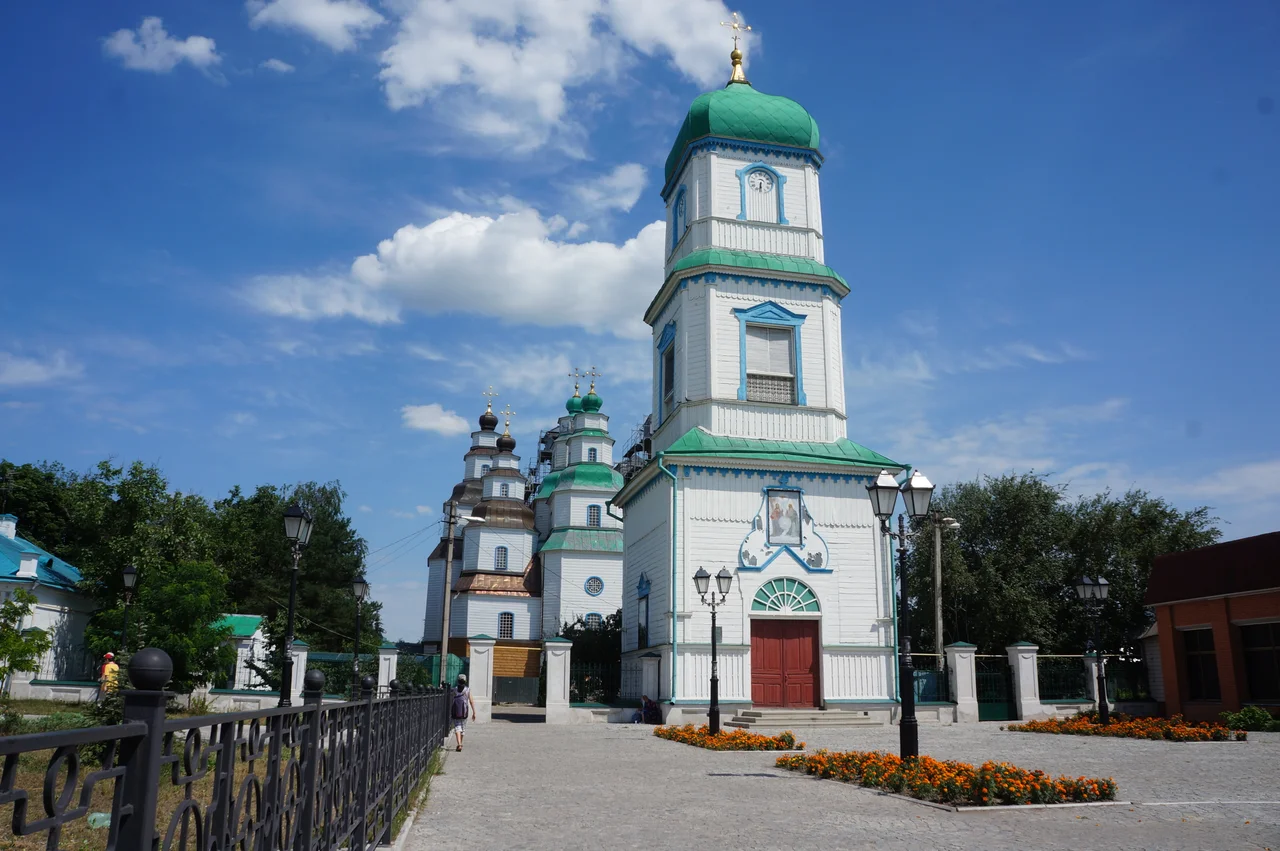
Trinity Cathedral, Samar
Nine wooden domes climb into the sky over Samar, arranged with such geometric confidence that architects have called the structure without parallel anywhere in the world. This is the Trinity Cathedral, and it holds a distinction no other church in Ukraine can claim: it is the only surviving nine-domed church built entirely of wood. The Zaporozhian Cossacks raised it between 1772 and 1781 in what was then the heart of the Samara Palanka, a district of their self-governing realm. To stand beneath its central dome, sixty-five meters overhead, is to look up through the confidence of a people who built their grandest monument not in stone but in timber, and made it soar.
Built Without Nails
The man credited with the cathedral is Yakym Pohribnyak, a self-taught folk architect, and the building is his masterwork. Its plan is a symmetrical composition of nine domes: the tallest at the center, four lower ones facing the cardinal directions, and four lower still filling the corners between them. Inside are three thrones, dedicated to the Trinity, to the apostles Peter and Paul, and to the Three Holy Hierarchs. What sets the structure apart from ordinary wooden churches is not just the count of its domes but the engineering that holds them aloft, a solution folk builders arrived at without formal training and which later architects struggled to explain. The founders were Cossack leaders, the kish otaman I. Chepiha, the polkovnyk Antin Holovaty, the elder M. Petrenko, and the Sich fighters who worshipped here. That such a building came from the Cossacks says something about them: the same men remembered for war and horsemanship also commissioned one of the most ambitious works of wooden sacred architecture their world produced, a house of worship meant to stand for centuries.
Rebuilt in Its Own Image
A wooden building this large is a wager against time, weather, and fire. The cathedral was first renovated in 1830, then rebuilt between 1887 and 1888, restored in the old style but with some alterations, and the bell tower that now accompanies it went up after that reconstruction. Each intervention faced the same challenge: how to renew a timber monument without erasing the thing that made it worth renewing. The nine-domed silhouette survived every round of repair, passed down from one generation of carpenters to the next like a form too important to change. For a structure of wood to reach its third century still standing, and still recognizably itself, is its own quiet miracle of maintenance.
The Cathedral in a Novel
Under Soviet rule the church was put to a humiliating use, turned into a storehouse, its sacred space filled with goods. That indignity became literature when the Ukrainian writer Oles Honchar made a threatened cathedral the center of his novel The Cathedral, a book that captured official contempt for such monuments and, in doing so, turned this specific building into a national symbol of heritage worth defending. The novel gave the cathedral a second life in the imagination of a country, so that its neglect became a public wound rather than a local one. Few buildings can claim a great writer among their guardians; this one can.
Racing the Rot
By 2012 the cost of survival had come due. The monument had gone more than 130 years without a proper restoration, and the wood was failing. Restoration work began that August, and the building was worked on again in 2021, a slow campaign to save timber that had stood since the age of the Zaporozhian Sich. It is painstaking work: replacing what has decayed while keeping faith with what Pohribnyak's carpenters achieved. The alternative, as Honchar's novel warned, is to let a singular thing collapse because no one thought its preservation urgent enough. That the cathedral still rises over Samar today is the answer several generations chose to give.
From the Air
The Trinity Cathedral stands at about 48.63°N, 35.26°E in the town of Samar, on the right bank of the Samara River near its junction with the Dnieper. From roughly 3,000 to 6,000 feet the cathedral's tall central dome, reaching around sixty-five meters, is a clear landmark against the low riverside town. Dnipro International Airport (UKDD) lies about 27 kilometers to the south-west.
Nearby Stories
- 1979 Dniprodzerzhynsk Mid-Air Collision 11 km away
- Dnieper Rapids 20 km away
- Battle of the Vorskla River 50 km away
- Battle of Dibrivka 61 km away
- Borki Train Disaster 93 km away
- Poltava Governorate Zemstvo Building 97 km away
- Kryvbas 110 km away
- Second Battle of Kharkov 116 km away