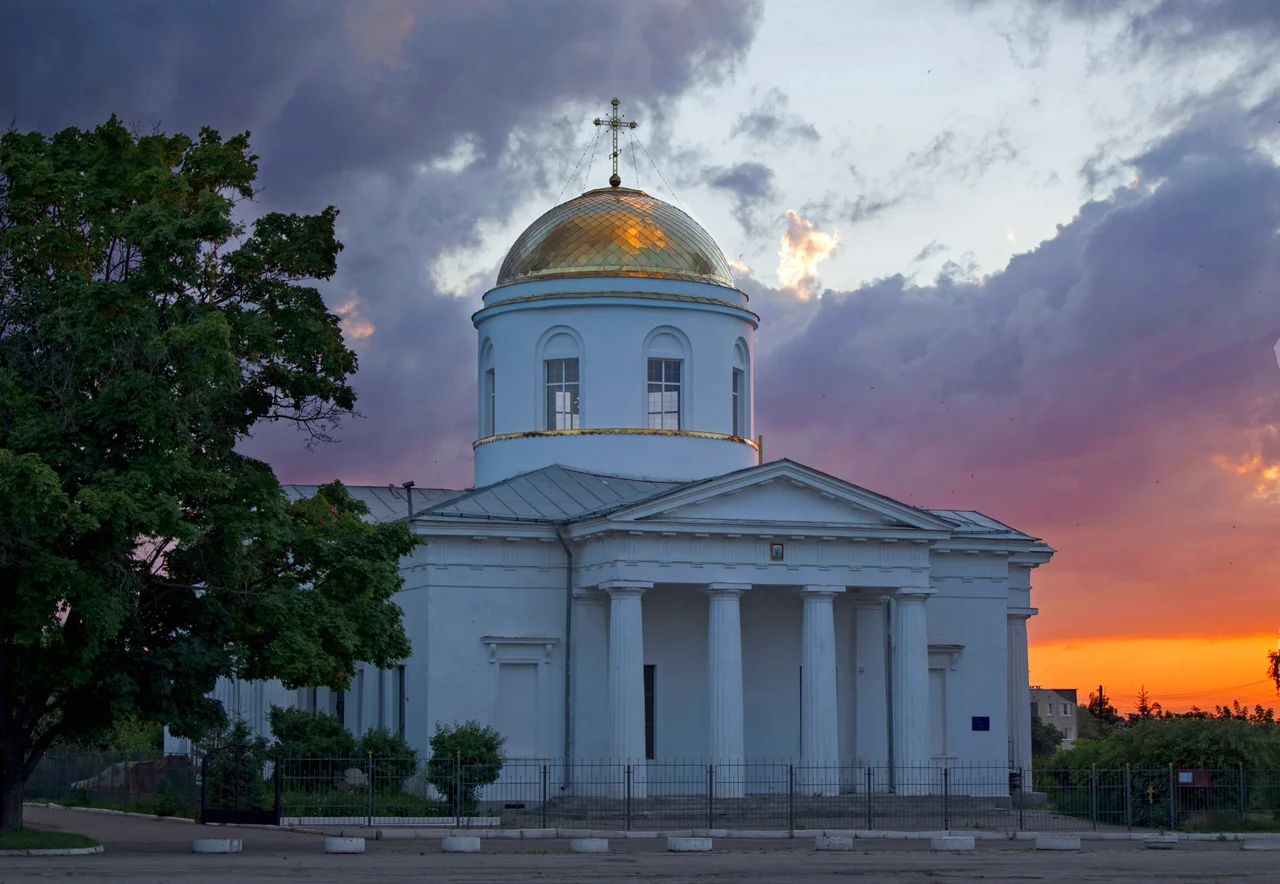

Chuhuiv
The boy who would become Ilya Repin grew up here, among the low houses of military settlers on the banks of the Seversky Donets, and the whole trajectory of his life can be read in that single fact. Chuhuiv was a place where soldiers were made, and Repin's family belonged to the class of state-organized military colonists who worked the land and answered the drum. He escaped into art, painting Volga barge haulers and Cossacks and tsars until he was celebrated across the empire. But Chuhuiv itself never escaped its founding purpose: for nearly four hundred years, it has been a garrison town.
A Fortress on the Frontier
The city's exact birthday is a matter of dispute, with claims ranging across the late sixteenth and early seventeenth centuries, and some accounts trace its origins to the reign of Ivan the Terrible. What is certain is that in 1638, Ukrainian Cossacks led by Yakiv Ostryanyn raised a fort here on the order of the Muscovite tsar, planting a defensive outpost on the open steppe of Sloboda Ukraine. This was borderland country, exposed to raids and contested by empires, and a fort made sense. That logic never really faded. A military presence of one kind or another has clung to Chuhuiv ever since, making it one of those places whose identity was fixed at the moment of its creation and never fully renegotiated.
The Painter Who Left
Ilya Repin was born in Chuhuiv in 1844 and lived until 1930, long enough to see the empire he painted swept away entirely. He became the towering figure of the Peredvizhniki, the movement of realist painters who broke from academic tradition to depict ordinary Russian and Ukrainian life with unsparing honesty. His canvases hang in the great museums of the world, and yet his origins mattered: he returned to Chuhuiv repeatedly, drew its people, and kept a home here. The town honors him still, with a monument, a preserved house, and a school that bears his name. It is a quiet kind of pride, the sort a small place takes in having sent one of its own to greatness while itself remaining largely unchanged.
Wings Over the Steppe
In the twentieth century the garrison grew wings. The Soviet Union turned Chuhuiv into a serious military training center, home to the Red Army's Artillery School and later a pilots' academy, and the tradition of teaching young men to fight carried into the age of aviation. Today a Ukrainian Air Force base sits beside the city, and the nearby academy is named for Ivan Kozhedub, a triple Hero of the Soviet Union celebrated as one of the great fighter aces of World War II. The town has known the cost of that vocation. In September 2020, a military transport plane carrying air force cadets crashed near Chuhuiv, killing twenty-six people, a tragedy that struck at the heart of a community bound so tightly to flight and to the young.
A City That Endures
For all its uniforms, Chuhuiv is an ordinary Ukrainian city of some thirty thousand people, with schools and shopping rows and an early nineteenth-century cathedral, a food industry that specializes, of all things, in producing mayonnaise. Its population is largely ethnic Ukrainian, though it has long carried one of the highest shares of residents with Russian roots of any settlement in the Kharkiv region, a reflection of its layered frontier history. When war came again in 2022, the city was shelled on the very first morning of the invasion, and a fourteen-year-old boy was among the first killed. Ukrainian forces held and retook it within weeks. Chuhuiv has always lived close to conflict; four centuries of standing on a contested frontier have taught it, above all, how to endure.
From the Air
Chuhuiv lies at 49.84 degrees north, 36.69 degrees east, in Kharkiv Oblast on the Seversky Donets River. From 3,000 to 5,000 feet, look for the compact urban grid, the river's meander, and the adjacent air base with its runway. The city sits about 40 kilometers southeast of Kharkiv International Airport (UKHH); the region is within restricted Ukrainian airspace.
Nearby Stories
- Verkhnii Saltiv Museum-Reserve 5.4 km away
- Borki Train Disaster 17 km away
- Hryhorii Skovoroda Literary Memorial Museum 32 km away
- Second Battle of Kharkov 47 km away
- Chalk Flora Nature Reserve 90 km away
- Trinity Cathedral, Samar 126 km away
- Yunkom Coal Mine 193 km away
- Grace Darling 553 km away