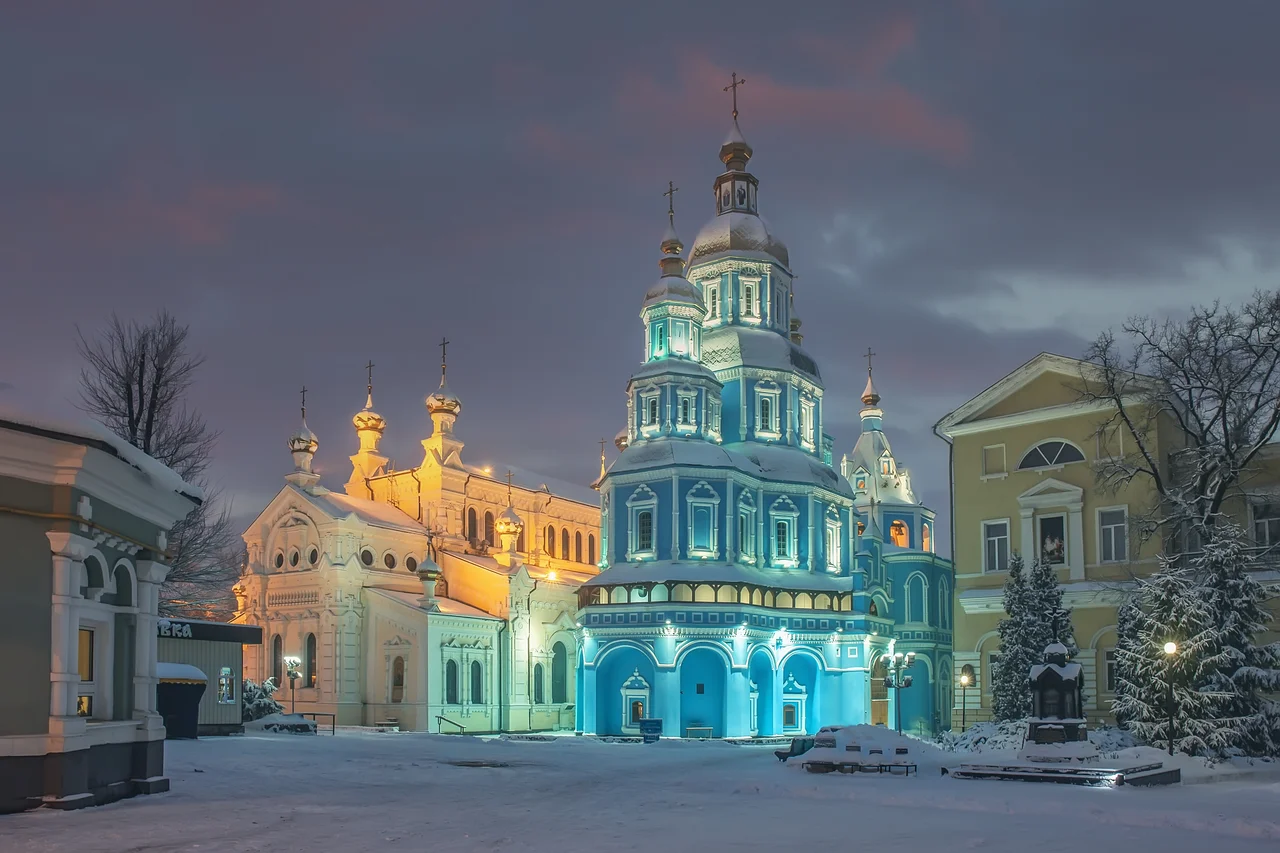

Intercession Cathedral, Kharkiv
It is the oldest thing still standing in Kharkiv. When the Intercession Cathedral was completed in 1689, the city around it was a rough frontier fort on the edge of the steppe; today, more than three centuries later, glass towers and Soviet monuments have risen and some have fallen, but this Cossack church remains, the single unbroken thread connecting modern Kharkiv to its beginnings. The local Cossacks who decided in 1659 to replace their humble wooden church with something permanent could not have known they were raising a building that would outlast every other in the city. Slender, white, and crowned with domes, it is a survivor by the simple measure of having endured longer than anything else here.
Two Churches in One
The cathedral is a masterwork of Ukrainian Baroque, the exuberant style, sometimes called Cossack Baroque, that flourished across the Left Bank in the seventeenth and eighteenth centuries. Its design solves an old northern problem with elegance: it is really two churches stacked together. Below sits a warm winter temple, low and easily heated for the bitter cold months; above rises a soaring three-domed upper church for the rest of the year, its verticality pulling the eye toward heaven. A narthex gallery links the upper church to the bell tower, tying the whole composition together. Consecrated by a bishop in 1689, restored and re-furnished in 1729, the church received a new bell weighing 1.6 tonnes in 1732, its voice carrying across a city that was still, in those years, very young.
The First University in Kharkiv
The cathedral's greatest legacy is not architectural but intellectual. In 1726 a bishop and the field marshal Mikhail Golitsyn established a monastery here, and with it a collegium, the first institution of higher education in Kharkiv and, indeed, on the entire Left Bank of Ukraine. Long before Kharkiv University made the city a center of learning, this monastery complex was where the region's students first studied at an advanced level, a seminary of scholars gathered in the shadow of the old Cossack church. The complex that grew around the cathedral eventually included a seminary, the episcopal residence of Kharkiv's bishops, and a second church dedicated to the Ozerianska icon of the Mother of God, making the site a spiritual and educational heart of the city.
A Complex Around the Church
The cathedral never stood alone for long. Over the centuries a whole monastic and educational complex grew up around it, and much of it survives as part of the ensemble today. Beyond the seminary and the collegium, the grounds came to include the episcopal residence of Kharkiv's Orthodox bishops and a second church dedicated to the Ozerianska icon of the Mother of God, one of the region's most venerated images. The result is not a single building but a layered compound, accumulated across generations, that traces the growth of the church's authority in the city. Where the first Cossacks had raised a lone wooden chapel on the frontier, later centuries assembled a small ecclesiastical city, its bell tower and domes anchoring the skyline of the district that grew up on University Hill.
Decay and Return
The cathedral's long life has not been without silence. Closed in the 1920s under Soviet anti-religious policy, it fell into decay for more than three decades, an ancient building left to crumble in a state that had no use for it. Its fortunes turned only after the fall of the Soviet Union: in 1992 the cathedral was returned to the church, and worship resumed within walls that had first echoed with prayer three hundred years earlier. For a period between 1799 and 1846 it had held the formal status of a cathedral, and it carries that title again today. To stand before it is to stand before the founding stone of Kharkiv itself, the one structure that has watched the entire history of the city unfold and remained, through it all, standing.
From the Air
The cathedral stands at roughly 49.99 degrees north, 36.23 degrees east, on the elevated ground of University Hill in central Kharkiv near the Lopan River, close to the taller Dormition Cathedral. From the air, look for its cluster of Baroque domes among the historic downtown. The nearest major airport is Kharkiv (UKHH) to the south.
Nearby Stories
- Giant Ukrainian Radio Telescope 12 km away
- Hryhorii Skovoroda Literary Memorial Museum 18 km away
- Borki Train Disaster 20 km away
- Hetman National Nature Park 61 km away
- Central Black Earth Nature Reserve 81 km away
- Second Battle of Kharkov 88 km away
- Poltava Governorate Zemstvo Building 95 km away
- Grace Darling 538 km away