
Battle of Blue Waters
The river gave the battle its name: the Syniukha, whose name evokes blue water, winding through the open country of central Ukraine toward the Southern Bug. Somewhere along its banks, in the autumn of 1362 or 1363, two very different powers collided, the rising Grand Duchy of Lithuania and the once-invincible Golden Horde of the Mongols. The Lithuanians won decisively, and with that victory they finalized their conquest of the Principality of Kiev. It was a hinge moment in the history of Eastern Europe, fought far from any great city, on a stretch of riverbank most people today could not find on a map.
An Empire in Fracture
The Golden Horde that met the Lithuanians here was no longer the unstoppable force that had once swept across the Rus' lands. When its ruler Berdi Beg Khan died in 1359, the Horde plunged into two decades of succession disputes and internal wars, a long crisis that lasted until 1381. The great Mongol state began breaking apart into separate districts, its unity dissolving from within. Grand Duke Algirdas of Lithuania, a shrewd and ambitious ruler, saw the opening for what it was. With the Horde distracted by its own quarrels, he organized a campaign southward into Tatar-held lands, pressing an advantage that a stronger, united enemy would never have offered. Timing, as much as arms, set the stage for what happened on the Syniukha.
The Turning of the Tide
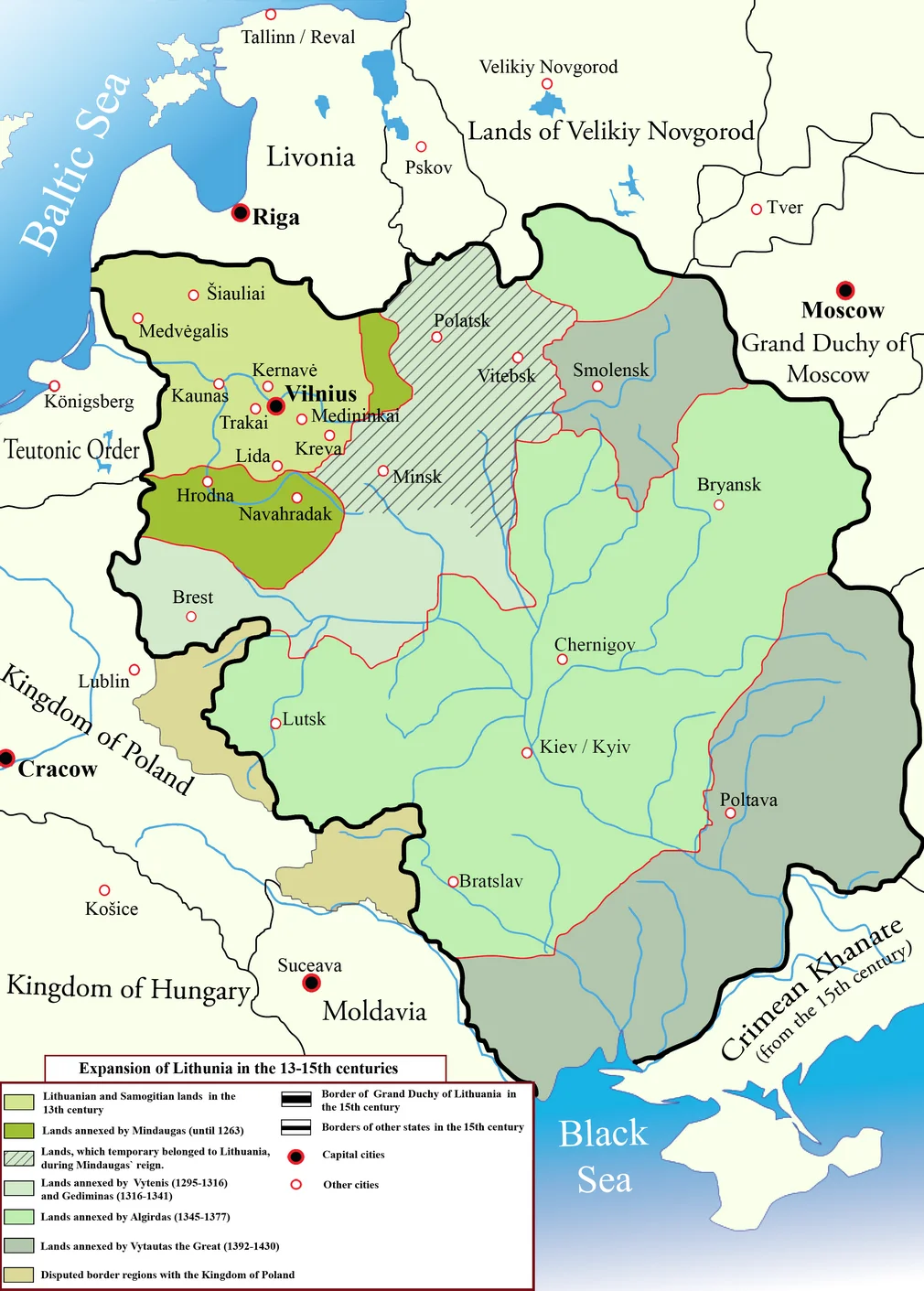
The Lithuanian victory at Blue Waters carried weight far beyond the day itself. For more than a century, the lands around Kyiv had lain under the shadow of the Golden Horde, paying tribute and bending to Mongol overlordship. Algirdas's triumph broke that hold and folded the Principality of Kiev firmly into the expanding Grand Duchy of Lithuania, which at its height would stretch across a vast swath of Eastern Europe from the Baltic toward the Black Sea. The defeat was one of the early, telling signs that the Horde's dominance over these western territories was ending. Power was shifting, and a battle on an obscure Ukrainian river marked one of the clearest early turns in that long transformation.
A Battle Half in Shadow
Much about Blue Waters remains uncertain, beginning with its very date, which the sources place in either 1362 or 1363. The precise site along the Syniukha, the numbers who fought, the details of the maneuvering, all are dim, the kind of gaps common to medieval battles recorded only in scattered later chronicles. Yet its importance was never in doubt to those who studied it: the memory of Blue Waters endured for centuries as a milestone in the histories of Lithuania, Ukraine, and the wider region, commemorated even in modern times. Standing today by the quiet Syniukha, with its blue-named waters running through the grasslands, it takes an act of imagination to see it, but this unremarkable river once helped decide who would rule the heart of Eastern Europe.
From the Air
The battle is placed at 48.66°N, 30.78°E, along the Syniukha River in what is now Kirovohrad Oblast, central Ukraine. From about 3,000 to 6,000 feet, the winding course of the Syniukha toward its junction with the Southern Bug is the guiding landmark across the surrounding plains. Ukrainian airspace is closed to civil aviation; the nearest operating airport is Chișinău (ICAO LUKK) in Moldova.
Nearby Stories
- Uman 16 km away
- Strategic Missile Forces Museum 19 km away
- Khutir Nadiia 50 km away
- Battle of Korsun 70 km away
- Aktove Canyon 71 km away
- Kholodnyi Yar 75 km away
- Bila Tserkva 104 km away
- Tiraspol 172 km away