
Tendra Spit
From the air, Tendra Spit barely counts as land: a pale filament of sand drawn across the Black Sea off the coast of Kherson Oblast, so thin it looks as if a single storm could erase it. Yet this fragile ribbon has held onto human memory for more than two thousand years. In classical antiquity, Tendra and the neighboring island of Dzharylhach joined the mainland in one unbroken bar of sand, and the Greeks gave that long causeway a name worthy of a hero: the Course of Achilles, the Dromus Achilles. Somewhere out here, they believed, the greatest warrior of the Trojan War ran and was honored. It is a curious thing to name a windswept sandbar after the fastest man in legend, but the sea and the sky here have a way of making even the smallest strip of ground feel like a stage.
The Coins That Confirmed a Legend
For centuries the tie between this sandbar and Achilles was half legend, half rumor, until the ground itself testified. In 1824, a naval expedition under Captain Nikolaj Kritski dug into the spit and unearthed roughly 800 ancient coins, and, more tellingly, graffiti dedicated to Achilles. Those inscriptions were proof: the Cult of Achilles had truly been active here, and a sanctuary to him had once stood on the sand. Later work only deepened the picture. Soviet-era expeditions recovered glazed pottery and Roman amphorae, and artifacts from the late Middle Ages. In 2017, a survey of the spit's northern tip, using sonar alongside divers, pulled up amphora fragments spanning the first centuries BC and AD, ancient tiles, and a bronze plaque likely torn from the hull of a ship that wrecked here in Roman times.
A Fleet's Triumph and a Battleship's Mutiny
The sea around Tendra has a habit of witnessing history. On 8 and 9 September 1790, the waters off the spit hosted the Battle of Tendra, a naval engagement fought during the wars between the Russian and Ottoman empires for control of this coast. More than a century later, in June 1905, another moment of upheaval unfolded nearby: the mutiny aboard the Russian battleship Potemkin, when the crew rose against their officers in an episode that would echo through the twentieth century as a symbol of rebellion. Two lighthouses, the Tendra Lighthouse on the island and the Bili Kuchuhury Lighthouse on its western spur, still keep watch over these crossings, marking the shoals for any vessel threading past the low, shifting sand.
A Wall of Sand Against the Sea
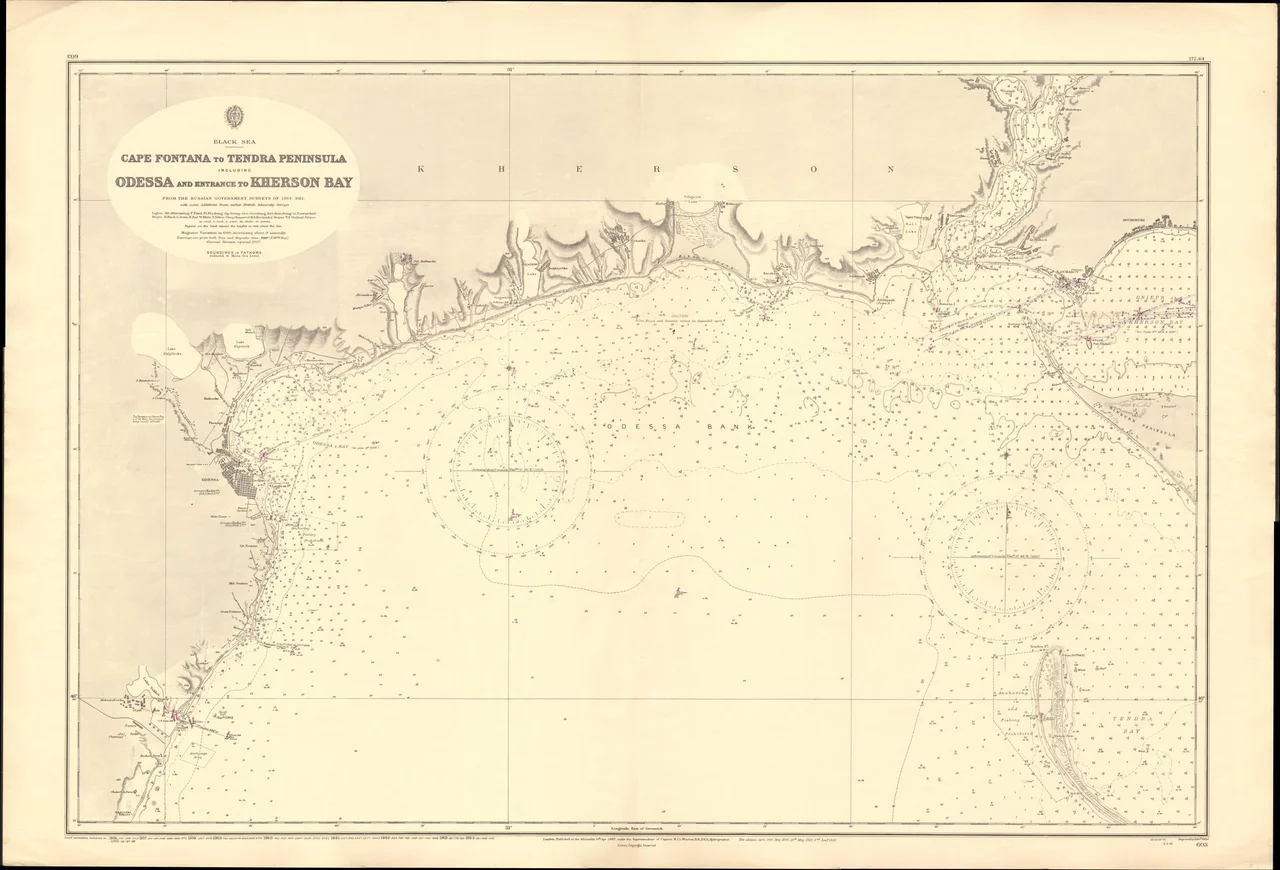
Look closely at the spit's geography and you understand why sailors respected it. Tendra runs along the southern and western edge of its bay, separating the calm Gulf of Tendra from the open Black Sea like a long, low breakwater laid down by the sea itself. At its western end, a narrower arm called Bili Kuchuhury reaches out and continues eastward through the gulf as a submerged shoal, trailing toward the Yahorlyk Kut peninsula, a hidden ridge of sand just beneath the surface that could gut an unwary hull. To warn ships of these traps, two lights stand guard: the Tendra Lighthouse on the island and the Bili Kuchuhury Lighthouse out on its western spur. Together they mark a landform that is constantly reshaped by wind and current, a shifting boundary between sheltered water and open sea that has never quite held still.
The Sand Contested Again
War returned to Tendra in the twenty-first century. During the Russian invasion of Ukraine, on the night of 28 February 2024, Ukrainian troops from the 73rd Maritime Special Operations Center attempted a landing on the spit and were ambushed; the operation ended in heavy losses, with soldiers killed and one man captured, a costly night that Ukrainian sources mourned openly. That August, Ukraine reported another raid, striking Russian equipment on the sandbar. It is a strange fate for a place so slight and remote, this line of sand that has been a shrine, a battlefield, and a graveyard by turns. The Greeks who honored Achilles here understood something the centuries kept confirming: even the frailest scrap of ground can carry the weight of the men who fought and died on it.
From the Air
Set near 46.24 N, 31.63 E, off the Kherson coast. From 2,000 to 3,500 feet the spit reads as a long, narrow arc of bright sand separating the Gulf of Tendra from the open Black Sea, its lighthouses the clearest fixed landmarks. Kherson International Airport (UKOH) lies to the northeast; expect open water in every other direction.
Nearby Stories
- Berezan Island 4.4 km away
- Racecourse of Achilles 16 km away
- Arcadia 19 km away
- Kuialnyk Estuary 19 km away
- Mykolaiv Regional Museum of Local History 43 km away
- Karkinit Bay 56 km away
- Dzharylhach 102 km away
- Danube Delta 147 km away