
Arcadia
The name is a promise. Arcadia, in the old Greek imagination, was a mountainous country of shepherds and unspoiled contentment, a byword for the simple good life, and when this stretch of Odesa's Black Sea coast took the name, it was reaching for exactly that ideal. Today Arcadia is the city's best-known resort, a coastal quarter of beaches and pleasure grounds where the sea does most of the work of persuasion. It has been a place of escape for well over a hundred years, ever since a horse-drawn tram first rattled down to the shore and turned a quiet farm into a destination.
The Land of Shepherds by the Sea
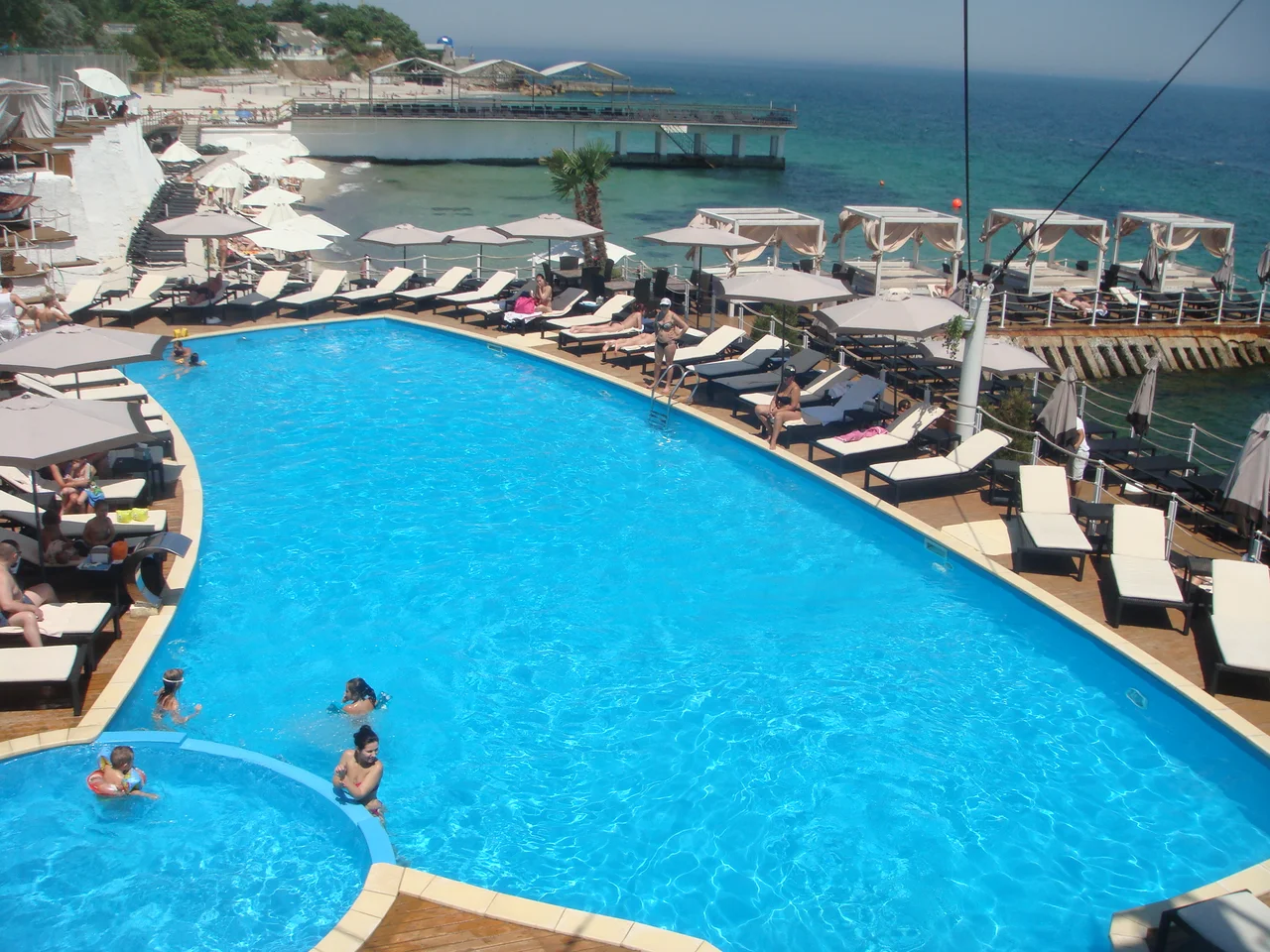
Arcadia sits in the coastal part of Odesa, close to the quarters of the fifth and seventh stations of Velyky Fontan, the old tram stops that still name the neighborhoods along this shore. The borrowed name is telling. The original Arcadia is a mountainous region of Greece long celebrated as the home of pastoral villagers, an emblem of rustic peace that European culture has invoked for centuries whenever it dreams of a gentler life. To attach that name to a seaside district was to make a certain kind of pitch, an invitation to leave the city's noise behind and step into an idyll. The famous Arcadia Beach and Arcadia Park anchor the quarter, and over time the idea has grown into a bustling complex of restaurants and entertainment threaded with elements of a shopping center, the modern face of an old promise of pleasure.
From a Nobleman's Farm to a Resort
Before it was a playground, Arcadia was farmland. Until the end of the eighteenth century, the area belonged to the Wittgenstein family as a farm on the edge of a young Odesa. It then passed to a striking figure: the Decembrist general Sergei Volkonsky, whose purchase of the land marked the beginning of settlement here. Volkonsky belonged to the generation of reform-minded officers whose failed uprising against the tsar in 1825 sent many of them into Siberian exile, and his name attached to this seaside ground links a resort of sun and leisure to one of Russia's most consequential political dramas. Under his ownership, what had been open farmland began, gradually, to become a place where people would come to stay.
The Tram That Made a Getaway
Arcadia's life as a true resort has a precise beginning. In 1894, work started on a horse-drawn tram running through the settlement down to the coast, the essential thread of infrastructure that could carry city-dwellers to the water in comfort. The resort itself was completed and opened on 1 July 1895. That single summer's day set the pattern for everything that followed: with the shore now easily reached, Arcadia became the seaside escape of Odesa, a role it has held through empires, wars, and the passage of well over a century. The pleasures have modernized, and the crowds have grown, but the core appeal is the one the founders were selling in 1895, the meeting of a great city and the open sea, with the whole afternoon free.
From the Air
Arcadia lies at 46.43 N, 30.76 E on the Black Sea coast of Odesa, southern Ukraine, near the Velyky Fontan shoreline. From low altitude the curve of Arcadia Beach, the green expanse of Arcadia Park, and the resort complex right at the water's edge are the clearest landmarks along the coast. The nearest major airport is Odesa International (UKOO), just to the northwest; Ukrainian airspace is closed to civil aviation.
Nearby Stories
- Lower Dniester National Nature Park 9.3 km away
- Battle of Berezan (1788) 15 km away
- Moldavian Autonomous Soviet Socialist Republic 46 km away
- Black Sea Shipyard 57 km away
- Racecourse of Achilles 57 km away
- Tiraspol 87 km away
- Zaliznyi Port 119 km away
- Danube Delta 128 km away