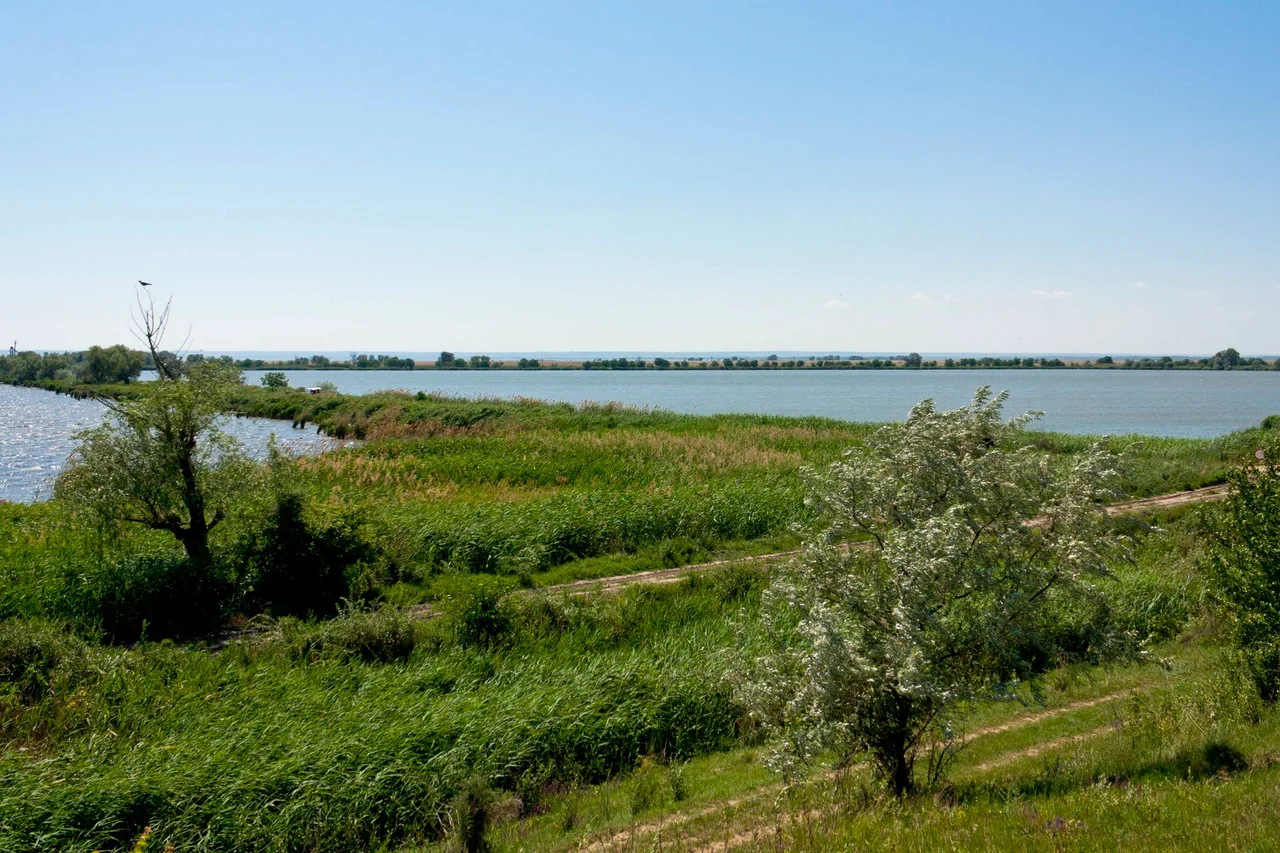

Lower Dniester National Nature Park
Locals call one of its channels the Amazon, and paddling through it, you understand why. The forest closes overhead, the water goes still and green, and the ordinary world drops away entirely. This is the Lower Dniester, the last stretch of a great river before it spills into the Black Sea, and it does not so much end as dissolve, breaking into a maze of reed thickets, floating bogs, and floodplain islands. Just thirty kilometers west of the bustle of Odesa, the national nature park protects one of southwestern Ukraine's richest wetlands, a place where the boundary between land and water is a matter of opinion.
Where the River Comes Undone
The park covers the northern part of the Dniester Liman, the broad estuary where the river's freshwater meets the sea. Here the Dniester is joined by the Turunchuk River, which arrives from Moldova to the west, and the two braid together into a landscape that refuses to hold still. The coastal edge is a freshwater lagoon; inland lie permanent deltas and shallow lakes that appear and vanish with the seasons. All of this sits within the Pontic-Caspian steppe, the immense band of grassland that stretches from the northern shores of the Black Sea all the way to western Kazakhstan. Against that dry, open backdrop, the Lower Dniester is an anomaly of abundance, a green artery of accumulative peninsulas, scroll ridges, and drifting islands of bog that rearrange themselves year by year.
A Kingdom of Birds
The wildlife here is staggering in sheer number. As many as 15,000 nesting pairs of birds have been estimated within the park, and the reed beds ring with them through the breeding season. The dominant waterfowl are the Eurasian coot, the great crested grebe with its elaborate courtship dances, the familiar mallard, and the black-headed gull, wheeling in noisy clouds over the shallows. The waters below are just as productive: more than seventy species of fish, grouped into twenty families, spawn in these floodplains, making the estuary a nursery as much as a habitat. For nesting and wintering waterfowl alike, the tangle of channels offers exactly what open steppe cannot, food, cover, and quiet water, and the birds arrive in the thousands to take it.
Four Ways Into the Wetland
The park is best explored slowly, by boat, and it offers four marked ecotourism routes for the purpose. The first, aptly named the Dniester Amazon, threads the picturesque forest channel of the Amazon Strait and the Turunchuk River, with six observation stops along the way. Running parallel to it is the Brilliant Ibis, a second river course through the same shimmering country. For those who come chiefly for the wildlife, the Kingdom of the Birds is a twenty-kilometer excursion through the shallow reaches of the estuary, drifting past the very rookeries where the coots and grebes raise their young. A fourth route, the Trail of Dad Ovsia, rounds out the choices. Each one trades speed for immersion, the only sensible way to travel a place where the water leads and the traveler follows.
From the Air
The Lower Dniester National Nature Park centers on roughly 46.41 N, 30.21 E, about 30 km west of Odesa in Odesa Oblast, southwestern Ukraine. From low altitude in clear weather the braided channels of the Dniester and Turunchuk, the reed-fringed lagoon, and the broad Dniester Liman opening toward the Black Sea are unmistakable from the surrounding flat steppe. The nearest major airport is Odesa International (UKOO) to the east; Ukrainian airspace is closed to civil aviation.
Nearby Stories
- Odesa Catacombs 6.8 km away
- Moldavian Autonomous Soviet Socialist Republic 33 km away
- Black Sea Shipyard 108 km away
- Racecourse of Achilles 111 km away
- Danube Delta 115 km away
- Battle of Vaslui 137 km away
- Zaliznyi Port 173 km away
- Battle of Baia 261 km away