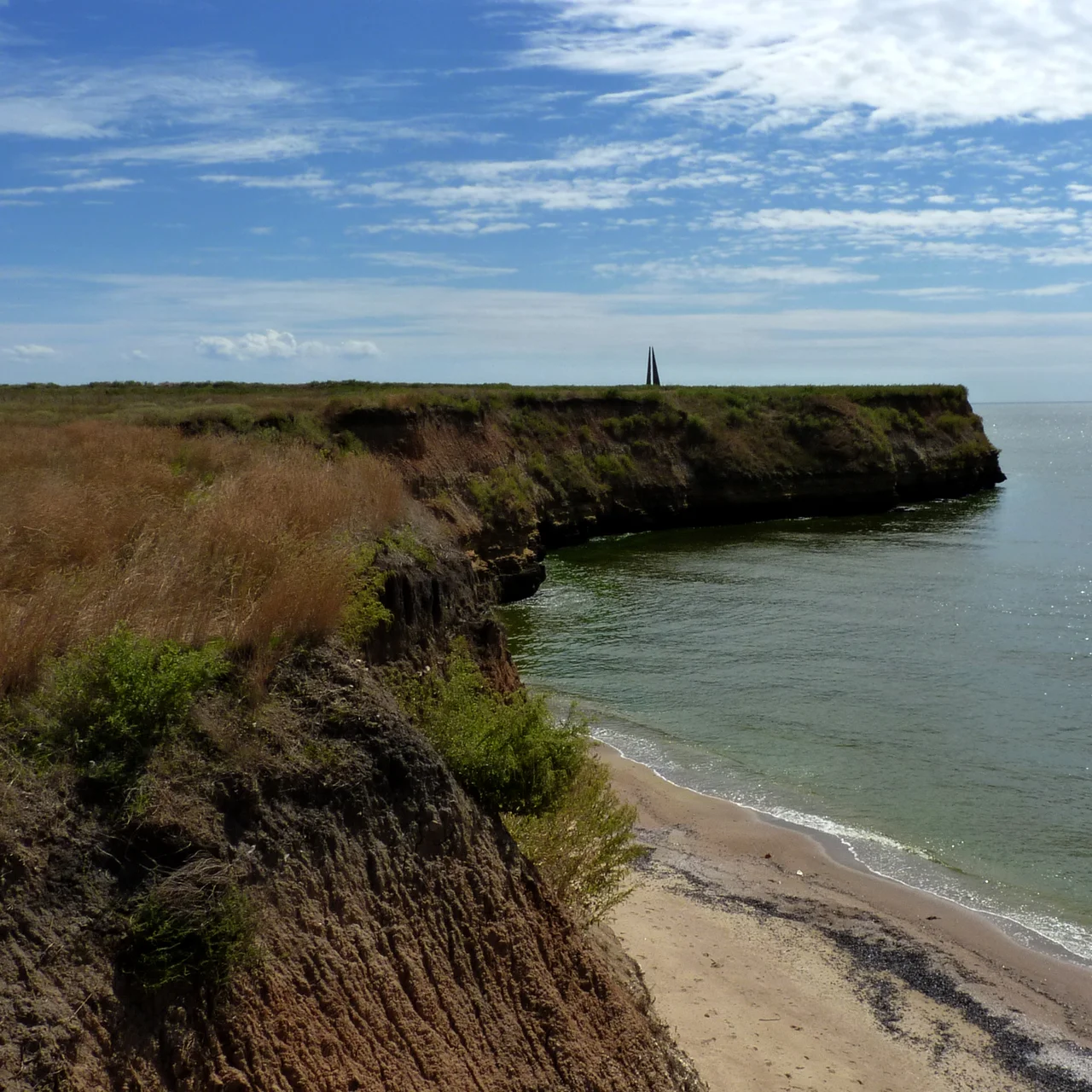

Berezan Island
It is barely nine hundred meters long and three hundred wide, an uninhabited scrap of land you could walk across in minutes, and Herodotus came here in the fifth century BC to ask about a river. Berezan Island sits just off the mouth of the Dnieper-Bug estuary, and its smallness is deceptive: this speck of windswept ground hosted one of the earliest Greek colonies on the entire Black Sea, sheltered Viking traders bound for Constantinople, and witnessed an execution that would echo through a revolution. Whoever wanted to command the Dnieper's mouth, and across nearly three millennia many did, had to reckon with Berezan.
The First Greeks on These Shores
Around the middle of the seventh century BC, Greek settlers, most likely from Miletus, established a colony here, possibly called Borysthenes after their name for the Dnieper. It was among the very first Greek footholds in the northern Black Sea, and it thrived on a single lucrative trade: wheat, grown in the vast Scythian hinterland and shipped south to feed the Greek world. The great historian Herodotus visited in the fifth century BC, gathering what he could learn about the mysterious upper course of the river. Berezan flourished until the end of that century, when the nearby colony of Olbia rose to dominate the region and the island faded. Archaeologists have dug here since the nineteenth century and, despite erosion and the looting of tombs, recovered rich finds, archaic pottery, inscriptions, the material traces of a Greek town at the edge of the known world.
A Viking's Grave and a Single Stone
Berezan's location made it valuable again in the Middle Ages, because it commanded the mouth of the Dnieper, and the Dnieper was a highway. In the age of Kievan Rus, the island was an important station on the trade route from the Varangians to the Greeks, and it was here, sources suggest, that Varangians and Greeks first came into contact. In 1905 an archaeologist found something remarkable: the only runic inscription ever discovered in southern Ukraine. The Berezan Runestone, now in the Odesa Historical Museum, had marked a grave, and its message is human and plain: "Grani made this vault in memory of Karl, his partner." Control of these waters, called Beloberezhye, the White Shores, in old East Slavic sources, was fought over by Rus and Byzantium; a treaty in 944 let the Rus use the island in summer, and after one campaign the Rus prince Sviatoslav wintered his hungry troops here in 971 and 972.
Cossacks, Colonies, and an Execution
Through the 14th and 15th centuries the island lay within the sphere of the Grand Duchy of Lithuania, then passed under the Crimean Khanate, uninhabited but never forgotten; the Zaporozhian Cossacks used its shelter to anchor and rest during their sea raids. In the 16th and 17th centuries those Cossacks revived Berezan as a fort in their campaigns against the Crimean Tatars and the Ottomans, and after neighboring Ochakov fell to Russia the island was absorbed into the empire. Then came March 1906, and the island's most solemn chapter. Pyotr Schmidt, a naval lieutenant who had led the 1905 Sevastopol Uprising against the tsarist order, was brought here and executed by firing squad. His name would live on long after, a martyr's memory carried through the turbulent years that followed, and an obelisk on the island still marks the loss.
The Island Today
Berezan is uninhabited now, an integral part of the Olbia historical and archaeological reserve of Ukraine's National Academy of Sciences. In summers past, expeditions from the Academy's Institute of Archaeology and even the State Hermitage Museum came to work its ancient soil, though the site suffers constantly from unauthorized digging. Its layers keep yielding surprises: in 2013 archaeologists found an encolpion cross from around the turn of the twelfth century, hinting at a small settlement that may once have guarded the Varangian trade route. The island's long strategic logic has not entirely faded, either; in 2023 an underground munitions depot was built here. But stand on this low tableland with the estuary on one side and the open Black Sea on the other, and what lingers is the sheer depth of it, a field-sized island where Greek grain merchants, Viking traders, Cossack raiders, and a revolutionary lieutenant all left their mark on the same few hundred meters of ground.
From the Air
Berezan Island sits at 46.60°N, 31.41°E, near the seaward mouth of the Dnieper-Bug estuary, roughly 8 kilometers from Ochakiv. From 2,000-4,000 feet it reads as a small, flat-topped island alone in open water, its southern cliffs rising to about 21 meters while the northern end stays low. Nearest airports are Mykolaiv (UKON) and Odesa (UKOO) along the coast to the west.
Nearby Stories
- Mykolaiv Regional Museum of Local History 4.4 km away
- Kuialnyk Estuary 17 km away
- Tendra Spit 22 km away
- Racecourse of Achilles 26 km away
- Adziogol Lighthouse 27 km away
- Mykolaiv Observatory 39 km away
- Strategic Missile Forces Museum 141 km away
- Danube Delta 174 km away