
Perchem
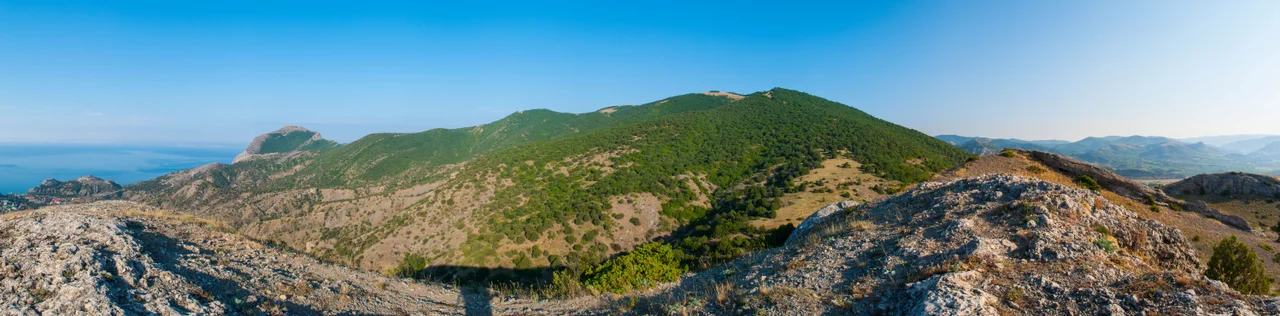
The rock underfoot on Perchem was once alive. A hundred and thirty million years ago, in the warm, shallow water of the Tethys Ocean, corals and sponges and lime-building algae grew in colonies no more than forty or fifty meters below the surface. Each generation extracted calcium from the sea, died, and left its skeleton for the next to build upon. Over unimaginable stretches of time those skeletons hardened into stone, the ocean drained away, and the reef rose into the air as a mountain. Today Perchem stands 576 meters above the Sudak valley in southeastern Crimea, its slopes wooded, its summit crowned with steppe glades, its Crimean Tatar name meaning simply fringes, for the ragged cover of trees along its ridge.
A Reef Turned to Stone
The mountains around Sudak and neighboring Novyi Svit form what geologists call a reserve of fossil reefs, among the most vivid on Crimea's southern coast. What makes them unusual is not just their origin but their hardness. In porous reef rock washed by water, dissolved calcium carbonate settles into the empty spaces and cements the coral-algae framework into dense, marbleized limestone. Cut and polished, the fossils and calcite crystals inside take a lustrous shine, their intricate shapes making a striking decorative stone. The scale is staggering. Nearby Sokol mountain holds 300 to 350 meters of reef, many times deeper than the shallow water in which it grew, because the seabed sank at roughly the same pace the reef climbed, allowing the coral to keep building upward for ages. Erosion later carved Perchem apart from the ancient Sokol and Krepostnaya reefs to its south.
Temples in the Woods
People have been drawn to these slopes for a very long time. At the end of the 18th century the naturalist Peter Pallas found quarries still working near Perchem's western spurs, where dense sandstone was cut into millstones. In 1927 an expedition led by the academician Yuri Gautier came to study the great fortress at Sudak and the archaeological sites scattered across the surrounding hills. On Perchem's southern slope, one of Gautier's colleagues, a man named Fomin, uncovered the ruins of a temple. Later surveys suggested at least two more religious sites still lie unexcavated on the mountain, their stones waiting under the leaf litter and the juniper. To walk Perchem now is to move through a landscape where deep geological time and human devotion have both left their marks, one written in coral and calcite, the other in cut stone.
The Winter of 1942
The forest on Perchem was once a refuge in war. In January 1942, during a Soviet landing operation on this coast, an advance party of 218 men from the 226th Mountain Rifle Regiment came ashore near Novyi Svit under cover of a naval destroyer. They slipped inland without resistance, but in an attack on the local commandant's office their commander and several of his fighters were killed. The survivors withdrew into Perchem's woods, where they kept watch over the road between Alushta and Sudak until the main force arrived and relieved them. Those men are part of the mountain's story now, alongside the corals and the quarries and the ruined temples. Since 1972 the northeastern slope has been a protected park, a monument of garden and park art, its rare pines, junipers, and Atlas pistachios sheltered so that the reef that became a mountain can go on being a refuge.
From the Air
Perchem rises to 576 meters at 44.86°N, 34.93°E, west of the Sudak valley on Crimea's southeast coast. From about 6,000 feet its wooded, dome-shaped summit stands out against the pale limestone of neighboring Sokol and the Black Sea beyond, with the town of Sudak to the east. Nearest airport is Simferopol (UKFF), roughly 60 nautical miles northwest; expect turbulence in mountain weather.
Nearby Stories
- Partenit 12 km away
- Valley of Ghosts 19 km away
- Aeroflot Flight 6515 32 km away
- Crimean Nuclear Power Station 33 km away
- Ayu-Dag 53 km away
- Battle of the Kerch Peninsula 53 km away
- Juma-Jami Mosque 84 km away
- 1976 Anapa Mid-Air Collision 142 km away