.jpg)
Katanga
Ask where the Congo's heart of mineral wealth lies, and any Congolese will answer without hesitation: Katanga. This is the southeastern cape of the country, the broad plateau that rolls down toward Zambia and nudges Lake Tanganyika on its eastern flank. It was de facto independent from 1960 to 1966 during the Katanga Crisis, and it has never quite stopped thinking of itself as its own place. Visitors who make it here - not many do - find a landscape of fertile ranchland, ore-rich hills, and a capital city that has a golf course older than most African nations.
Lubumbashi, the Capital of the South
Lubumbashi is the Congo's second city and, for travelers, the practical gateway. Lubumbashi International Airport pulls flights from Addis Ababa, Nairobi, Johannesburg, and all major Congolese centers. The city itself is wide and leafy, laid out on a grid inherited from the Belgian colonial period and filled in with a century of Congolese urban life. The Cathedral of Saints Peter and Paul, built in 1910, anchors the old center. The National Museum of Lubumbashi on 750 Avenue du Musee holds some of the best ethnographic collections in central Africa. The Mineralogical Museum is a smaller building with a focused collection that makes sense of the landscape outside - malachite, cobalt-rich cobaltite, and polished copper specimens from mines all around the region.
Colonial Bones
The Lubumbashi Golf Club on Route du Golf was laid out in 1934. The Cercle Wallon, the old Belgian social club at 2 Avenue de la Revolution, still keeps a tennis court going. The Saint Therese Church was built around 1925, the Saint-Albert Church is older still, and the Sacred Heart Church on Boulevard De L'Independance holds Sunday liturgies that fill the nave. These are monuments from a particular colonial moment - comfortable for the Belgians who ran the mining empire, less so for the Congolese who worked it - and they survive in a kind of awkward dignity, still useful, still in service, now inherited by a country that is not the country that built them.
Getting Around (the Honest Version)
Roads in Katanga range from bad to non-existent depending on the season. A railway connects Lubumbashi to Likasi, but trains run only once or twice a month and schedules are flexible in the way that 'flexible' has come to mean 'do not plan a trip around this.' Flying is simpler and, for most of the distances involved, necessary. Charter services run out of Lubumbashi to mining towns and smaller airstrips across the region. The rainy season, November through April, makes ground travel genuinely difficult; the dry season is easier on vehicles but filled with dust that reaches the lungs and the camera lenses alike.
Eating, Drinking, Sleeping
Lubumbashi has a handful of established restaurants: Le Boucher for grilled meat, Cercle Grec for a Greek-accented menu that reflects the old Mediterranean trading community, India Spice for Indian food, Restaurant OKAPI for Congolese cooking. The Park Hotel - the former Hotel Leopold II at 50 Avenue Munongo - retains faded colonial grandeur. The AMS Guest House on Avenue de la Revolution is a practical modern option. Up on the lake at Kalemie, the Musalala Hotel on Ave Tanganyika offers rooms facing the water. Bars stay open late; the music is rumba, soukous, and the modern Lingala pop that sweeps through the city from the FM stations.
Go Carefully
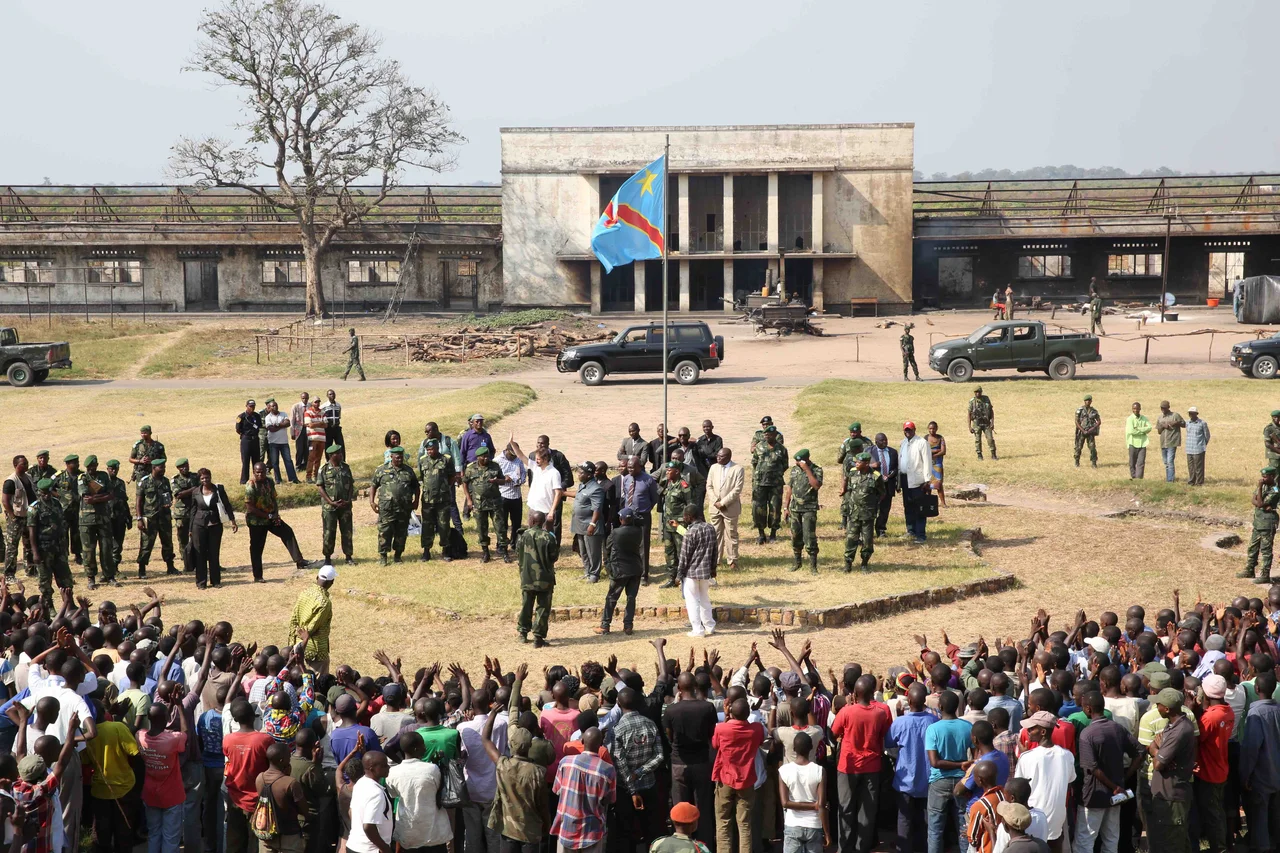
The Democratic Republic of the Congo is one of the poorest and most troubled countries in the world. Much of eastern Congo is unstable, and even Katanga has seen armed conflict - the Mai Mai Kata Katanga militia briefly took over part of Lubumbashi in 2013. Most visitors here come on business: mining contractors, NGO staff, diplomats. Independent travel is possible but requires Congolese contacts, patience with the paperwork, and a realistic assessment of the risks. What you find if you do make it is a part of Africa that few outsiders see - a land of long blue-green plateaus, enormous copper skies, mining towns with neon signs and generator hum, and people who have lived through more than most countries have ever asked of their citizens.
From the Air
Katanga centers around 11.14°S, 27.10°E on the southern Congolese plateau at roughly 1,200-1,500m elevation. Lubumbashi International (FZAA) is the primary airport with a 3,266m paved runway handling regional and international flights; Kolwezi (FZQM) and Kamina (FZSA) serve outlying mining regions. At cruise altitude (FL200-FL280) the Katanga Plateau, copperbelt, and the western shore of Lake Tanganyika are all visible. Dry season (May-September) offers excellent VFR; rainy season brings strong afternoon thunderstorms.
Nearby Stories
- Mwadingusha Hydroelectric Power Station 16 km away
- Shinkolobwe 22 km away
- Kafue River 23 km away
- Kalukundi mine 95 km away
- Copperbelt 108 km away
- Nchanga Copper Mine 150 km away
- Dambo 170 km away
- Lumwana 178 km away