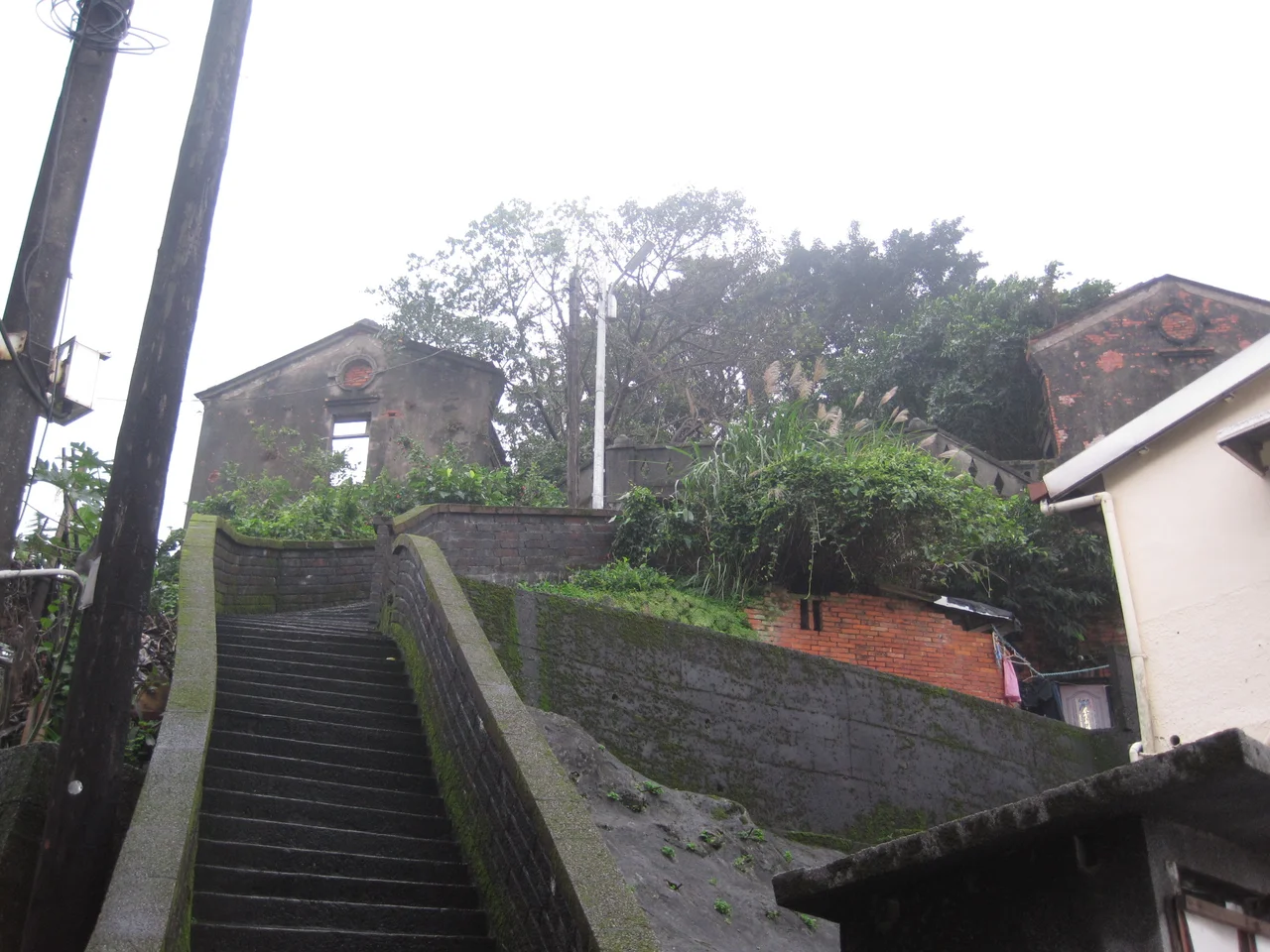

Khóo Tsú-song Old House
You can only reach it on foot. The streets near Keelung's famous night market eventually give way to narrow passages that become stairways, climbing a hillside until the city opens out below you — rooftops in every direction, the harbor somewhere in the haze — and there, at the top, is the house. It has no roof on its second floor anymore. The walls are brick, still standing after more than ninety years, red against the green of the surrounding vegetation. This is the Khóo Tsú-song old house, and the man it was built for deserves to be known by more than the beautiful ruin that bears his name.
The Man Called Hsu Tsu-sun
Khóo Tsú-song was born in 1874 and died in 1945 — a lifespan that bracketed the entire Japanese colonial period in Taiwan, from shortly after the Qing dynasty's cession of the island to the end of the Second World War. His name is the same name said two different ways: Khóo Tsú-song in Hokkien, the language he grew up speaking as a native Taiwanese; Hsu Tsu-sun in Mandarin, the name by which he is more widely known today. The difference in pronunciation signals something real about his life: he moved between worlds. During the Japanese period, he served in significant administrative roles, overseeing Keelung city and serving in capacities connected to Taipei province — a Taiwanese man operating within a colonial governance structure, navigating the complexities that entailed. In another register entirely, he was a recognized figure in literary circles, a poet connected to poets across Taiwan. Administration and art, official duty and cultural life — he held both.
The House on the Hill
In 1931, Khóo Tsú-song built his house on this Keelung hillside, a structure that combined architectural influences in ways that reveal something about the period. The massive red brick walls echo the fortifications and official buildings that Dutch and Spanish colonizers had erected in Tamsui and Tainan centuries earlier — colonial materials become domestic use. The two-story structure, and its symmetrical double staircase leading to the upper floor, suggest European stylistic influence as well, the kind of form that moved through colonial Taiwan in the nineteenth and early twentieth centuries. But step onto the second floor, and the plan changes register: the arrangement of rooms and the central square courtyard are distinctly Hokkien — Fujian architecture as it was practiced in the communities that crossed the Taiwan Strait. The house is three histories in one.
A Ruin Worth Protecting
Khóo Tsú-song died in 1945. His house outlasted him by decades, but not comfortably. The structure was recognized as a historical building in 2001, but that designation stopped short of the stronger protections afforded to an officially listed Historical Site — a distinction that matters because the property is partially privately owned, and legal recognition without full protection leaves buildings vulnerable. The house has been abandoned for more than thirty years. Keelung's climate is one of the wettest in Taiwan; without maintenance, buildings here deteriorate. The second floor has lost its roof entirely. The red brick walls and most of the windows remain, but the house now exists as a ruin, beautiful in the way that ruins can be beautiful — the sky visible through where ceilings used to be, vegetation finding its way through gaps in the masonry.
Keelung Youth Front and the Work of Memory
In July 2014, a local organization called the Keelung Youth Front began cleaning the Khóo Tsú-song old house with the practical goal of making it accessible to visitors who want to see this piece of Keelung's architectural and cultural heritage. The effort is modest — cleaning and opening, not restoration — but it reflects something important: a recognition that places like this are irreplaceable once they are gone, and that the people who cared about them need to act before the question is decided by decay. The house on the hill above the night market is, for now, both ruin and landmark. It is worth climbing the stairs to see. The view of Keelung's rooftops from the top is the same view that Khóo Tsú-song had from his window — a poet and administrator's view of the city he served, the city whose humid climate has been slowly, steadily reclaiming his house ever since.
From the Air
The Khóo Tsú-song old house sits at approximately 25.13°N, 121.74°E on a hillside in central Keelung, Taiwan. From the air at 3,000–5,000 feet, Keelung's distinctive harbor geography is the dominant feature — a nearly landlocked harbor basin surrounded by hills on three sides, with the city built densely along the slopes. The house itself is on one of the inner hillsides near the city center, close to the famous night market area. The Port of Keelung's container terminals are visible to the north and east. Nearest major airport: RCSS (Taipei Songshan), approximately 25 km to the southwest. Keelung is one of Taiwan's rainiest cities; low cloud and reduced visibility are common, especially in autumn and winter. In clear weather, the harbor is a striking visual landmark from altitude, with the surrounding green hills providing dramatic contrast.
Nearby Stories
- Taoyuan Air Base 4.7 km away
- Min Ping Yu No. 5540 Incident 6.9 km away
- Neiwan 14 km away
- North Jiangsu Main Irrigation Canal 982 km away
- Sinking of MV Sewol 1049 km away
- General Cliff Rock Paintings 1058 km away
- Yellow Sea 1108 km away
- Sibuyan Island 1376 km away