
Kisangani
The river decides everything in Kisangani. For thousands of kilometers the Congo runs smooth and broad, carrying barges up from Kinshasa over weeks of slow water - and then, here, it breaks. The Boyoma Falls scatter the river across a hundred-kilometer chain of cataracts, and boats can go no farther. So a city grew at the obstacle, the way cities always do, to unload what the river could no longer carry. Its name comes from Swahili for the city on the island, because the tributaries here splinter the land into a scatter of islets. Today roughly a million and a half people live at this dead end of the great river, deep in the equatorial forest, about as far from anywhere as a city can be.
The Men on the Tripods
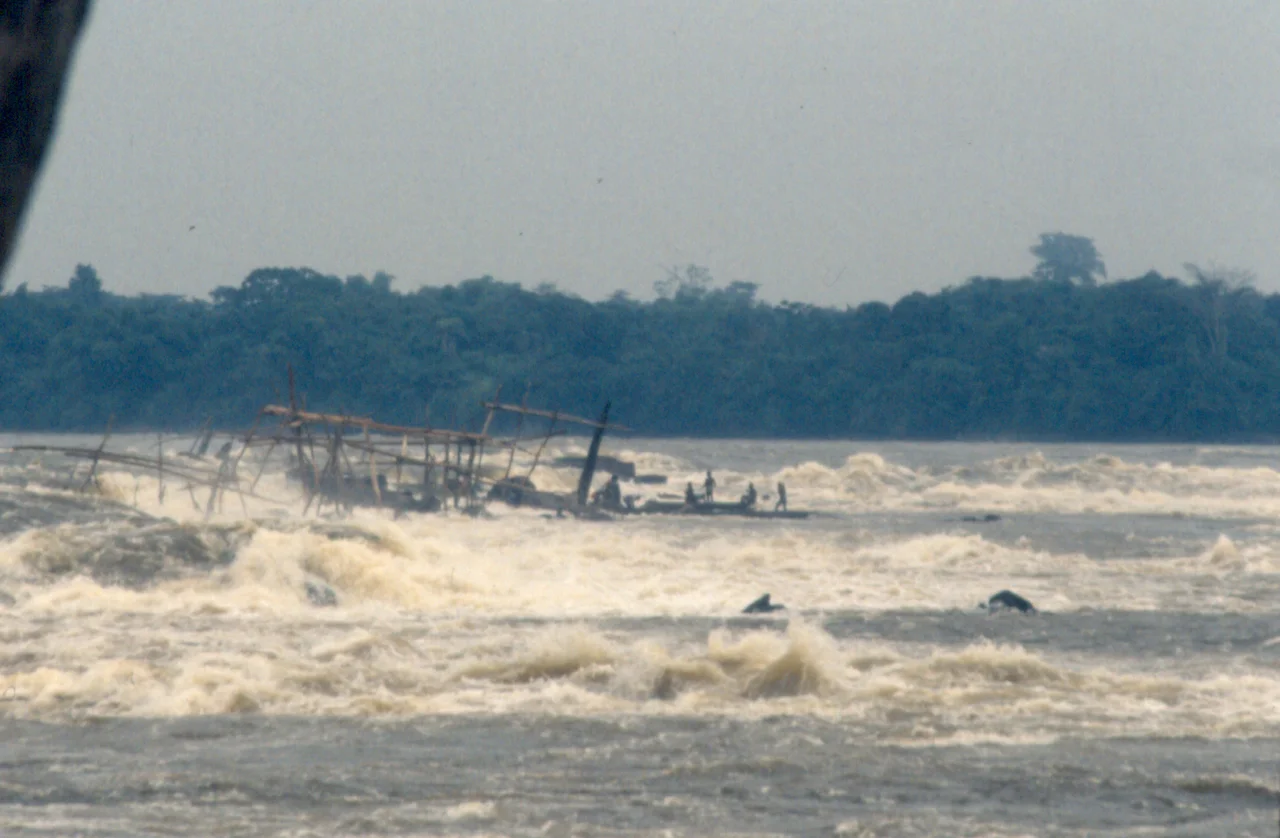
Where the river breaks into the first cataracts, the Wagenya people fish the way their ancestors have for some two hundred years. They build enormous wooden tripods out over the rapids, anchoring the legs in holes the current itself has bored into the rock, and from these scaffolds they lower huge conical baskets into the white water. The river sieves itself through the traps; the catch is hauled up by hand. It is dangerous, exhausting, and astonishing to watch - a piece of engineering improvised against one of the most powerful rivers on Earth, maintained across generations by knowledge that lives in nobody's manual. The weirs are now the thing visitors come to see, but for the Wagenya they remain what they have always been: the daily work of feeding a family from a river that does not forgive mistakes.
Stanley's Falls
In December 1883, the explorer Henry Morton Stanley founded a trading post on an island near the cataracts and gave them his own name - Stanley Falls - and the settlement that grew became Stanleyville. The early years were brutal. Slave-raiders operating out of Zanzibar pushed into the region, and the post was abandoned in 1887; the Belgians only secured control by striking a deal with the notorious slave-trader Tippu Tip, handing him authority over the eastern Congo. By the late 1890s Stanleyville had become the capital of Belgium's prosperous Eastern Province - prosperity built, as everywhere in the Congo Free State, on coercion and extracted labor. The colonial city that rose here was beautiful and violent in equal measure, and the river carried both its riches and its cruelties downstream.
Years of Fire
Few cities have absorbed as much war as this one. In 1958 Stanleyville was a stronghold of Patrice Lumumba's independence movement, and after his assassination it became a rival seat of government. In 1964 the Simba rebels held the city and seized more than 1,800 European and American civilians, packing them into the Victoria Hotel for 111 days until Belgian, American, and Congolese paratroopers stormed the city in a chaotic rescue; some sixty hostages died. Far worse came later. During the Second Congo War, Ugandan and Rwandan armies - nominal allies - turned their guns on each other inside Kisangani itself, and ordinary residents paid the price. Fighting in August 1999 killed an estimated 200 civilians; a six-day battle in June 2000 destroyed roughly a quarter of the city and killed an estimated 1,000 more, wounding thousands. The people of Kisangani did not start these wars. They simply lived where the wars were fought.
The Quiet After
Kisangani today is a strangely peaceful place for all it has endured - a commercial town set down in a sea of green, the cathedral of Notre Dame du Très Saint Rosaire rising above streets where bicycles and motorbikes far outnumber cars. The city's isolation is total: the road in from Bukavu is long and unsafe, and the ferry down to Kinshasa can take two or three weeks, an unhurried epic aboard lashed-together barges crowded with traders and cargo. That same isolation has kept Kisangani extraordinarily diverse, a meeting point of more than 250 cultures where no single people dominates. It is not an easy city, and not a rich one. But it is a survivor, perched at the edge of navigation where the Congo finally refuses to be tamed.
From the Air
Kisangani sits almost exactly on the equator at 0.52°N, 25.19°E, in the heart of the Congo rainforest where the Congo River bends and the Boyoma (Stanley) Falls begin. Bangoka International Airport (ICAO: FZIC) lies about 17 km northeast of the city and is the main gateway; the older Simi-Simi airfield near the center is now military. From the air the dominant feature is the river itself, vast and braided into islands, with the white line of the cataracts northeast of town and unbroken forest stretching to every horizon. The cathedral and riverfront mark the city core. Expect heavy equatorial humidity and frequent buildups; mornings generally offer the clearest air before afternoon convection, with a relatively drier window from December to early March.
Nearby Stories
- Maringa-Lopori-Wamba Landscape 287 km away
- Congo Basin 291 km away
- Okapi Wildlife Reserve 347 km away
- 1976 Zaire Ebola Virus Outbreak 375 km away
- Virunga National Park 433 km away
- Rwenzori Mountains 468 km away
- Bwindi Impenetrable National Park 516 km away
- Komanda Massacre 521 km away