
Okapi Wildlife Reserve
For most of history, the okapi was a rumor. European explorers heard the forest people of the Ituri speak of a striped, horse-sized creature deep in the trees, and dismissed it as a tale - until 1901, when a skin and skull finally reached London and the world learned that the forest had been telling the truth all along. The okapi turned out to be the only living relative of the giraffe, a velvety brown animal with zebra-striped legs and a tongue long enough to wash its own eyes. It exists almost nowhere else on Earth. And the single greatest stronghold for it is here, in a vast reserve carved from the Ituri Forest in the far northeast of the Democratic Republic of the Congo.
The Forest That Survived the Ice
The Okapi Wildlife Reserve sprawls across roughly 14,000 square kilometers, about a fifth of the entire Ituri Forest. This is one of the oldest forests on the planet - a Pleistocene refuge, a pocket of green that endured when ice ages dried and shrank the rainforests around it, preserving an ark of species through the millennia. Towering Mbau trees, Gilbertiodendron dewevrei, dominate the canopy in dense stands. Beneath them moves a roll-call of creatures found in few other places: leopards, forest buffalo, the spiral-horned bongo, the giant forest hog, the tiny water chevrotain, and the iridescent Congo peafowl, a bird so rare it was unknown to science until 1936. The reserve protects perhaps 5,000 okapi, a meaningful slice of the dwindling wild population. UNESCO named it a World Heritage Site in 1996.
The People of the Ituri
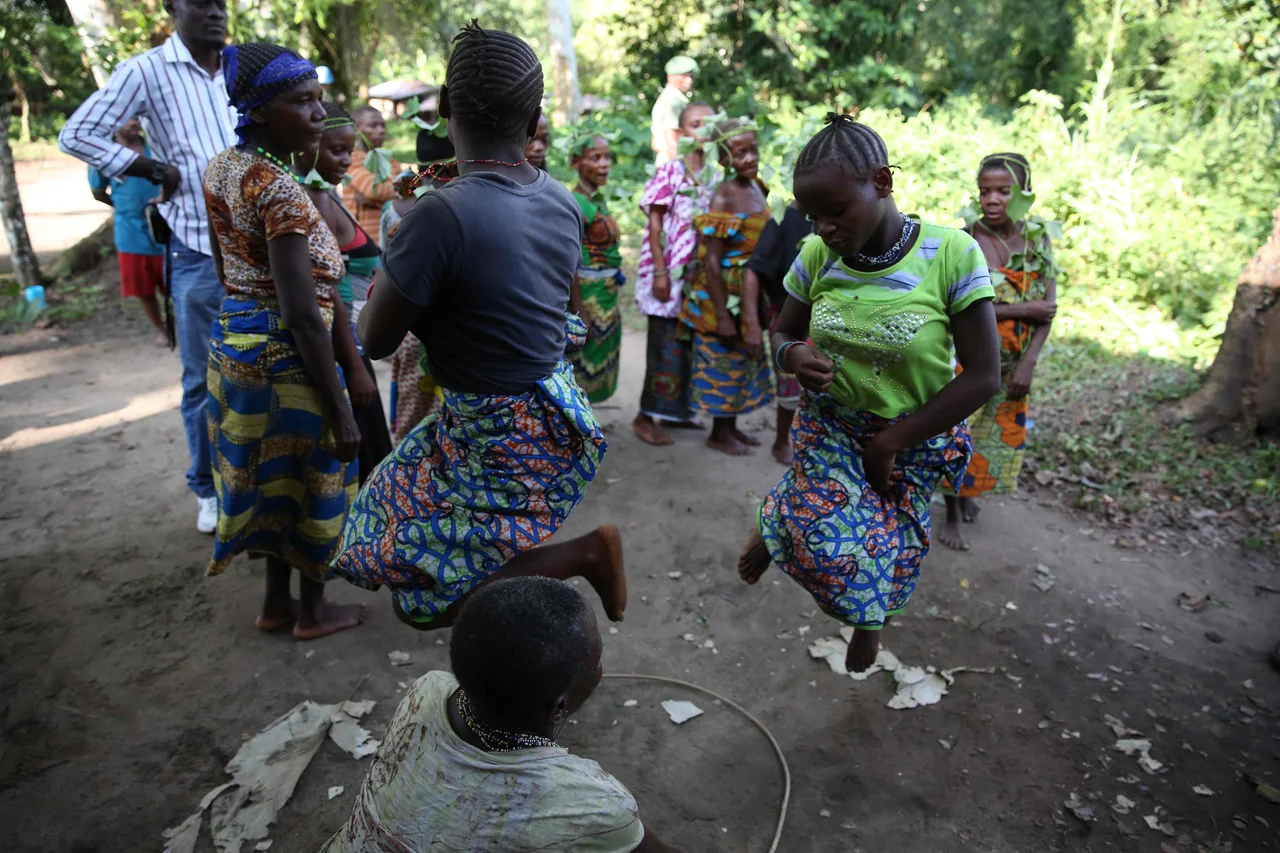
The Ituri has never been empty. For countless generations the Mbuti and Efe peoples have lived in and from this forest, moving through it as hunters and gatherers who know its plants, animals, and seasons with a depth that no outside survey has ever matched. They are not visitors to the reserve but part of its living fabric, their knowledge woven into the place as thoroughly as the roots of the Mbau trees. It was forest people who first told outsiders of the okapi, long before any naturalist believed them. Their continued presence is part of what makes the Ituri what it is - not a wilderness untouched by humans, but a homeland where people and forest have shaped each other across an immense span of time.
Epulu
On the banks of the Epulu River stands the reserve's beating heart: the Epulu Conservation and Research Center. It traces back to 1928, when the American anthropologist Patrick Putnam set up a station here to capture wild okapi for zoos in America and Europe - a trade that continued, in altered form, for decades. By the modern era Epulu had become a place of study and protection rather than export, a base for the rangers and researchers working to keep the okapi alive in the wild. It drew scientists from around the world to one of the least accessible corners of Africa, a clearing of purpose in an ocean of trees. And then, on a June morning in 2012, it became a crime scene.
The Attack at Epulu
On 24 June 2012, a band of Mai-Mai fighters led by a warlord called Paul Sadala - known as Morgan - stormed Epulu. They were elephant poachers and illegal miners, and they came to punish a conservation effort that stood in their way. They looted and burned the center. They killed all fourteen of the captive okapi. And they killed six people, including two wildlife rangers, men who had given their lives to the work of protection. It was a deliberate assault on the idea that this forest could be defended at all. But the answer came from across the world: donations poured in, the Congolese army and wildlife authority restored a measure of security, and within a year Epulu was rebuilt. The reserve still faces gold mining, poaching, and the long shadow of regional conflict. The rangers who remain still walk the forest paths. The okapi, century after century, are still out there in the green dark - rarely seen, and still here.
From the Air
The Okapi Wildlife Reserve covers roughly 14,000 km2 of the Ituri Forest in the northeastern Democratic Republic of the Congo, centered near 2.00°N, 28.50°E, not far from the borders with South Sudan and Uganda. There is no major airport at the reserve itself; Bunia (ICAO: FZKA), about 150 km to the east, and Isiro (ICAO: FZJH) to the northwest are the nearest fields, both small and weather-dependent. The Epulu settlement and research center sit along the Epulu River near the RN4 road that bisects the forest. From the air the reserve is an almost unbroken green canopy threaded by dark rivers; the Epulu and Ituri waterways and their occasional waterfalls are the main landmarks. Expect persistent equatorial humidity, low morning mist over the canopy, and rapid afternoon cloud buildup - early flights offer the clearest conditions.
Nearby Stories
- Komanda Massacre 80 km away
- Matupi Cave 130 km away
- Garamba National Park 191 km away
- Rwenzori Mountains 204 km away
- Lado Enclave 312 km away
- Kisangani 354 km away
- Ironstone Plateau 417 km away
- Wau 632 km away