
Garamba National Park
The last wild northern white rhinos on Earth lived here, in the long grass of Garamba, and then they didn't. By 2008 a survey could find none. The subspecies had been hunted out of the wild, and its final refuge was this park in the far north-eastern corner of the Democratic Republic of the Congo, pressed against the South Sudanese border. Garamba is among Africa's oldest protected areas, established in 1938 and named a UNESCO World Heritage Site in 1980. It is also one of its most dangerous to defend. The story of these 4,900 square kilometres is told as much in the names of dead rangers as in the species they died protecting.
Where Two Africas Meet
Garamba sits in a seam. The park straddles the transition between two great biological zones, the Guinea-Congolian forest and the Guinean-Sudanese savanna, and that overlap gives it an unusual richness. Elephants here are a genetic blend of bush and forest subspecies. Giraffes graze the woodland; hippos crowd the rivers; lions, buffalo, giant forest hogs, and hyenas move through the grass. Some 286 bird species have been recorded, including the long-legged secretarybird stalking the savanna, enough for BirdLife International to designate the park an Important Bird Area. Hunting reserves wrap around it on three sides, and to the north and northeast lies South Sudan, a border that has shaped Garamba's fate as much as any river or ridge. War, refugees, and weapons have crossed it for decades; between 1991 and 1993 alone, some fifty thousand Sudanese fleeing their own conflict settled just outside the park, and poaching surged in their wake.
The Rhino That Could Not Be Saved
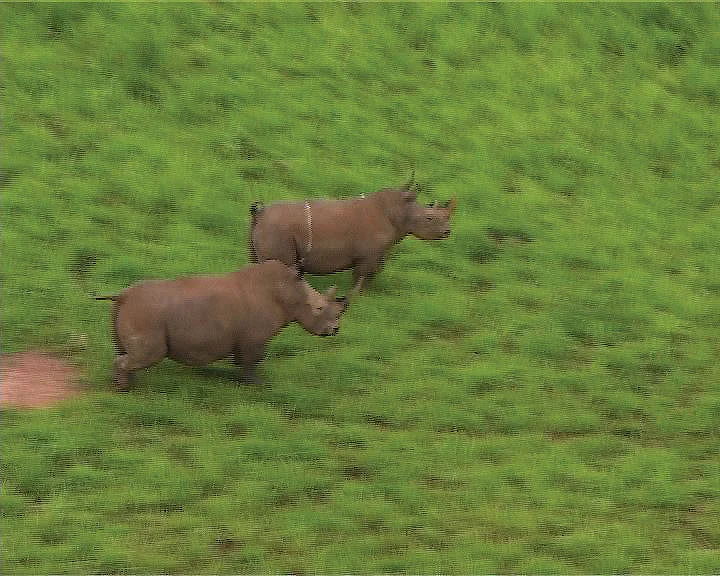
Northern white rhinos once roamed from Chad to Uganda. Poaching in the 1970s and 1980s erased them almost everywhere, until Garamba held the only wild population left. Through the 1990s their numbers hovered between twenty and thirty. Then came collapse: around thirty in 2003, only four confirmed by 2006, and by 2008, none. The subspecies survives now only under armed guard in Kenya, down to two animals — Najin and Fatu — both female. Garamba's grass would not stay empty forever, though. In 2023, in a careful act of restoration, sixteen southern white rhinos, a related subspecies, were airlifted from a private reserve in South Africa back into the park, the first rhinos to walk this land since the wild northern whites vanished.
The Rangers' War
Defending Garamba has cost lives, and the toll is not abstract. Poachers killed at least twenty-one rangers in the decade up to 2017. On 2 January 2009, fighters attacked the park's Nagero headquarters, killed at least eight people including two rangers, wounded thirteen more, and burned buildings before stealing food and fuel. In April 2016 poachers shot dead three rangers and wounded others, among them the park's manager. The following April, two more rangers were killed by elephant poachers. These were ICCN park staff, often backed by Congolese soldiers, going out against armed groups for a salary and a conviction. In 2017 the Tribeca Film Festival posthumously gave its Disruptor Award to rangers killed at Garamba, honouring their bravery in defending elephants.
Holding the Line
Since 2005 the park has been run by the non-profit African Parks in partnership with Congo's wildlife authority, the ICCN, and the strategy has begun to bite. Elephant poaching, which claimed dozens of animals a year at its worst, fell from ninety-eight killed in 2015 to just three in 2022 under tougher enforcement. The giraffes, down to thirty-eight in 2016, recovered to seventy-one by 2022. Garamba is still no easy tourist destination, ringed by instability and history. But the documentary record kept growing, including a 2017 virtual-reality film directed by Kathryn Bigelow that put viewers in the rangers' shoes. The park endures because people keep choosing to walk its grass with rifles, season after season, so that something wild remains to defend.
From the Air
Garamba National Park centres near 4.0°N, 29.25°E in the far north-east of the Democratic Republic of the Congo, hard against the South Sudan border. The terrain is gently undulating savanna woodland cut by rivers, with the park headquarters at Nagero on the Dungu River. This is remote, sparsely served airspace; the nearest significant airstrip is at Dungu to the south, while Kibali Mine's airstrip near Watsa has handled wildlife translocations into the park. Larger regional airports lie far off, including Juba (HSSJ) in South Sudan to the northeast. Expect tropical haze, seasonal smoke from bush burning, and afternoon storms in the wet season; this is conflict-affected ground, so it is best appreciated from a respectful distance.
Nearby Stories
- Lado Enclave 87 km away
- Bidibidi Refugee Settlement 164 km away
- Okapi Wildlife Reserve 192 km away
- Juba 201 km away
- Equatoria 214 km away
- Ironstone Plateau 251 km away
- Komanda Massacre 263 km away
- Tonj 370 km away